
Dimner Avenue
If I could live inside my fantasies, the home would be endless.

“Congratulations Miss Spalding. I’m sorry for your loss.”
The lawyer handed Collette a check, a deed and an antique fountain pen she couldn’t get to work. She pulled a plastic ballpoint from her purse and signed the check for $20,000 and the deed to the mansion owned by her late Aunt Aria.
“I never met her actually. I didn’t even know she existed,” Colette said.
“I meant your husband,” he said.
“Fiance.”
“Fiance, thank you.” She returned his unusable antique pen to break the awkward silence.
“So that’s it?” Colette asked.
“That’s it. Oh, and the keys.”
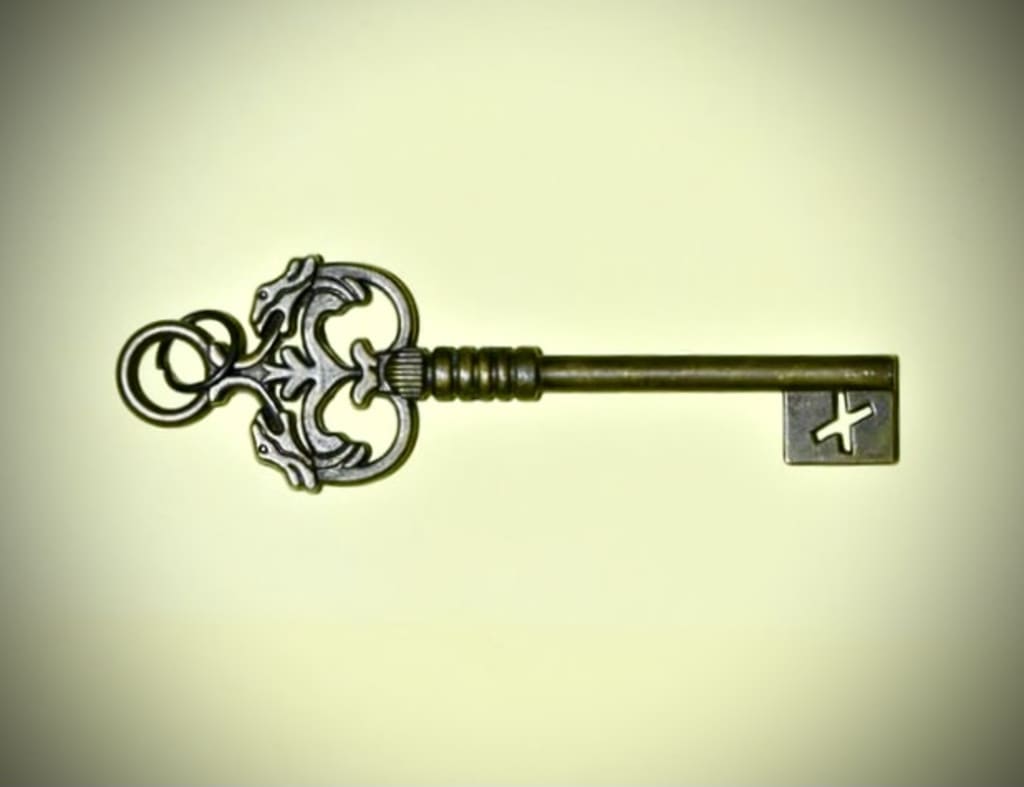
He opened a heavy wood drawer and pulled out a small metal ring holding two keys. The first was a large Victorian skeleton key made of twisting silver and gold etched with inscriptions. Small figures climbed the handle to a domed web of ivory.
The second key was a little plastic fob.
“This opens the gate. The big one opens the house. A bit weird isn’t it? Neat key though.”
Confused, she stared at the odd keys.
“Call us if you need anything. Hopefully this will be a much needed distraction. Either way, I’m sure the money couldn’t hurt.”
A small sedan arrived to pick up Colette. She watched her reflection pass across the car windows. She hated the pear shape of her body that her fiance always told her was only in her head. Maybe he was right. Maybe it was just the car windows, stretching her reflection like circus mirrors. Or maybe he loved her no matter what fruit she thought she resembled.
The elderly driver talked over bad pop music.
“Hey the address you gave isn’t coming up on my navigation, can you check that again?”
“874 North Dimner Avenue South?”
“I see Dimner Avenue but not that address.”
He looked at her through his rearview mirror — her face red, eyes glassy with tears.
“Don’t worry, Dimner’s a short street. We’ll figure it out, ok? There’s a charger back there if you need one.”
Colette put her earbuds in. No music, just silence. She zipped the keys into her puffy jacket. It was seventy-three degrees that day, but she couldn’t get warm. Colette watched out the window as the city highrises shrank into suburban homes.
On the bright side, she thought, the timing of two people’s deaths couldn’t have been better. It had been three months without him. After too many sleepless nights, she sold the house they had just bought. The next morning she received the call from the attorney about her aunt, the money, the mansion, the chance to start over.
Dimner Avenue was only three blocks long, lined with single-story homes that ended in a conundrum: a massive Victorian mansion. Perfectly preserved. Impeccable in every way. Gold numbers on the towering iron gate confirmed the address: 874 North Dimner Avenue South.
Colette held the fob to a sensor mounted next to the gate. The gates screeched, jerked, then found their footing and glided open with an impossible silence.
An immaculate lawn split by a stone walkway led Colette to the front door. She pressed the ornate skeleton key into the lock, afraid its fragile decorations would snap off. But the lock was its exact mirror, down to every detail. It was effortless to put in. She hadn’t even turned it when the lock clicked open.
__________
The house seemed like an endless maze the first two weeks. Colette left her phone somewhere on the third day. Maybe the fifth. She couldn’t remember and didn’t mind. If it was swallowed up, that was fine. She was swallowed up too.
Room after room, hallway after hallway. Each one was a tiny world. It didn’t feel like a home, more like an eclectic museum of histories Aunt Aria had gathered. There was a period-accurate Prohibition speakeasy. A hall of Greek frescos and bas reliefs. A bamboo room displaying a 16th century Japanese tea ceremony shared walls with a 70s Italian disco and a perfect replication of NASA’s mission control center in Houston. Flemish tapestries lined a stone corridor with a gypsy tattoo parlour. A library of illustrated histories and hidden doors. An igloo. Suits of armor from every era and continent guarded every hall, every door.
Colette slept in a different bed each night.
The Babylonian chamber of Persian rugs and ferns that led to an ivory bed with silk drapes.
A 1960s hotel room with shag carpet and a heart-shaped waterbed.
A couch in an office with a blanket and pillow.
The knit hammock in the garden.
__________
Colette woke up at the teacher’s desk in the 1970s classroom. Kids’ projects hung from the ceiling. Planets. Volcanos. Dinosaurs. Crayon, colored paper, glitter covered in glue.
She was bored. so she opened one of the desk drawers. It was full everything it should have been: tests, pens, chalk, a flask. She went room to room opening closets, pantries, drawers and cabinets and found folded clothes, scrap paper, sewing needles, daggers and maps.
Colette went to the cozy Berlin cafe and filled a mug to the brim with dark coffee, then walked room to room, careful not to spill.
Colette finally entered the only room she hadn’t entered: a tiny undecorated bedroom. 1980s maybe. 1960s. Now. White walls and a generic twin bed with generic white sheets. Generic beige carpet. A generic desk with a generic chair. The only remarkable thing about the room was the window that overlooked the garden where the sun rose over cherry blossoms.
Colette set down her coffee and opened the center drawer of the desk. There was only one thing inside it: a little black book.
She opened it and flipped through what looked like lecture notes. Each page was filled with hand-written descriptions and sketches on eclectic topics. The history of North American wood preservatives. The properties of extinct Brazilian flowers. The unique advantages of Native American nomadic dwellings. How to identify fine marble. Floor plans for young couples.
As Colette read on, each page sounded more and more familiar. Drawings of an ivory bed from an Indian museum collection. NASA telecommunications systems. Quotations from the salon scenes of Sherlock Holmes. Egyptian metallurgy. Thoughts on elementary schools in the 70s.
With wondrous surprise, Colette realized the book was a catalogue of everything in the mansion. The entries went back decades, all in the same diligent handwriting. Her signed and dated every page. And just like everything in every room, the book looked untouched.
A phone rang from somewhere deep in the mansion. She jumped and knocked the mug of coffee onto the notebook. Then another phone rang. She tried to pat down the soaked pages with her shirt. And another phone rang. Every phone in the endless house rang. Clanging, buzzing, chiming every one of their awful sounds. The pages ran with coffee-colored streaks of lead, graphite and ink.
A phone rang in the room next door, a small switchboard room. She ran in and picked up the receiver.
Every phone in the mansion went silent.
“Hello?”
“Hi Colette, this is James Hawthorn from Anderson, Alvin and Chambers. I handled your deed.”
“Right. James. Hi, what can I do for you?”
She kept dabbing the wet pages.
“We found another document with stipulations your aunt had drafted for the house.”
“Ok. What are they?”
“It reads, ‘you may not pass the home onto anyone until your death. You may not use it as a lien against debts. You may not destroy or in any way alter the little black book in the child’s bedroom in the east wing.’”
Colette hung up the phone and sprinted to the closest bathroom and blowdried the book. She saved most of it, but the NASA pages fell out, design in the Islamic Golden Age was unreadable, French art deco glasswork was in tatters, and advancements in Chinese body armor was barely salvageable. Luckily the rest were untouched. The last few pages were blank and bone dry.
Colette walked down the hall with the notebook and its torn pages. But the hall she knew so well was shorter. Much shorter. So was the next. Rooms were missing. There was no NASA mission control anymore. It simply didn’t exist now. No exquisite Indian bedroom chamber. No ‘70s classroom. No Chinese suits of armor guarding the doors. The hallways lined with rugs and columns were nowhere to be found.
With each lost page, the house grew smaller.
Colette sat in the gazebo of a Japanese garden behind the house. She thought about this living labyrinth of her aunt’s wishes, fantasies and fascinations. She stared at the last pages of the little black book, blank and dry, and wondered:
“Did we decide to mount the living room TV or get the fake fireplace and put it on a stand?”
She filled the first blank page with detailed descriptions of the dream living room she and her fiance had planned. She tried to fit as much as she could on the page, then left room for a small overhead sketch of the room.
Then she ran down the halls until she found the restored French doors they had picked together. She stepped into that living room, the dream she thought would never come true. She laid down on the sofa and turned on the TV above the faux fireplace. She curled up in the woven blanket his grandmother had made them and slept in the living room of their dreams for the first time.
The kitchen came next. Then the bathroom with the clawfoot tub. She wrote every detail then found the rooms scattered around the mansion. She danced, drank champagne, took baths and made waffles. She was happy. Happy until she walked out of her bathroom and passed an ancient room with a woven bed just large enough for two people. Colette wondered if her aunt had laid in that bed and felt what she felt. If she missed someone.
Colette filled the last blank pages of the little black book with him. The good and the bad, the exciting and mundane, the things no one else knew but her. She wrote until she fell asleep in the mansion for the last time.
The next morning, Colette leapt up and searched the corridors for him. The kitchen, the living room, the bedroom. But no matter what room she ran to, it looked like he had just left. Clothes tossed on the floor, kicked-off shoes, lights left on, a movie still playing. Everywhere she went, it was like had just left.
Over and over, in every space she created for him, for them, he was gone. She let it sink in. The rooms were not for him, they were not for them, they were for her. The little black book could only bring back the artifacts of her memories and fantasies, but it couldn’t create someone to share them with. They were hers alone. Unlike her aunt, Colette found no value in holding onto her fairytales.
Colette laid down in the tiny undecorated bedroom where she found the little black book. She hesitated, thought about it, then with cathartic confidence, she tore each page out of the notebook until the only page left was the won describing the room she was in. She read it over, then drifted to sleep.
When Colette woke up, the room was a little bigger, but the same room. She stepped out to a small stucco hallway. She passed one more bedroom, a bathroom, then it opened up to a living room and a kitchen. The backyard needed some work, but the fence was in pretty good shape, just like the other houses on Dimner Avenue. The front door was a bright blue, restored antique. Colette hoped that some day the house would become a memory worth keeping, worth sharing.
All in all, Aunt Aria’s two bedroom home had potential. Nothing $20,000 couldn’t buy.
About the Creator
Ryan Hunter Phillips
Ryan is an award-winning writer-director based in Los Angeles. He has a deep love for emotive, character-rich genre fiction. Whether it's sci-fi, crime, espionage, thrillers, he sees as an opportunity to delve into what makes us tick.
Keep reading
More stories from writers in Humans and other communities.
Whiskey At Dusk
Guess the whiskey was more important to you in the end, wasn’t it? It was more than the well-being of your friends; more vital than showing up to the places you promised you would and could come to; more critical of a matter than fulfilling your damn responsibilities and getting the press off your back.
By Snarky Lisa4 days ago in Humans



Comments
There are no comments for this story
Be the first to respond and start the conversation.