
Crime without punishment
The dark side of power

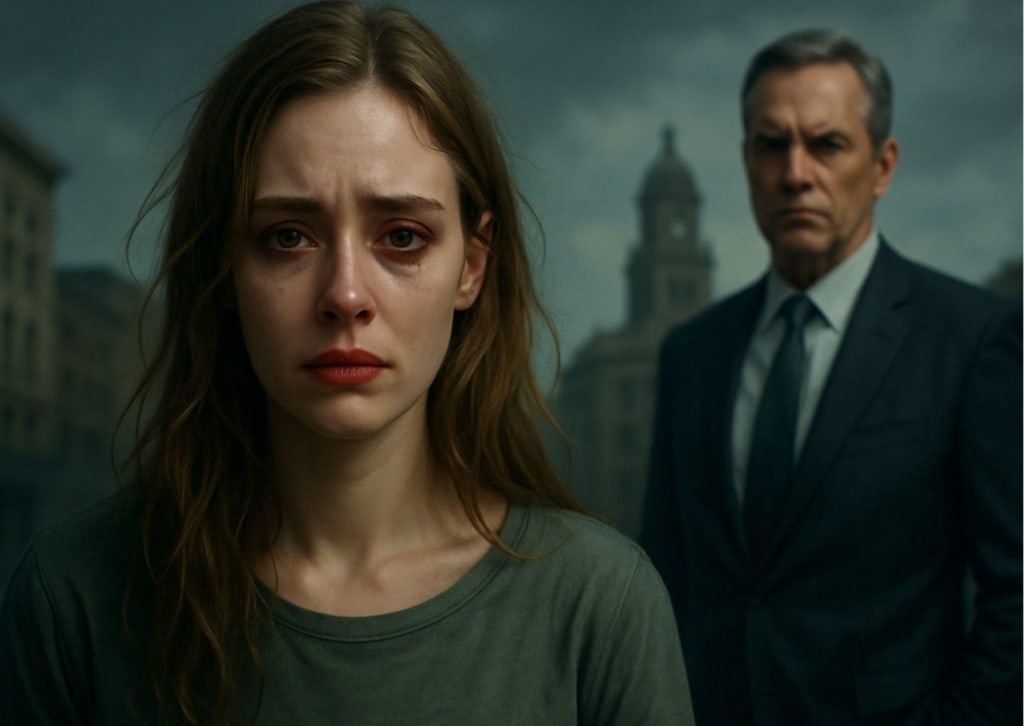
Melissa didn't see him coming, but she felt him. Every step of the mayor was heavy, and every word he spoke made her feel as if she were sinking deeper and deeper into an abyss. It wasn’t his power that troubled her, nor his fame: it was his indifference. His existence revolved around the city he had built, his image as an invincible man, and she, a young architect, was nothing but a pawn in his game. A game that seemed fun to him.
She had come seeking an opportunity, and perhaps she would find one, or so she thought. The mayor had shown interest in her project, her proposal for the revitalization of an old neighborhood, and had invited Melissa to discuss it privately. At that point, she already felt good. Her work was finally receiving the attention it deserved.
But then things changed. The mayor’s words were no longer kind and professional, but full of a condescending tone that Melissa couldn’t ignore. He started making jokes, half-complements, half-humiliations. Then he approached her. It was all too fast, too unexpected. There was no space to think, only to react, and when he forced himself on her, his powerful hands crushed her against the cold wall of the room.
That feeling. Not the immediate fear, but the paralysis that followed. She couldn’t speak, couldn’t scream. It felt as though she had lost control of herself. His hands gripping her, the words she couldn’t utter. All there was was the sound of her heart beating too fast, her breath growing frantic. Like a trapped animal, motionless, waiting for the end to come. But the end didn’t come. She stayed there, her body reacting, but her mind struggling to escape.
When he stepped away, leaving her almost stripped of everything, Melissa sat on the floor. The silence around her was absolute. For a long moment, she could do nothing but stare at the void, unable to comprehend what had just happened. And while her mind tried to deny what she had experienced, the world around her changed.
Melissa tried to seek justice. The next morning, still confused by the trauma, she went to the police. She told them what had happened, trying not to tremble as she spoke. But the response she received was a mix of skepticism and indifference. "Are you sure about what you're saying? Think it over," one of the officers told her. There was no support, no sign of empathy. Only a series of questions that made her seem like the guilty one, not the victim. The mayor was too powerful, too respected. Melissa couldn’t compete against him.
Her complaint was dismissed. And while she fought to understand how her world had collapsed, the mayor used his influence. With his network of contacts and friends, he spread rumors that painted Melissa as an unstable person seeking attention. Journalists, eager to follow him, picked up these rumors and spread them like wildfire. The story they told was never hers. It was not the truth.
Instead of being protected, Melissa was treated as a threat. Her beauty, her innocence, everything that had made her admired, was now turned into a weapon against her. Her once-bright figure became the symbol of temptation, of danger that had to be avoided. The press, social media, conversations in bars—all focused on her as if she were the guilty one, as if she were the one who had to pay for what had happened. Not a monster, but something worse: a woman who had dared to challenge the power of those above her.
The mayor, meanwhile, remained unscathed, his name never questioned. No one ever looked at him with suspicion. His reputation was too solid, too built on foundations of mutual protection. His friendships, his position made him immune to any accusation. Melissa, on the other hand, was isolated, condemned to live in forced solitude, as if her very existence were a punishment for something she had never chosen.
Every day that passed, Melissa felt the weight of the city on her like an unbearable burden. Every glance she caught, every word of sympathy spoken, made her feel even further removed from who she had been. There was no justice for her, no space for her pain. Her suffering was invisible, as if no one wanted to see it. And while the mayor continued to live in his ivory tower, Melissa found herself trapped in a world she had never chosen.
People looked at her as if she were the monster. The rumors followed her everywhere, condemning her. The same city that had once admired her now rejected her. Melissa had become the symbol of shame, of guilt, of "what happens to those who challenge power." A monster, yes, but not for what she had done, but for what had been done to her and what no one wanted to see.
And meanwhile, the mayor continued to smile at the public, running the city like a king who feared no enemy. No one challenged him, no one dared question his behavior. The real monster was there, invisible, in the locked rooms, behind the locked doors, while the world continued to look at Melissa as his victim.
An ancient story
Now, surprisingly, the story we’ve just read is not at all modern. Although it seems set in a contemporary context, this tale has its roots in an ancient myth: that of Medusa. Yes, Medusa, the mythological figure of the Gorgon, a young woman who suffers violence at the hands of Poseidon and is transformed into a monster by Athena, the deity who instead of protecting her, punishes her. Medusa's story is, in the end, the same as Melissa's, only the names change, but not the heart of the tale: a victim turned into a monster, while the true culprit remains immune from any responsibility.
What we've just read could be the core of several modern films that deal with themes of injustice, abuse, and inequality. The Accused (1988), with Jodie Foster, for example, tells the story of a woman who suffers group violence and must fight against a society that doesn't believe her version of events, treating her as the guilty one rather than the victim. The Hunt (2020), a film that explores media manipulation and the construction of false enemies, tells a similar story, where the victim is turned into a threat by society. Promising Young Woman (2020) also deals with the theme of denied justice and revenge, where the protagonist clashes with a society that downplays sexual violence and blames the victims.
All these films, though very different in details, follow the same thread: the victim becomes the guilty one in the eyes of society, while the aggressor remains unpunished.
Reflections on the link between mythology and modern culture
Many of the stories we see today, which excite us, captivate us, reflect ancient myths. And this is no coincidence. Myths are intrinsically linked to universal archetypes, which speak of inner conflicts, desires, fears, and human dreams. These themes, universal and timeless, remain ever-relevant. When you think about it, almost every film that excites us can be connected to some myth or legend.
Myth is the foundation of our collective narrative.
1. The myth of Hercules and modern superheroes
Take, for example, the myth of Hercules, the Greek hero who faces the famous twelve labors. It’s an archetype that we see continually repeated in modern superheroes. His extraordinary trials, his courage, and his desire for redemption are clearly reflected in films like those of the Marvel Cinematic Universe, where characters like Thor or Hulk are constantly put to the test to prove their worth. Thor himself, with his superhuman strength and his connection to the god of thunder, is a prime example of how an ancient myth is translated into a modern figure.
2. The myth of Odysseus and the exploration of the contemporary hero
Another example is Odysseus from the Odyssey. Odysseus is a hero who embarks on a long journey filled with pitfalls and obstacles, a journey in search of himself and his home. This myth has inspired modern stories like The Lord of the Rings, where the protagonist, Frodo Baggins, embarks on an epic journey, similar to Odysseus, overcoming enormous difficulties and making hard choices. The figure of the hero who grows, changes, and transforms during a journey of self-discovery is a mythological theme that recurs in today's films, books, and TV series.
3. The figure of Persephone and the metamorphosis of modern protagonists
Another myth that constantly reflects in contemporary cinema is that of Persephone, the goddess kidnapped by Hades and forced to spend half the year in the underworld and half on Earth, symbolizing death and rebirth. This myth is often explored in stories about inner transformation and redemption. A cinematic example might be the film Mulan, where the protagonist undergoes a journey that radically transforms her, much like Persephone, moving from darkness to light, from symbolic death to rebirth. Similar stories can be found in other protagonists who undergo personal growth, like Elsa in Frozen, who embodies a figure similar to Persephone, going through a cycle of initiation and revelation.
4. The myth of Narcissus and the cult of beauty
And we cannot forget the myth of Narcissus, the young man who fell in love with his own reflection in the water, symbolizing egocentrism and self-destruction. In an era where obsession with image, beauty, and the cult of the body are so strong, the myth of Narcissus is more relevant than ever. We see it reflected in social media, in platforms like Instagram, where people become obsessed with their own image, just as Narcissus was with his reflection. Even in films like Black Swan, where the character Nina (played by Natalie Portman) is a victim of narcissism that leads her to self-destruction, we can see a direct parallel with the myth of Narcissus.
As you can see, ancient mythology continues to permeate contemporary culture. Recently, I wrote the article "Mythology and Contemporary Beauty, an Unexpected Connection." In it, I explore how ancient myths have left an indelible mark on what we now define as "beauty," both outward and inward. You will find a fascinating reflection on how ancient myths are still alive and continue to shape our thinking, our culture, and our perception of beauty.
#CrimeWithoutPunishment #DarkSideOfPower #UnjustJustice #ContemporaryMythology #PowerAndMadness #SocialInjustice #ModernNarrative #AncientMyths #ViolenceAndManipulation #MythologicalArchetypes #StoriesOfRedemption #ContemporaryBeauty #SubtleJustice #ChallengingPower #ModernCulture
About the Creator
Halina Piekarska (UltraBeauty Blog)
Blogger, writer, and illustrator, I share stories, reflections, and practical tips on psychology, well-being, and natural beauty. I believe that learning never stops, and I strive to enrich readers’ lives with knowledge and inspiration.
Keep reading
More stories from Halina Piekarska (UltraBeauty Blog) and writers in Humans and other communities.
The limits of human vision and the perception of the invisible
The perception we have of the world is mediated by our senses, and in particular by vision, one of the most powerful but also limited senses. Although we see with surprising clarity the world around us, our visual perception is just a tiny fraction of a much larger universe. The human eye is designed to perceive only a limited range of electromagnetic frequencies, what we call visible light, but the reality surrounding us is much more complex and escapes our everyday senses. What we cannot see, however, does not mean it doesn't exist. And the way our senses, particularly vision, interact with reality is much more complex than we think. One of the most intriguing experiments exploring the limits of visual perception is that of total darkness, which helps us understand not only how limited our senses are, but also how our perception of reality can be an illusion.
By Halina Piekarska (UltraBeauty Blog)11 months ago in Humans
How Singles Overcome Social Anxiety While Meeting Potential Romantic Partners
Social anxiety may pose a considerable challenge to the singles who want to have relationships. It can usually be seen in the form of fear of being judged, being self-conscious and being reluctant to socialize, such as during a dating outing or during an online chat. It is important to realize that such feelings are a shared experience and not an individual weakness to overcome them.
By Willian Jamesa day ago in Humans


Comments
There are no comments for this story
Be the first to respond and start the conversation.