
Conflict in The Most Dangerous Game
How conflict is established in the famous short story


“The Most Dangerous Game,” the most famous story by Richard Connell, was originally published in 1924 by the American magazine Collier’s. The plot focuses on the main character, Rainsford, finding himself trapped on an island with an insane general who loves hunting, and finds the new thrill of hunting people after hunting begins to bore him. The story is enthralling, gripping, and intense, keeping your attention throughout the entire plot and making you wonder what the outcome will be. Part of the quality of the story involves the conflicts brought upon the characters throughout the story. These conflicts develop our characters, especially Rainsford, giving them motivation for their actions and making the reader want their stories to be resolved. Of these conflicts, “The Most Dangerous Game” by Richard Connell illustrates three main ones: man vs. man, man vs. nature, and man vs. self.
The first and biggest conflict illustrated in the short story is man vs. man; more specifically, Sanger Rainsford vs. General Zaroff. The story makes it very clear that while Rainsford is not very keen on the idea of hunting humans for sport in general and refers to it as murder, General Zaroff is incredibly enthusiastic about the idea of hunting Rainsford himself, calling him “a foeman worthy of (his) steel- at last.” The entire story centers around Rainsford using his cunning and strength to beat Zaroff at his hunting game, to which he has never lost, by using nature to his advantage and creating traps and diversions to distract Zaroff. The story also talks about how he distracts Zaroff in order to escape his grasp, and focuses on how trying to escape the murderous Cossack starts to take a toll on him. The man vs. man conflict of “The Most Dangerous Game” is the most obvious and most important conflict to the story, as it is the conflict that basically starts the entire story.
The second conflict featured in Richard Connell’s story is man vs. nature, or Rainsford vs. the jungle on Ship-Trap Island. While trying to escape the Cossack’s small-caliber pistol, Rainsford has to find a way to navigate through the jungle, and the story talks about how he struggles in this new environment and how it starts to affect his judgement and how he thinks. The story shows the individual struggles Rainsford faces to make it through the jungle and figure out how he can use it to his advantage. Eventually, the story documents Rainsford realizing how to use the environment to distract Rainsford, and how he finally figures out how to navigate the environment easier. He even uses the ocean to his advantage when the dogs are sent after him, “leap(ing) far out into the sea…” and swimming to safety. While the conflict of man vs. man in “The Most Dangerous Game” is not the most obvious conflict in the story, it is one of the most important conflicts, as it directly affects the man vs. man conflict that is featured so prevalently.
The third and final conflict featured in the story is man vs. self, or Rainsford vs. his own sanity. As he keeps evading General Zaroff’s grasp, the loneliness and threat of death slowly starts to get to him, to the point where he has to keep saying “I must keep my nerve” repeatedly to himself in order to keep himself calm. He tries his best not to let Zaroff’s actions affect him and his judgement, and attempts to keep himself calm even if it doesn’t always work. He also tries his best not to let his complete loneliness in the jungle affect him, as he can only use his own brain and his own judgement to save his life; he has no one else to help him escape death. Rainsford fighting with himself develops his character and makes him a much more interesting character; his fight to keep his sanity finally makes him realize “how an animal at bay feels.” This conflict is the most subtle main conflict featured in the story, but it is still important to the development of the main character and the story as a whole.
The conflicts of man vs. man, man vs. nature, and man vs. self are amazingly prevalent conflicts in Richard Connell’s “The Most Dangerous Game.” Without these conflicts, the story would probably lose most of its quality and would probably lose its timelessness. The author creatively weaves each of the individual conflicts into the story to tell an incredibly unique, interesting, and exciting tale. Each of the conflicts featured in the story develop each character and makes them stronger, giving the reader a stronger connection to each of them. Without these conflicts weaved into the plot, “The Most Dangerous Game” by Richard Connell just wouldn’t be the same and wouldn’t be nearly as good as it ended up being.
About the Creator
Jamie Lammers
This is a collection of miscellaneous writing of mine from all over! I hope something here sticks out to you!
Keep reading
More stories from Jamie Lammers and writers in Humans and other communities.
I'll Learn My Lesson
How did my plan backfire so horribly? I had her right in my hand, I could feel it. I was doing everything right, but somehow, my plan failed. Why? Let me think about what happened for a second. Maybe then, I’ll be able to figure out what went wrong. Earlier today, I decided to ask my crush, Jennifer, out for lunch this weekend… or coffee or maybe a walk in the park, I couldn’t quite decide. I talked to my friend, Malcolm, about doing this, and he thought that was a terrible idea.
By Jamie Lammers5 years ago in Humans
A Historic Declaration
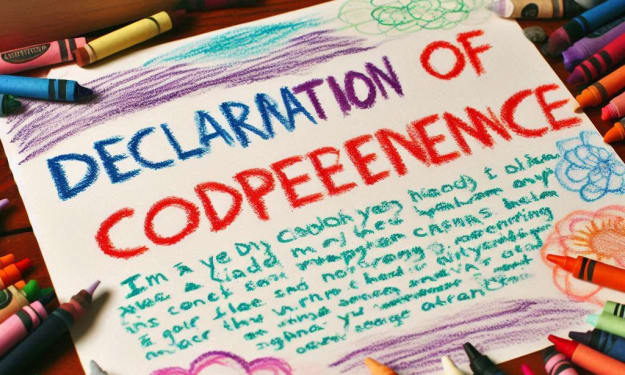
We the People of the Husbands of the United States of America, in Order to form a more perfect Union, and I mean you...with me...establish Justice, insure domestic Tranquility, provide for the common defence, promote the general Welfare, and secure the Blessings of Liberty to ourselves, after Puberty, do ordain and establish this Declaration of Co-Dependence.
By Gerard DiLeo6 days ago in Humans
When the Sky Burned Red
When the Sky Burned Red The first bomb did not sound like thunder. It sounded like the sky tearing apart. Aamir had never heard silence scream before. But that morning, when the explosion shattered the windows of his small family home, silence screamed louder than the blast itself. For a moment, everything froze — the birds mid-flight, the wind mid-breath, his mother’s voice mid-sentence.
By Tazamain khan 2 days ago in Humans
Review of 'Man on the Run'
My wife and I saw Man on the Run, a nearly 2-hour documentary on Amazon Prime, about Wings, Paul McCartney's group that flew around the world from shortly after The Beatles broke up in early 1970 to shortly after John Lennon was murdered at the end of 1980, making a Beatles reunion forever impossible.
By Paul Levinson4 days ago in Beat



Comments
There are no comments for this story
Be the first to respond and start the conversation.