

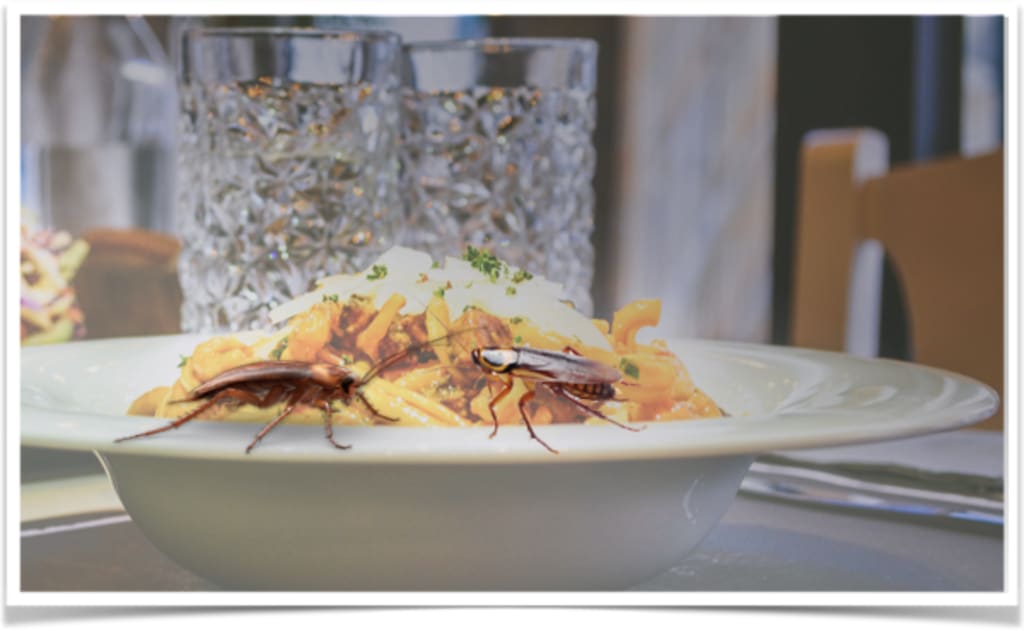
Insects typically communicate using odors called pheromones; those that attract males to females are well-studied. And how about people? What we eat affects the bacteria in our guts, which in turn can affect what we smell like. link
Fred was drying out on an Arkansas youth ranch when I met him. Though he wasn’t a youth, his mother had rescued him from the streets of Albuquerque and pulled strings to get him in there. When we ended up marrying, he appeared to have beaten his alcohol addiction and we settled into our roles in Little Rock: I as a graphic artist, and he as a custom-home framer. His work was exhausting: studying blueprints, cutting lumber, building walls, scaling ladders, lining and bracing roof framing. As hard as the work was, and as hot as it could get in central Arkansas, he never was funky with sweat smell. I liked the way my husband smelled, whether working or not; he had the right pheromones. Life was good and I was happy.
In a few years, Freddy and I took a chance to leave the big city and move to the Ozarks, to a tiny northern Arkansas town which shall remain unnamed. We built up a handyman business and I was an active participant, even though at the beginning we joked about my duties being “holding the dummy end of the tape measure.”
Like people, cockroaches like to hang out together, especially when they have nothing else to do. Since the 1970s, entomologists have also known that so-called aggregation pheromones encourage roaches to stick close to one another. link
Our small town accepted us and business flourished. Everyone knew everyone else, and shared all the gossip, so word-of-mouth referrals were all we needed to keep busy. One summer, a deacon from one of the three town’s churches contacted Fred about a project. He asked us to meet him at their church’s parsonage, because it needed “a little work.” Their pastor had moved on, so touching it up for a new leader was necessary.
The deacon chatted quite a few minutes outside the parsonage. We were used to “making nice”; it was good for business, but what he was relaying seemed inconsequential to the project scope. He told Fred and me about the pastor’s wife and five children, and how the church members had never been allowed into the home. Their leader had always insisted that business be conducted in his church office, and his home was to be private.
Then the deacon apologized. “I’m not going to come in with you,” he said. “Go in and take some notes; we’d like an estimate in a day or two.”
We exited the house seconds later. The deacon was clearly embarrassed. “We hope you can keep this quiet. Is this something you still want to tackle?”
“Sure, give us a minute,” I answered, swiping my ankle socks free of a hoard of clinging fleas. Freddy got a can of insect repellent from the van and we doused ourselves, thoroughly girded for the inspection.
Our tour of the parsonage found that there was serious damage to everything water related due to unchecked leaks; piles of clothing, paper, or maybe diapers, filled almost every corner; floor coverings were matted and sticky; crayon and marker doodles decorated walls in the kids’ bedrooms. There was so much damage and abuse, it was almost unfathomable that the place had been remodeled for the exited pastor’s arrival five years earlier. During the inspection, Freddy and I asked each other a couple of times, “What is that smell”? It wasn’t like anything we’d ever encountered before.
A group of cockroaches is called an intrusion. Cockroaches are a social bug that typically are found in groups. They live and interact with each other, with some scientists even suggesting cockroaches have personalities. When an intrusion invades a home or a business, the intrusion then is considered an infestation. link
Cockroaches have been clocked running up to 3 miles an hour, which is very fast for an insect. A human-sized cockroach would be able to run over 100 miles per hour and if a horse could run as fast as a roach it would be able to cover approximately 450 feet per second. link
The dark basement was last. At a click of the light switch, the floor surface parted in ripples like stone-peppered water. The place was swarming — no polluted — with cockroaches. Our can of insect repellent would have worked only if used as an incendiary device. And this was the pastor’s wife’s laundry room. And this is where the smell was the strongest.
We met the deacon outside. “Preliminary work needs to be done before we can give you a thorough assessment,” Fred told him. “That work would be to clear out the fleas and roaches.”
For three nights, we set off multiple bug bombs before leaving, but still, every morning, baby fleas assaulted our legs. Fleas hatch after sensing vibration, and pulling flooring, removing trash, and other demolition gave them plenty of incentive. Chemistry eventually managed to kill or drive out the flea and roach population. Yet, no matter what we removed from that house, the smell was still there. I can only describe it as sickly sweet, perhaps what I'd guess a mound of fermented and rotting hops might smell like. It even clung to our clothing and hair after work. Our first day in there convinced us that wearing full-face respirators was critical to our health.
We kept the deacon apprised of progress. He wouldn’t come in the parsonage, and we sure couldn’t blame him. When he said he hoped we could salvage the kitchen cabinets, I showed him a door I’d removed. The inside panel was speckled with roach poop. “Even if we fixed the water damage, the cabinetry could never be cleaned enough to be sanitary,” I stated. “Would you approve replacing all of them?”
Cockroaches have the charming tendency to defecate where they live and sleep, Schal says, and they are also gregarious insects—ones that like to spend their time in groups. Feces, therefore, evolved as an olfactory signal for leading roaches to friends. “It’s a beautiful behavior where they like the smell of their own feces,” Schal says. link
"Cockroaches literally live on their feces," he adds. They even eat it when they're young. link
New cabinets were approved, so we took out the old ones. We’d already seen plenty of roach egg casings, body parts, and droppings throughout the house, but we weren’t prepared for what we saw there. On formerly white walls, behind the removed cabinet boxes, were dark shadows of themselves, composed entirely of dots of roach poop. It was putrid insect pointillism, you might say. I can conjure the image memory to this day.
The deacon board approved most things, but balked at tearing out the kitchen drywall and duct work. This was even when we coaxed our man inside to show him the poop coating electrical switch and outlet boxes and AC vents. The most the church budget could afford was electrical box replacement, but, what other steps could we take?
“We’ll get the strongest solvent primer we can get,” Fred said, “and use our airless paint sprayer to get it as far back into vents and cavities as possible.”
He and I didn’t need pheromones to communicate to each other that the backside of those kitchen walls probably looked the same as behind the cabinets.
The American cockroach has been documented feeding on toenails, eyelashes, eyebrows, and hair of sleeping children. link
It must have been terrible for those five children in that house. The insects in there had been literally eating them alive. It was apparent they had spent most of their time in their bedrooms, which were the farthest rooms from the kitchen. Their walls were canvases for many scribbles and drawings. I broke down and cried in one of their closets while prepping the baseboard. There in a corner — written in perhaps second-grade handwriting — were the words, “Help me.”
A flooring company followed after we’d finished the major rehab, and the deacons later invited us to a parsonage open house. Socializing with church members, they complimented us on our efforts. It was apparent many weren’t aware of the conditions beforehand. Our deacon contact drew us aside, and in confidence he gave us details.
“Our former pastor was abusing his wife. When the deacons found out, we sent him to [another town] to get counseling. He kept it up for a few months, but I think the stigma of us knowing got to him. That’s probably why he left. Not many people in the church know what was going on here, and we beg you to be circumspect. It’s a very small town; you know.”
To humans, the pheromone [odor] presents itself as a lingering and unpleasant musty smell. As a cockroach infestation grows, the scent will become increasingly intense, tainting more and more items and surfaces. link
Once you’ve smelled it, you’ll never forget it. Despite our thorough work, nothing short of burning that parsonage down would have cured that hint of sickly sweet odor we recognized every time we walked through the door, though others didn’t seem to pick up on it.
No one else but me picked up on when my husband Fred started to act different and smell different. Not like sweat. Not like bad aftershave. He started to smell like booze. He thought he was keeping it a secret, but its telltale odor exuded from him in faint wafts. We still managed to do great handiwork together, but at home things were deteriorating. Sometimes an alcoholic’s sense of confidence gets them in trouble. We had an almost debt-free home, savings, community respect, and a good business, and as Fred once said to me sober years before, “when things are good, a train wreck is sure to follow.”
No amount of counseling, cajoling, patience, jail-bailing, or prayer made a difference. He chose alcohol over me. I was devastated by the stink of alcoholism. The only way out was to burn it down. I left him the house, business, savings, work vans, car, tools, reputation, respect and a divorce decree. I was a pariah in our town, because yes, it was a small town, we were circumspect, and nobody knew. But I knew, that if I left it to him, he’d lose it all anyway.
He did lose it all gradually after I left Arkansas. His sister called me when he passed away a few years later. She said he had been living in his van, and he died alone. I listened to her weeping story politely, then said, “Thank you for your call. I can put it behind me now.”
The last traces of stink dissipated.
About the Creator
Jennifer Johansson
After a lifetime in the graphics and printing trade, I figured it was time to create my own stories.
Keep reading
More stories from Jennifer Johansson and writers in Humans and other communities.
Marlee's Muse
“Underqualified. For a barmaid job.” Marlee blew this out of her mask as she slammed her catch-all bag down on the subway seat and plopped beside it. The memory of the bar manager’s oily phone voice saying, “Come by after we’re closed,” raised an uncontrollable shiver. Marlee wished she could scrape his smarmy visage from her thoughts like the winter mud clotting her boots.
By Jennifer Johansson5 years ago in Humans
Memento Mori
Life is not short. I’ll explain: we feel like it’s short because time passes by quickly. And if it isn’t, on hindsight, it did. But when we think we have quantified it quite well, we don’t, really. It happens to me. It happent to everyone. It’s human, actually. Because time is beyond our full comprehension.
By Maya Or Tzura day ago in Humans



Comments
There are no comments for this story
Be the first to respond and start the conversation.