
Chinese jet flew past nose of U.S. plane, Pentagon says
A senior U.S. official said, “We have seen an alarming increase in the number of risky aerial intercepts and confrontations at sea" by Chinese aircraft.
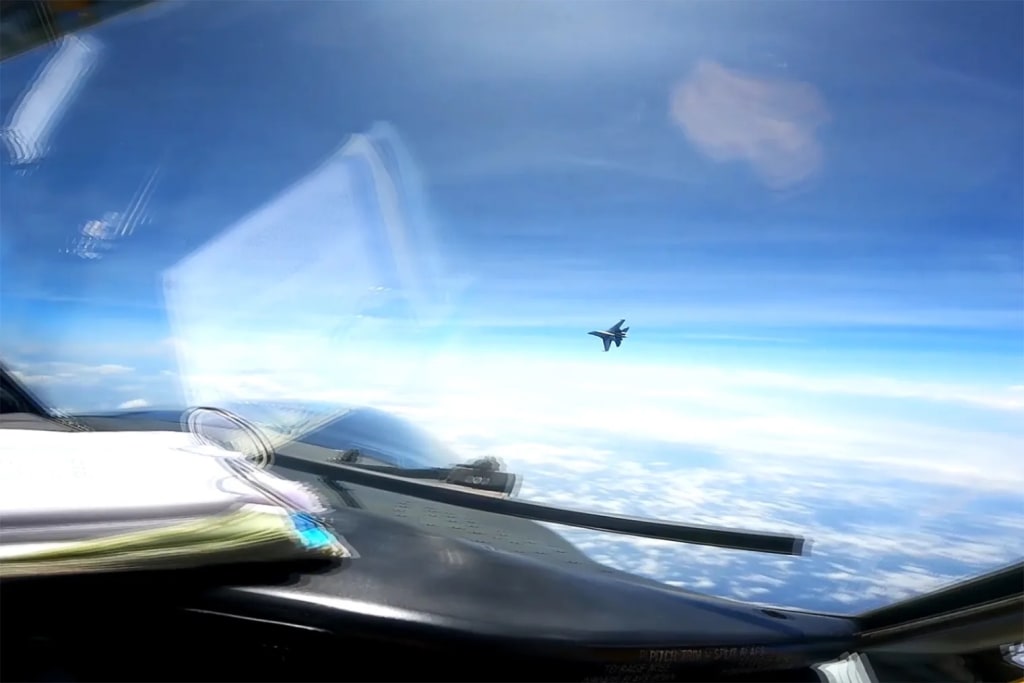
A Chinese fighter jet flew directly in front of the nose of a U.S. reconnaissance plane over the South China Sea on Saturday, the Defense Department said Tuesday, another in a rising number of incidents involving Chinese military aircraft and ships.
The “unnecessarily aggressive maneuver” by the Chinese J-16 forced the U.S. RC-125 to fly through the fighter jet’s wake turbulence, according to the Pentagon, which released video of the encounter.
The Pentagon said that the U.S. plane was “conducting safe and routine operations … in international airspace, in accordance with international law.”
On Wednesday, Secretary of State Antony Blinken said that the "Chinese pilot took dangerous action in approaching the plane very, very closely. There have been a series of these actions directed not just at us, but in other countries in recent months."
Late Monday, the Pentagon reported that China had rejected a U.S. request for Defense Secretary Lloyd Austin to meet with his Chinese counterpart in Singapore. The Pentagon had suggested a meeting between Austin and Li Shangfu on the sidelines of the Shangri-La Dialogue, an annual security forum held from June 2 to June 4.
Blinken said the Saturday incident "underscores why it is so important that we have regular open lines of communication, including by the way between our defense ministers. It’s regrettable that the meeting that Secretary Austin sought did not go forward."
"The most dangerous thing is not to communicate and as a result, to have a misunderstanding and miscommunication. And as we’ve said repeatedly while we have a real competition with China, we also make sure that doesn’t veer into into conflict and the most important starting point for that are regular lines of communication."
“We have seen an alarming increase in the number of risky aerial intercepts and confrontations at sea by PLA aircraft and vessels,” a senior Defense Department official said, using the initials for China’s People’s Liberation Army. “As leaders have said, actions such as these have the potential to create an unsafe incident or miscalculation.”
A People's Republic of China J-16 fighter pilot performed an unnecessarily aggressive maneuver during the intercept of a U.S. Air Force RC-135 aircraft, May 26, 2023. The PRC pilot flew directly in front of the nose of the RC-135, forcing the U.S. aircraft to fly through its wake turbulence. The RC-135 was conducting safe and routine operations over the South China Sea in international airspace, in accordance with international law. The United States will continue to fly, sail, and operate – safely and responsibly – wherever international law allows, and the U.S. Indo-Pacific Joint Force will continue to fly in international airspace with due regard for the safety of all vessels and aircraft under international law. We expect all countries in the Indo-Pacific region to use international airspace safely and in accordance with international law.
A Chinese J-16 fighter pilot intercepts a U.S. Air Force RC-135 aircraft Friday. U.S. Air Force
A spokesperson for U.S. Indo-Pacific Command said that U.S. concerns about the interaction “will be addressed through the appropriate, established diplomatic and military channels.”
On Wednesday, Chinese Foreign Ministry spokesperson Mao Ning said frequent U.S. naval and aerial surveillance in the region had long endangered China’s national security.
“Such provocative and dangerous actions are the root cause of maritime security problems,” she said at a regular news briefing in Beijing.
Mao said China will “continue to take necessary measures” to protect its sovereignty and security.
Past incidents
In February, a Chinese J-11 fighter jet appeared about 500 feet off the left wing of an American P-8 Poseidon maritime patrol aircraft and remained for well over an hour. The U.S. plane was flying above mostly uninhabited islands that are claimed by both China and its neighbors.
About the Creator
Keep reading
More stories from Alia Winston and writers in Humans and other communities.
MLB players say drag troupe invited to Dodgers' Pride Night mocks Christianity
Cy Young Award winner Clayton Kershaw and Washington Nationals hurler Trevor Williams tore into the former's Los Angeles Dodgers for holding a Pride Night event that will include a popular, satirical drag troupe.
By Alia Winston3 years ago in Humans
Wild Card Weekend Recap: What Happens Now?
I think I figured out why I love Wild Card Weekend so much. It's because it's the first playoff anything of the calendar year. The NFL season starts in the fall, and once upon a time, the champion was crowned either on or slightly before New Year's. The evolution of the NFL schedule has resulted in the playoffs starting just into the New Year, and currently, the final week of the season falls on the first weekend of the New Year, with Wild Card Weekend coming a week after that. So yes, chronologically, the NFL's Wild Card Weekend serves as the first playoff anything of the calendar year.
By Clyde E. Dawkins5 days ago in Unbalanced




Comments
There are no comments for this story
Be the first to respond and start the conversation.