
Changing the World One Privileged White 4 Year Old at a Time
Kindness Starts with the Kids

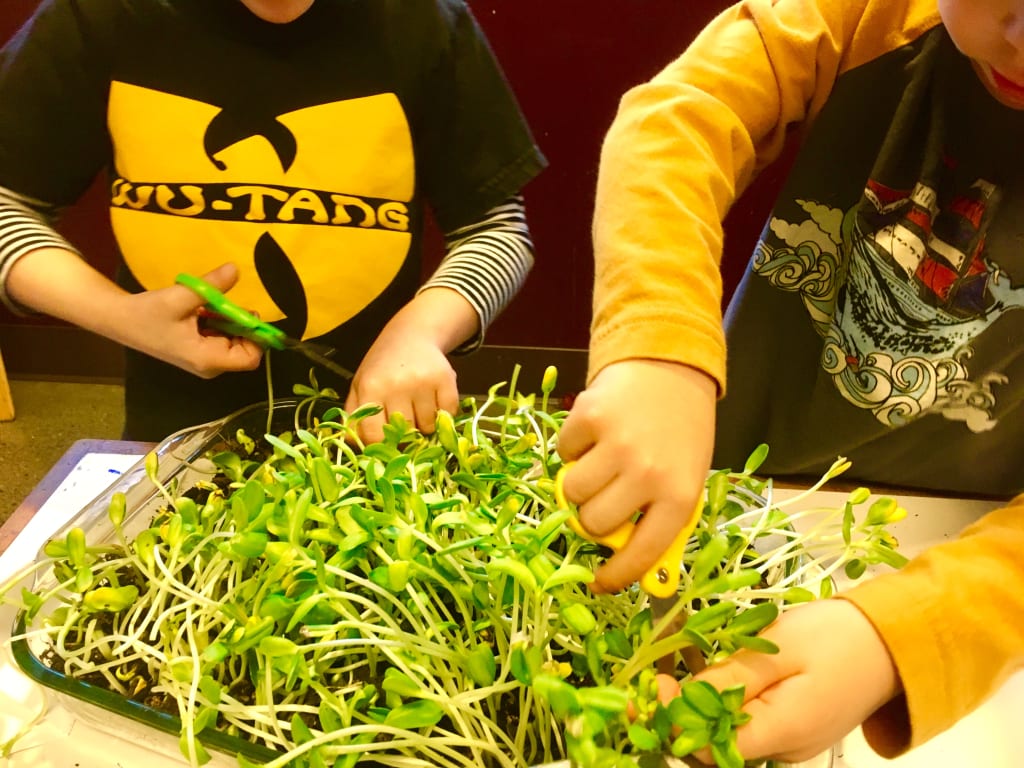
For nine years I have been a professional preschool teacher in a predominantly rich white neighborhood, in a predominantly rich white school in a predominantly rich white city. Families cross their fingers, with white knuckles, in hopes that they get on the waiting list in time, and then they pay the equivalent of a college tuition for their kids to enroll. The school is inspired by the teaching approach used in preschools in the city of Reggio Emilia, Italy. In Reggio Emilia, it’s the culture to take kids seriously and acknowledged them as capable, competent citizens who have a desire to learn and share ideas. The curriculum is emergent, child-led and play-based, and the environment is engaging and simple, with open-ended items set out for kids to build ideas off of, at whatever pace they need, as they discover who they are and what interests them, with the freedom and resources provided by their caregivers to pursue those interests. Nature, science, social-emotional, literary and art materials, among other things, are set out as suggestions for kids to explore, manipulate, talk about, and build off of using their imagination. The point of this method is to acknowledge and welcome the fact that all kids, like adults, are different, therefore they have different needs, interests and gifts, and that our differences are what make us human. This philosophy, in itself, creates a culture of inclusion, not only for the kids, but for the people whose paths they cross, their educators and their families. It taught me to see children as the competent, capable individuals that they are.
For nine years I have been a professional educator at a school that was built off of (and continues to be inspired by) these values. The school is in Seattle. Seattle, where I grew up poor, the youngest of five neglected siblings, with parents who battled with untreated PTSD and undiagnosed behavioral disorders stemmed from their own childhood trauma. Every day of the week I go to work so that some of the people with the most access can keep building their wealth and maintaining their good health, while they rest easy in the fact that their kids are receiving optimal care in an encouraging, safe and educational environment that truly values them, and takes their development seriously. At the end of each day, these kids go home with their families or caregivers, in cars that I could never afford, to houses that I could never afford, to homes just a few minutes away from the school. After they leave, I drive myself home, mentally drained, in my old car, through the traffic in the city, to a farther away neighborhood where the rent isn't so high, to my small room in a house that I can only afford because it’s shared with others. Good, healthy food is expensive, so I buy it when I find a bargain, because the cost of living is always adding up, including the fuel it takes to press on, through the slow moving traffic, to get to and from this school. To maintain my mental health, I take myself up to the mountains or down to the coast because nature time is essential for me to be my best self and therefore a better teacher. And yet the cost of this adds up, as does everything else involved in city living. So, to be able to afford what I need to be fit for the job, I also run a small side business, caring for other peoples’ pets and homes, to supplement.
I feel the need to add that I truly respect and appreciate the families whose kids I teach. For one, they chose a school that offers their kids a sense of autonomy, teaches them community building, empathy and working together. Our school also holds a strong focus on anti-bias work, which teaches kids to embrace differences, take a stand for social justice and practice non-violence in working through conflicts. Many of these parents are doing the hard work that makes the world a better place. We have parents who are social workers and psychologists, doctors, nurses and scientists. We have engineers, firefighters, pilots, environmentalists and artists. Society would be stunted without these people and the outstanding work that they do. Beyond that, I never entirely knew what being part of a wildly caring, open-minded and thoughtful community was like until I started teaching at this school. Many parents whose kids I’ve taught throughout the years have shown me incredibly generosity, gratitude and support for what I do, and some I’ve known and maintained valuable relationships with since I first began teaching. One parent offered me the use of an apartment for half a year, as I faced housing challenges due to Covid, while asking for nothing in return. Another family paid for me to stay in a hotel room with a view one night when I had no place to go, since their guest room was in use. Another family is my longest standing dog sit client. So many of these parents are incredibly selfless and giving people, who recognize their privilege and do what they can to help those in need. They are making the world a better place and I feel lucky to know them and their kids. Keeping in mind that we technically are co-parenting together, I often consider these families my own family. My bringing up the struggle has little to do with these families, and mainly to do with the systems that control the low level at which preschool educators are supported and acknowledged in the professional world. These are the systems that hold us back from being the best we can be for the children and families we provide care for. The systems that overlook the intense psychological burnout that we face each and every year, and the impact it has on our overall well being.
Teachers are not only unfairly compensated and under-recognized for all the in-depth work that goes into teaching a classroom full of young children, but we are also often misunderstood for what we do, and I think this especially applies to preschool teachers. We are in no way baby sitters who get to play all day. We come up with curriculum based on what we see the kids are interested in, searching for recources to help kids explore these interests. We resolve conflicts constantly, clean up spills, tears and other bodily fluids. We teach kids how to be empathetic and look out for one another, to take responsibility and be aware of how their behavior affects others and themselves. We redirect kids who are having trouble finding productive things to do, and we have to make sure that they stay interested, engaged and heard all day. We keep our eyes and ears open for the teachable moments that arise in a room full of 3-5 year olds, of which there are many, and we communicate with parents on their child’s growth and development. We not only educate the kids, but we teach their parents as well, offering our professional insight, concerns and things to try at home when they're dealing with the difficult behavior that we deal with, collectively, all day.
Recently, I discovered that there are some people, mainly in the US and mainly people who are still learning to see diversity as a strength who believe that preschool teachers are one of the biggest threats to our society. That we force the children that we care for, at such a young age, to develop extremist views on gender, race, and class, which in turn only feed social dilemmas and create more division in the world. I can’t speak for all educators, but I’m here to break that concept open and offer my own personal perspective, as a professional preschool educator, who believes strongly in what I do for the sake of our future as a species. This is what I’m doing to pave a new path toward a more inclusive and kind world. This is also, in a way, a letter to all the people who believe that my work is problematic, or not valuable. Here is what I know.
Kids are competent no matter what gender they were assigned to at birth or what gender they identify with now. Every day, I watch young girls keeping up with boys all day long. Recently, for example, when it was close to the end of a school day, only six kids were left in my classroom, all boys except for one girl and another kid who sometimes refers to himself as “he,” but has more than once announced, “I’m a they/them,” which they know they have the freedom to express in this space. It was the final hour before they would be picked up, and the kids were all making a game of running around the couch in the middle of the room, over and over, which lasted for at least 45 minutes. At no point did the girl slow down. Sometimes she would stop to catch a breath like everyone else did, but she didn’t stop any more than anyone else did. The only difference that I saw in the behavior of the girl vs the boys, was that, while the boys would often bump into each other (both intentionally and by accident), or point out the fault of another, or insist that they were the fastest, this 5-year-old girl, who displayed none of this behavior, instead offered words of encouragement, reminders of safety, and ideas that might make the situation more fun and interesting. She never slowed down, she persisted, and instead of focusing on being the best, or pointing out the faults of others, or disrupting the rhythm of the activity, she kept everyone in check in a loving way, in order to make the game more safe and enjoyable. And the other kid, the one who is still exploring where they fall on the gender spectrum, was aware of their surroundings and seemed only focussed on the simple enjoyment of what they were doing with their friends. They didn’t feel the need to compete. Why would you, if you understand that you are a deeply valuable human, and you are in a space where you are free to be you in every way, whether strong, nurturing, both, or any other amazing quality? So if some people think that teaching kids that girls have just as much value as boys is a threat, or that giving kids space to explore their identity is a threat, then I can rest easy in the fact that I’m just rising above fearful thinking and doing my part to build a more kind future. We can all benefit from living in a world where no one has to struggle just because they are who they are. Some people haven’t grasped, yet, that the world becomes stronger when the people in it are free and encouraged to find out for themselves who they are, to be who they are, and not who they’ve been lead to believe they should be.
Kids are able to grasp complex and challenging topics about humanity. I teach 3-5 year olds about difficult topics in history, and this includes racism and colonization. I explain how, in the past, there were more people who treated others unkindly for being different, how there were more people who believed that their white skin was a symbol of superiority. I teach them how this land that we live on was taken from the people who lived here first because of the idea that whiteness is better than the rest, because of the idea that white people could take all they wanted, no matter whose life they shattered in doing so. I don’t teach this to instill fear, negativity or for them to hate their own skin if they are white, but to use it as an example for kids to see that people are always learning and growing, no matter how old they are. I teach that people didn’t know how to treat each other kindly, because they were afraid of seeing people who were different, because it was new and they felt threatened. They were still learning that we are all human, no matter what our skin looks like, no matter how we talk, no matter the texture of our hair or what our culture is. I teach them how our ancestors didn’t understand all the things that we understand now, and I teach them that we still have a lot more to learn, but that some people are choosing not to. And, while I offer kids ways to see how humans have grown and gotten a little bit better at accepting one another, at being a little more kind, open and helpful, I make sure they know that there is always work to do and that healing from any kind of fear or injury takes time. Like learning to swim takes time, or healing a broken bone.
Seattle (like many cities) is experiencing a houselessness crisis, so I talk to kids about this as well. I explain that some people have illnesses or other struggles that have caused them to lose their houses and that’s why we see so many tents and people living on the street, or in their cars or motor homes. I don’t hesitate to tell them that people who have the power to easily change this are not, but then I tell them about all the incredible people who volunteer their time and resources to feed people, help them find shelter and give them coats, blankets and shoes. How there are many people who are finding creative ways to make things better, and that we all can do that, even if the ones with more power are not. I teach kids that we still have a lot of learning and healing to do, and the way we can do that is to practice being open, inclusive, giving and kind. I use these truths about humanity as examples to show kids that humans will always have the power to do better. I teach kids that they are a huge important part of this growth and that they have a voice in the matter just like the rest of us. Exploring these topics gives them power to do better than we have done in the past, and better than we are doing now, and it gives them knowledge to take with them into the future, so they can be an example to others who might not have learned these things.
Kids are the closest example we have to what the essentials to being human actually are. I mean this in the ways that they connect with one another, the ways that they uninhibitedly express their feelings, voice their struggles and tap into their energy. We, as adults, often lose our connection to these parts of ourselves in the tangle of our own egos with the egos of others. We lose sight when we start believing in things that are hurtful to ourselves and each other. We lose these connections when we lose sight of ourselves because of greed, whether blinded by our own, or buried by someone else’s. We lose it when we forget the importance of focusing on how we ourselves need to grow, and not on what everyone else needs to do. I often have to remind kids to not worry about what other kids are doing and only focus on their own responsibilities. The older we get, the more and more we get lost in the complexities of humanity, and it becomes harder and harder to bring our focus back to ourselves. Sadly, some people seem to have lost this connection so entirely, that it doesn’t even come up as something to consider. It seems like some people believe that the world outside of themselves is the only thing that needs to change. So if teaching kids to focus on how their own behavior and how they show up affects the world around them is a threat to some people, then we will continue to disagree. We all need to be more aware of what we are sending out into the world from within ourselves. I could easily go down the rabbit hole of anger that this dismissive and judgmental behavior in our society ignites in me, but I won’t. Because, luckily, I get to spend my time with amazing 3-5 year olds who know better than all of that, who focus on the joy of being alive and the excitement they have for learning and growing. Kids this young have an incredible ability to celebrate their own accomplishments, even if it’s the tiniest ones like hopping from one foot to the other, or drawing a heart for the first time, and this excitement is highly contagious. These kids are my teachers, too.
Our kids hold so much valuable knowledge, energy and inspiration, but our society is still too blinded by some deeply rooted beliefs; that age equals smarts, size equals strength, melanin equals less than human or a threat, disabled equals defective, and boys equal more powerful than girls. These stale beliefs cloud us from seeing all the ways that we can do better. But we can be better, and we can do better, and these kids teach me this every day. We can rewire the thinking of the world to reveal that love actually does win and it starts with our kids. This is the work I’ve been doing for years. It feels like it holds a new sort of urgency, but the nature of social progress requires that we take our time. Big change can take time, but we are always moving forward. We have to, because that’s the only way we can go.
And yet here I am, a preschool teacher who has dedicated nearly a decade of my life to this work, barely making enough money (the same as some people make on their first day serving fast food) to live in the city where I work. Here I am, not sure if I can make my car payment this month, or if my insurance and phone bill, along with a new car repair cost, is about to drain my bank account, even though I’m subletting a small room in a low-rent zone. This is the reality of a pre-k teacher, even in wealthy neighborhoods. We raise the kids of the wealthy, so they can live comfortably, while we struggle, whether due to financial burdens (especially us single folx and breadwinners), or illness, psychological burnout, or all of the above. Not surprising that statistics show teachers are in the top ten when it comes to heaviest alcohol drinkers in the US. We are buried in non-stop conflict resolution, saying the same messages all day long to a loud classroom full of kids who constantly need attention, validation, redirection and support, so they don’t grow up confused, disconnected, resentful or wounded with trauma on our part. This can cause us to go home at the end of the day feeling empty, exhausted and depleted, and to occasionally forget the things we enjoy doing for ourselves. And we do this with the understanding that our work still goes unrecognized. We teach kids to be inclusive and caring when we, ourselves, don’t receive care and inclusion in return. This is not intended to be a pity party, but a reflection of how when we humans believe in something enough and we see how necessary it is, some of us will take the short end of the stick just to do the work, for the sake of the world.
But I digress....a little.
Children are capable of sitting with discomfort, being in the moment, observing and finding their own positive solutions for difficult situations. I encourage kids to accept how things are and find a way to not mind losing, and to understand that through loss and difficulty we gain knowledge and strength. I share with them some times when I've experienced loss or failure, and how I worked through the feelings, and I encourage them to share their own experiences. My hope is that these growing humans can learn to not mind what happens, but to find other ways to get different results if that’s what they need or anyone else needs. To be willing to feel what they feel, to not be afraid to ask for help or someone to talk to, and to equally be open to the feelings, ideas and needs of others. And if they grow up in this world with this power, confidence and empathy to bring positive change, then maybe some day they will be in positions of power as adults, where they can bring the big changes that humanity needs, for marginalized communities like BIPOC and unhoused people and their families, for people living with mental illness or other disabilities, and maybe even for professionals who could use more support in exchange for the hard work that they do, like those in healthcare and education. By learning to be empathetic to themselves, kids will learn to be empathetic to others.
Kids are capable of acknowledging that their differences are actually strengths. My goal is to teach kids to acknowledge and love the imperfections in themselves, or anything that makes them different, so that they can accept and value the imperfections and differences in each other. And in that love, they can learn to flow with the world around them without judgement, and instead with a sense of curiosity and enthusiasm to make things right. In that openness, kids learn what it truly means to care, and how to show it. To embrace all that makes them and everyone around them human, even the things they aren’t used to, or the things that are difficult to accept. I want the kids who come through my classroom to see that complexity is a strength, just like a bridge is complex, as a single human body is complex. We are all here, as living organisms, part of one great big living planet, growing stronger every day as a whole, even when it doesn’t feel like it. It’s our job to teach our children how to accept what has been and what is, no matter how difficult, and move forward in a more proactive, empathetic and productive way.
It all comes down to kindness. Love. And if we are kind to ourselves, then we can take that kindness and love and give it to the world around us and the earth we live on. And kids have the ability to learn this, in the same way that they can learn to hate. Kids mimic what they see adults doing and how we respond to difficult situations and one another. I strive to guide these kids to a place where they can avoid the path to negative and harmful behaviors. To embrace their vulnerabilities. Kids, like all humans, will often reach for the quickest solution to not feel judged or rejected, because we live in a world that focuses too strongly on these things, on how everything “should be” and not enough on patience, acceptance, truth and understanding. We pass our judgements down to our kids in many ways and most of the time we don’t even notice it. If we as adults display positive resilience, self-reflection, openness and curiosity to one another, our children will display this same behavior.
Kids are capable of gentleness, safety and taking care. They can handle sharp objects and breakable things, and they can take all kinds of other risks if they are given the right messages, precautions and trust. Too often people shut kids down because they think they are too young or too small and can’t handle challenging tasks. But if we give them our trust and the truth about the potential dangers, they can handle much more than we give them credit for. This may not seem relevant, but I think it is. Trust is a huge part of the human experience and a major roadblock when it comes to inclusiveness. If we acknowledge kids as trustworthy and capable, no matter how small or inexperienced they are, maybe they will be more inclusive of others who have differences; those who are smaller than them, those who look different than them, those who have different abilities and ways of doing things. In a fiercely divided culture, we have a lot of work to do in the trust department.
Kids can work together to do great things. When kids learn how to offer encouragement, help and open communication to one another, they receive the same treatment in return. This creates an environment based on trust and community, where kids are excited to learn and explore together, to be open and receptive to each others’ different needs and to over all respect and care for one another. To work as a team. There will always be conflicts among young children and yet, as experienced educators, these conflicts are just what we are standing by waiting for, because they are what ignite conversations that lead to learning and understanding, so the kids involved can practice openness, kindness, inclusion and patience.
Kids are able to follow guidelines that keep each other safe and healthy, even if it means wearing a mask all day. Wearing masks allows kids to take part in making the world a safer place, and this does not alter the way they play, learn and communicate. Wearing masks is practicing kindness.
I may sound confident in the work that I do, but in a complex world, in a complex country, where mental illness, PTSD, trauma and hate form a cultural epidemic, how do we know if we are giving them the right messages? Too many of us adults grew up stretching ourselves to fit a mold in order to be accepted by society. We grew up believing in someone else’s truth. Too many of us are still unlearning these deeply rooted ideas and this includes educators, so how do we know if all this work is actually making a lasting and positive difference? Our foundation rests on children being seen and not heard. I hope that we can finally unlearn this human habit for good some day. Maybe then we can give our kids the space to find out for themselves who they are and what they bring to the world. How can we create a human culture where we finally have the collective knowledge we need in order to raise kids up, celebrate who they are, and give them the tools they need to make a difference before sending them off on this life journey in a way that encourages them to avoid creating roadblocks on someone else’s? Too many of us adults grew up with the overwhelming pressure to be the right size, shape and brightness, with the fear that we might not ever fit or thrive if we don’t conform to someone else’s ideals, if we don’t conform to social norms. We know how this plays out, so isn't it time to rewrite the narrative for our children and, in turn, for us?
Luckily, the school where I teach has been changing in terms of its predominant rich whiteness. We not only have more BIPOC faculty and leadership, including our school’s director, we have more BIPOC kids, and we have a program that offers care for more low income families on top of the scholarship program that we’ve had for years. However, kids in this new program are in their own separate classrooms due to the guidelines of the program so, still, the classroom where I teach remains predominantly white and privileged, and necessary Covid safety guidelines keep the classrooms distanced for now.
Building a new foundation for a more inclusive and kind future begins with our youngest. And, though it may be difficult at the school where I am teaching (during a pandemic, in a classroom full of mostly white kids who were born into privilege) to fully teach inclusion, I’m doing the work I believe in and I can’t envision myself stopping in the foreseeable future. And, no matter what any people may project about it, my goal in this job is to send kids off to their new schools, into the American education system, with a powerful voice, to be an example for others, to speak up for those who can’t speak up for themselves, to offer a lending hand for those who need it, to be comfortable in their own skin, to be comfortable with the skin of others, to know who they are, and to understand down to their core that they have, and will always have, the power to change the world for the better.
I feel very proud when I hear kids in my classroom checking in with each other, asking how they can make each other feel better when someone's hurting, educating each other on what they've learned, helping each other up, offering encouragement to do the right thing and showing incredible empathy toward one another. I do often question, being a white teacher in a classroom full of mostly white kids, if I'm making enough of a positive impact, if I should stay and keep trying to make an impact, or if there is some other place where my work would be more impactful. But it is always these moments, when I see these kids so willing to spread the love, speak up for the underdog, and share with one another, that encourage me to get back on track and keep pressing on. If there aren't enough teachers on this path to a more inclusive and kind future, then who will teach the kids who need to learn it the most?
Like a dear friend recently said, “Somebody’s gotta teach the white kids.”
About the Creator
Evie Minton
Writing has always been a main outlet for me. I generally write stories from my own experiences, but also love a good writing prompt. I have indigenous Sámi roots and I’m a teacher and nature lover, so these topics often inspire my writing.
Keep reading
More stories from Evie Minton and writers in Humans and other communities.
Diary of a Rescued Ragdoll
August 25th 2019 I’m beginning to wonder if this is what my whole life will be like, inside this small room with just a blanket to lay on. Last week, I still had siblings. My mother was taken from the room the week before that, and then slowly, one by one, my siblings also went away, aside from Crumpet and Snowball who went together. Now it’s just me in this tiny room. Sometimes the smallest human visits me to play or snuggle, but they don’t stay long. My whole life I have wondered what is out there. Why can’t I go? This is boring and I have no one to play with. Guess I’ll take a nap.
By Evie Minton3 years ago in Petlife



Comments
There are no comments for this story
Be the first to respond and start the conversation.