
Can You Be Queer and Christian?
A Midnight Reflection on Faith, Identity, and Acceptance

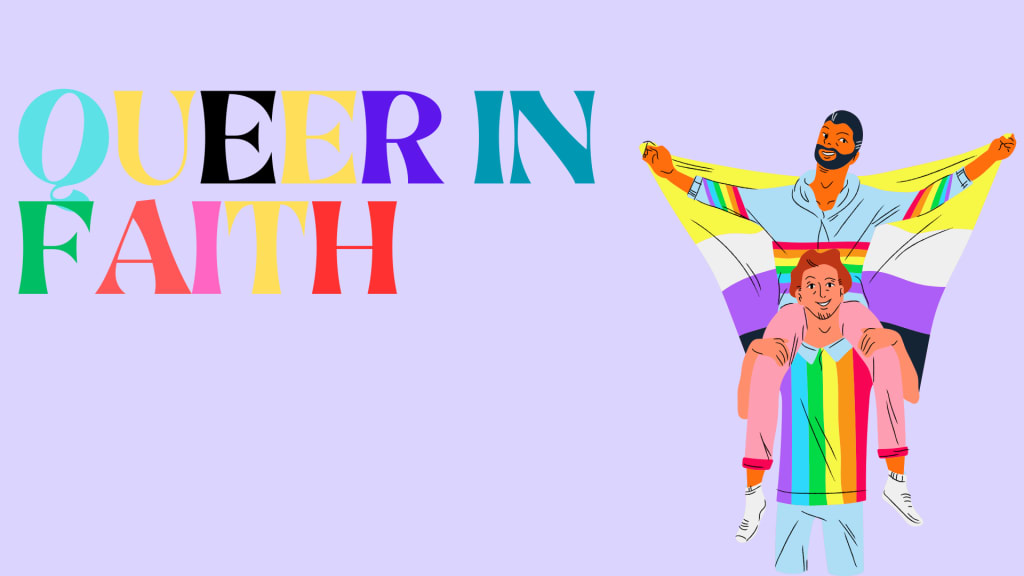
It’s past midnight on a Saturday. I can’t sleep. My mind is spinning, tangled in thoughts heavier than the silence around me. Sunday is only hours away, yet I dread the weight of Monday already. The kind of rainy Monday that hits different—not because of the cold, but because of the loneliness. The kind that reminds me that Julie’s gone. Yes, she left. And if you didn’t know, now you do. But we’ll save that heartbreak for another time—maybe when I’ve had a little whiskey.
Lying wide awake, I found myself questioning divine intentions. Did God create us only to disappear? Why give us complex commandments and a vague promise of return? Why do we have to wait until death to see Him? These thoughts ran deep, and I was just about to surrender to their weight when my phone rang, slicing through the night like a blade. Who calls at such ungodly hours?
Of course—it was Dave.
Dave isn’t just a friend. He’s more like a permanent number in your phonebook, one you may not call daily y but can’t delete. He's the guy my mom always praised—smart, composed, drama-free. He still is. But life, as always, isn’t that simple.
Dave is gay. And he wants me to call him “special.” Not because he’s a genius, but because his identity demands acknowledgment. I accept him without question. Being gay isn't a disease. The bile and judgment society throws at LGBTQ+ people—it’s what shocks me more than anything.
Dave wasn’t just calling to chat. He was hurting. Torn between faith and identity, he asked a question many fear to voice:
“Can you be queer and Christian?”
I didn’t have an answer. I’m not religious. I’m not gay. But something about his pain, his sincerity—it moved me. And I started to think, deeply.
Why is this even a debate? We accept sinners of all kinds in church—liars, thieves, adulterers. They’re welcomed, prayed for, and even given leadership roles. Yet, a person questioning their identity is labeled an abomination?
Hypocrisy is not holiness.
Most anti-LGBTQ+ arguments come from outdated interpretations. Leviticus 18:22 and Romans 1:26–27 are cited endlessly. But where is the balance? Where is the compassion? Most seem to forget that the scripture is not a weapon. We can also talk bible shall we?
Romans 8:38–39 reminds us that nothing can separate us from the love of God. 2 Corinthians 5:19 speaks of God reconciling everyone to Himself. Romans 3:23 says we all fall short—all, not just some. So, why do churches use Scripture to build walls instead of bridges? That s a question i'm yet to get a proper answer to, maybe you can.
Religious trauma is real. Dave carries it like a scar. He isn’t looking to change God. He’s seeking space in His house. But society? It keeps slamming the door. Can you imagine how lonely that must be—yearning for divine acceptance and being told you don’t belong?
Isn’t faith supposed to heal, not harm?
Thankfully, there’s hope. LGBTQ+ affirming churches are growing. They don't exist to promote an agenda. They exist to say: “You matter. You belong.”
Being gay and being Christian do not need to battle for space in one soul. Coexistence isn’t just possible—it’s powerful.
Listen closely. You’re not God. Stop acting like Him. Faith is personal. Salvation is a journey. Your role isn’t to condemn but to comfort, to guide without shaming, to welcome without conditions.
By the time Dave hung up, Sunday had already crept in. I lay there wondering how many others like him are out there. Struggling. Questioning. Hurting. Alone. Maybe even you.
You don’t have to choose between who you love and who you believe in. The two can walk together. They can kneel at the same altar.
Dave’s story is just one of many. But it sparked something in me. A realization that faith must evolve. We need churches that embrace. Communities that listen. People who choose love over dogma.
So here’s my question: What’s your story?
Don’t stay silent. Speak. Share. Be the voice that opens doors and softens hearts.
Because someone, somewhere, needs to hear it.
About the Creator
Everest
Writing isn't just what I do—it's how I make sense of the world, and how I invite others to see it a little more clearly, kindly, and colorfully
A Historic Declaration
We the People of the Husbands of the United States of America, in Order to form a more perfect Union, and I mean you...with me...establish Justice, insure domestic Tranquility, provide for the common defence, promote the general Welfare, and secure the Blessings of Liberty to ourselves, after Puberty, do ordain and establish this Declaration of Co-Dependence.
By Gerard DiLeo5 days ago in Humans
How Himalayan Salt Wall Relieves Sinus Problems Naturally?
Problems of sinus are extremely frequent nowadays. Nose is blocked, forehead exerts pressure, headache, and difficulty in breathing are observed in many people. These problems are aggravated by weather change, dust, pollution, and allergies. Pharmaceuticals are capable of assisting, but they remove the symptoms temporarily. It is due to this that individuals are seeking natural remedies that are safe and mild. Himalayan salt wall is one of such natural methods that are highly preferred in homes, spas, and even therapy rooms. It creates a light and calm environment that prefers smooth breathing.
By david smith7 days ago in Humans
me, me, me
when i read back my poetry it screams “me, me, me” on my screen in bold letters and i can’t shut it up — most days, i cannot make any other words out; i want to throttle a thousand versions of the me gone by, i want to throw myself from a figurative balcony, i want to sink a sword into every pen i’ve held
By angela hepworth6 days ago in Poets


Comments
There are no comments for this story
Be the first to respond and start the conversation.