
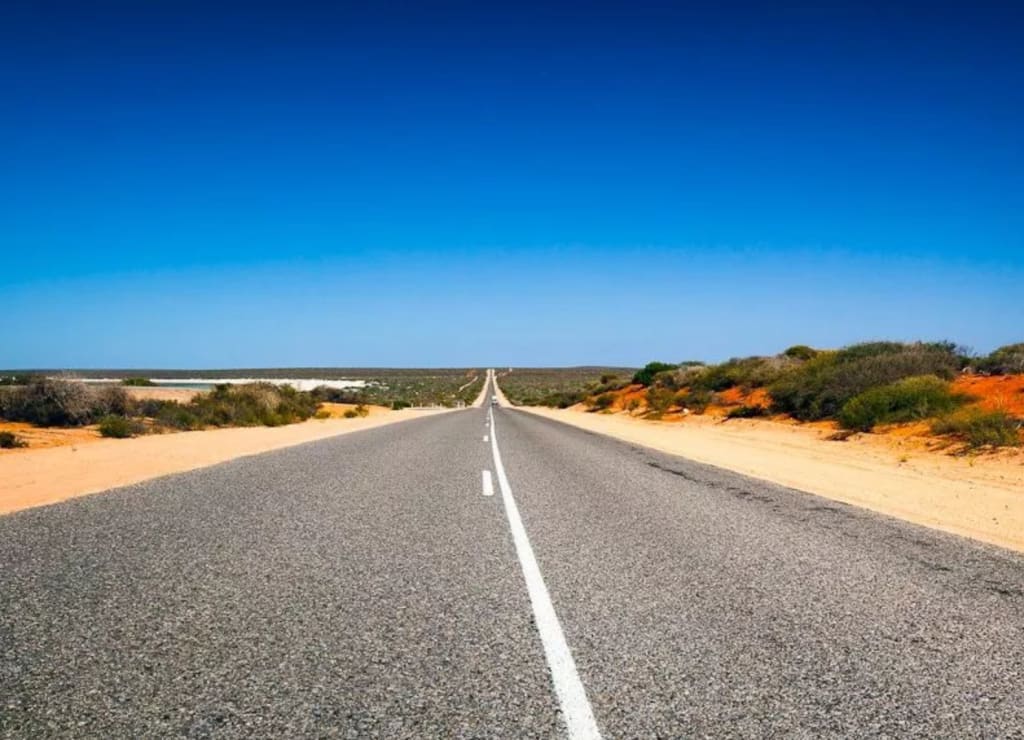
Blacktop therapy her dad used to call it, highway driving. Johnson gets in the car and makes for the Albany Highway. Armadale. North Bannister. Passes Italian mansions on the hill behind a fug of black foliage and toilet brush pines. Less than 80 kilometres from the city and Radio National is going staccato on her already.
At Arthur River she pulls in at Perfect Poultry for some chicken. A black and white collie rolls over in the dust, teats and black puddles of pigment and sparse white hair like seagrass around the lake of a belly, pink as a tongue. A small tuft of hair crowns a plump vulva. Johnson wonders momentarily whether dogs come, then chides herself for such a base thought.
A blackboard outside the corrugated iron shed offers thigh fillets for three dollars a kilo less than she’d pay in the city.
She looks around, scratches at the writhing dog, grins widely at its eel-like pleasure and waits for someone to appear. It doesn’t take long. A man in a white laboratory coat walks over from the house, motes of red dust rising like exhaust fumes behind him.
“G’day” she says brightly
“G’day” says the man, then looks down at the dog. “Upyerget, Bill. “
“Bill? Jeez. Thought she was a girl.”
“Yeah.”
Johnson gives him a quizzical look.
“So did we,” he says. “Didn’t realise before we named him. I mean her.”
Johnson laughs.
The man turns and walks towards the shed, unlocks it and turns to beckon her in. There are blotches of fading pink on the front of his coat.
“In ya come. Most of it’s in the freezer. Too bloody hot for fresh.”
“No worries.”
“Whaddya after?”
“Thigh fillets?” she asks.
The man looks skyward, scratches his fat, bristled chin.
“Nup. Sold out, sorry. Holidays ‘n all.”
The room smells of disinfectant, old chicken fat, blood. There is no sign of chicken anywhere.
“What about fillets proper?” she asks.
“Yep. Come in kilo bags, more or less.”
Bill winds her way around Johnson’s calves.
“I’ll grab two, thanks.”
A swell of cold air enfolds her as the man opens the freezer door. The dog is still at her legs, weaving in an out. She bends down to stroke the dusty coat.
“Goin’ far?” The man is back, bags in hand.
“Walpole.” Says Johnson, reaching for the bags.
“Coupla hours then,” says the man and pulls the bags gently from her grasp.
“Howabout I double wrap ‘em. Might keep frozen for ya.”
“Cheers.”
“Gotta be careful with chicken.”
“I know. Salmonella. People die.”
“Yeah.” He doesn’t sound convinced.
Johnson pays with cold coins from her coat pocket. Outside, the dust has settled again. Beyond the yard lie jaundiced paddocks, grey sheep, an occasional salt-sick eucalypt. A chook wire fence surrounds the house.
To keep out all those number eighteens, she thinks, and smiles.
“Thanks then.” She says.
“See ya, Bill!”
The man waves. “Not a worry. See ya later.”
It takes a good 10 minutes for the cold to drain from her fingers. She looks at her watch. Ten thirty. Clive will be at the supermarket, getting the stuff on the list she emailed him morning from the writer’s retreat. Suddenly she misses them both. She pulls over and dials Clive’s mobile. He answers in two rings.
“Hey babe. Tell me you’re not driving.” Her husband, always the carer.
“I pulled over. Is it cold down there? I’m planning to be home by four.”
“Freezing. I’ll get the fire on. Gert’s at a party ‘til five.”
“Can I talk to her?”
“Sure. Gert! Mum’s on the phone!”
Silence.
“Gert! Come and talk to mum!”
Another silence.
“Sorry babe, she’s watching Angelina Ballerina.”
Johnson laughs. She pictures her three year old fixated on the television screen.
“Give her a kiss and I’ll see you tonight.”
“Drive safe.”
“Will do.”
She stops at the Kojonup BP for fuel and something to eat. There’s no hunger in her but she knows she needs to fill up as badly as the car. She opens the driver’s door and enjoys the sensory rush, the effortless warmth of an Autumn day, the sweet acid tang of petroleum, frying chips. She reaches down to pull the release and feels the petrol cap pop satisfying behind her. She tut-tuts at her windscreen, filthy with old rain stains, dessicated moths, leaf grease.
A car-load of surfie blondes next to her are haggling over petrol money. Johnson reaches for the nozzle and fills up with unleaded, watching through her sunglasses. The blondes have nose rings and pierced bellies which glint in the sun. She likes their cackle, their exuberance. They don’t seem to notice she’s watching. Detritus hides the floor of their yellow veedub – empty flavoured milk cartons, cassettes without covers, old straws and the torn-up cardboard of cigarette packets.
Me a long time ago, she thinks, and chuckles.
She pays for the fuel, buys a banana muffin and a small choc milk. A man leans up against the LPG tank in front of her. She’s seen him on the way in but now she registers more detail. A green holdall. Blundstone boots. Jeans with frayed holes at the knee. European, she decides, twentyish and walks over.
“You after a lift?” Clive would kill her for doing this.
The guy wears sunglasses. Suddenly, she wants to see his eyes.
“Depends.” A Scottish accent.
“On?”
“Which way you’re heading.”
“South. Walpole.”
“Aye then. Thanks. Name’s Rory.” He offers a hand. Johnson shakes it.
“Hello Rory.”
She gestures to the car. He picks up his holdall. His hands are big, dusty knuckled. You look at a hand, she thinks, and already you know so much.
He sits in the front with the holdall between his knees. Dark hair pokes through at the knees of his jeans. Johnson notes a suggestion of browned skin. This is fun, she thinks. She feels free, reckless.
“Been here long? She goes for a light, conversational tone. Well travelled author Johnson Jones entertains a young Scottish hitch hiker.
“Arrived in Melbourne last week. Got a lift to Perth with a truckie.”
The day is blinkingly clear. They pass an eagle hunched on a leafless branch. Bird droppings ice the windscreen and there’s nothing worth listening to on the radio so she flicks on a greatest lovesongs CD. Ten kilometres up the road she turns right and Eric Clapton’s singing about how wonderful she looks tonight.
“Back route,” she says, “in case you were wondering.”
Rory grunts, takes out the grimiest blue plastic wine glass she has ever seen and holds it between his knees.
“Mind if I take a tea break?” It’s the most animated he’s been since they met.
“Not at all,” replies Johnson
Rory removes a bottle of wine from his holdall, unscrews the lid and pours himself a large glass of the red liquid. The wine label identifies the wine as ‘a light, fruity Merlot from South Australia.”
So,” she continues brightly, “What d’you do for a living?”
“Bouncer. In Aberdeen. You?”
“Writer. In Denial.”
Rory holds up the glass of wine.
“Fancy a swig?” he asks.
“No thanks,” says Johnson, reflecting that chivalry wasn’t dead after all.
Rory takes a large sip of his wine, replaces the bottle’s lid and tucks it gently back into his holdall.
The road continues its shadowed trajectory through arid country cleared for sheep. They breast a hill and suddenly they’re in amongst vineyards.
“Best riesling in Australia comes from right here,” Johnson says.
“Don’t drink the stuff,” replies Rory. “I’m a red man.”
Figures, thinks Johnson as the pungent odour of the wine fills her car.
A few sheep, bodies striped with ribcage shadows, graze in front of the vines. They do not look up as the car passes. Johnson pulls in at Bow Bridge for fuel. The tank’s still a quarter full but she gets more cautious in the country and, anyway, she needs a break from Mr Conversational. Rory comes back to the car with a bag of hot chips and a Coke. Johnson grabs a warm apple from the back seat.
“Bite?” Rory offers the chips.
“I’m fine,” says Johnson. “Really.”
She drives through Nornalup, past the olde tea shoppe and the small bridge where Clive fished for brim the year before amongst the crackle and Eucalyptus tang of summer leaf fall.
“This is where I live. Where we live,” she adds pointedly.
“Not Walpole?” Says Rory.
“No but it’s only 10 clicks further down the road. I’ll drop you off and come back.”
“Ta. I owe you.”
Johnson waves his gratitude away. They leave Nornalup and hit 90 well before the sign confirms it’s legal.
Rory turns towards her. She notes the telltale tilting of his head as he surveys her, up and down, up and down. He pauses at down.
“You on holidays or what?” He asks.
“I write. Getting away helps, but now I’m going home to hubby and daughter.”
The trees are overhanging the road, almost meeting each other in the middle. The car passes a turn-off for Peaceful Bay on the left and a parked four wheel drive with reddish mud up to its door handles. The sun is lower; not yet orange but heading that way and muted. Johnson squints and pulls at the visor until her forehead and eyes are, she hopes, lost to Rory in shadow. The road swings to the right and the road divides briefly as they pass a signed turn-off to the treetop walk.
They pass the Walpole township sign and Johnson pulls up outside a newish building built from pale orange brick. A sign out front advertises vacancies and a pathway leads to a glass double door covered in stickers and pieces of coloured paper. Two young women sit on the wall alongside the pavement and look over as Johnson kills the engine. Opposite there’s a park with eucalypts and altogether more dirt than grass. Through the trees, a children’s playground shines garish in the approaching dusk. Alongside are public toilets, a tourist bureau. A wooden a billboard by the door advertises two-hour eco-cruises on the inlet..
“Tourist Bureau,” says Johnson, pointing.
Rory has his hand on the door handle. She puts her foot on the clutch, pushes into first, waits. He turns to face her and leans in. She can smell the remnants of wine on his breath.
“Johnson?”
“Yes?” He’s smiling and it suits him.
“You wanna, you know?”
No-one is about in Nornalup. She parks behind their cottage and notes the smoke billowing from the chimney. Good old Clive, true to his word.
Killing time, Johnson walks to River Road. The ground is lumpy with gum nuts and double-gees. She wishes she’d donned shoes before leaving the car.
A kelpie sits on the bank, gnawing at its balls. The houseboats stand empty, lined up near the boat shed, ropes taut against the wooden bollards half-hidden by scrub.
Beyond the boats, the river shimmies in half-light, trees on the far side blackened by twilight. Johnson sits herself down on a small wooden landing deck alongside the largest of the vessels – a greying jarrah ex-cray with scruffy caulking, peeling red paint and the name ‘Laughing Girl’ picked out in fading white on her sorry prow. She dangles her hot feet into the cool, brown water and the deck creaks a little. Immediately to her left, about a metre out, something rises above the surface of the water and sinks again.
“You wanna, you know?” She asks the river in a broad Scottish accent, and bursts out laughing. Maybe 10 years ago before Clive and Gert she would have said yes.
Somewhere up in the hills behind town, where the land is cleared to pasture, but only just, a cow bellows as ‘Laughing Girl’ begins to worry at her mooring.
Johnson checks her watch. Clive and Gert will be home soon. She stands up and heads for the cottage.
About the Creator
Keep reading
More stories from Jane Cornes-Maclean and writers in Humans and other communities.
The dance
Hun·ting·ton's disease | noun A hereditary brain disorder that is a progressive, neurodegenerative condition marked especially by impairments in thinking and reasoning, disturbances of emotion and behavior, and the involuntary spasmodic movements that are associated with the loss or atrophy of nerve cells in the basal ganglia.
By Jane Cornes-Maclean5 years ago in Humans




Comments
There are no comments for this story
Be the first to respond and start the conversation.