
Beyonce And Jay Z Made A Mistake
Now they need to correct it

I come from Sierra Leone. A country whose reputation was tarnished by Hollywood’s blockbuster movie Blood Diamonds starring Leonardo Di Caprio.
According to the United Nations, blood diamonds, or conflict diamonds as they are otherwise called, are “any diamond that is mined in areas controlled by forces opposed to the legitimate, internationally recognized government of a country and that is sold to fund military action against that government.”
My country that has one of the most abundant reserves of quality diamonds in the world, had a brutal civil war from 1991–2002, and some of the most gruesome and barbaric actions like the hacking of limps took place. It was horrible, and many people suffered and lost their loved ones. I still cry when I think about it, but Hollywood’s powerful publicity machine, and a recent epidemic of Ebola, ruined the reputation of my country to this very day.
Whenever I say I am from Sierra Leone, people stare at me in shock and say:
“Blood Diamonds, aren’t people chopping off other people’s limbs in your country?”
Never mind that the war there ended almost twenty years ago, the Western world still thinks we are savages and it has been hard to find investors willing to fund projects in Sierra Leone. Things are starting to change, however. But for the longest time, the only thing that defined us Sierra Leoneans was savagery and those damned illicitly obtained hard carbon rocks.
Blood diamonds were and still is an issue for the diamond industry, so much so that companies that broker in these precious stones, now assure consumers that their diamonds were ethically mined – basically, no hacking of limbs or violent death was involved.
The Kimberley Process Certification Scheme (KPCS) that was set up in 2003, aims to prevent “conflict diamonds” from entering the mainstream rough diamond market. The effectiveness of the Kimberley Process Certification Scheme has been challenged by advocacy organizations like Global Witness and IMPACT who have both conducted investigations showing it does not provide markets with absolute assurance that the diamonds in commercial outlets are not blood diamonds. Human Rights Watch has also argued that the Kimberley Process is too narrow in scope and does not address other human rights violations i.e. poor working conditions, that are inherent to the diamond production chain.
I have stayed clear from falling into the marketing ploys of large jewelry companies. The reality is that you do not need a diamond to show or validate your love, that’s all a nonsense narrative to make you buy or expect a huge engagement ring. It was fabricated by the largest diamond broker in the world — De Beers — to increase consumer demand for diamonds in what was then a sluggish market.
But I’m not aiming to change the whole world’s buying habits with this piece, I’m just saying, the size of the diamond on the engagement ring doesn’t equate to the amount of love your partner has for you. That is the long and short of it period.
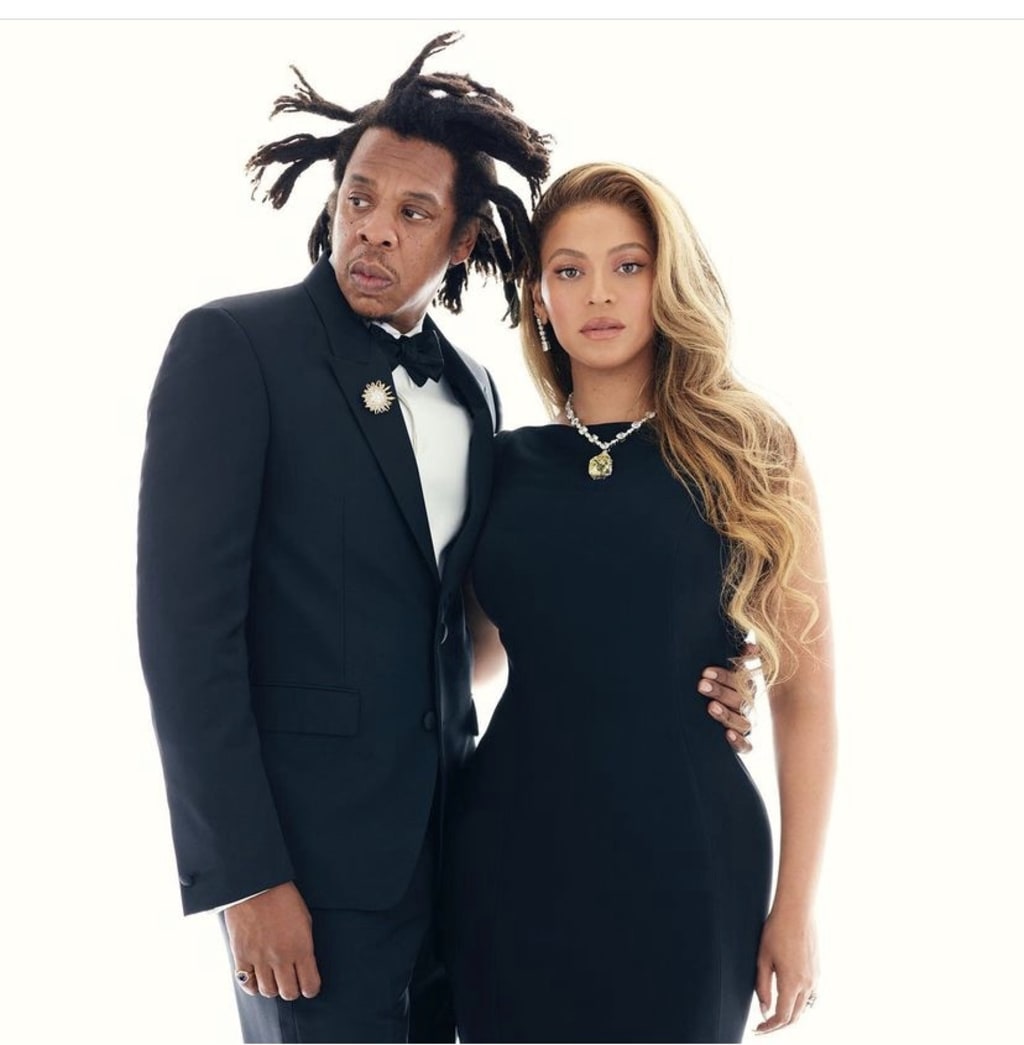
The issue at hand for me today is Beyoncé, Jay Z, and Tiffany & Co.'s cozy threesome that everyone seems to be talking about. Look, I get it, Beyonce had the opportunity to be the first Black woman to wear the iconic Tiffany & Co. Yellow Diamond, and she took it.
She was seeking to uplift and bring blackness into what has mainly been a white space, I get that. But in doing this with what I imagine were the best intentions in the world, she neglected to do her homework, and herein lies my disappointment. Let me deconstruct this further.
Firstly, Tiffany’s Yellow Diamond comes from a mine in South Africa. I don’t care how much they paid for it, that rock has no place in their personal collection. A bit like all the artifacts that were stolen from the African continent by greedy white imperialist colonialist powers, that yellow diamond should have remained in Africa where it belongs.
By associating herself with that diamond, Beyonce is condoning the theft of a precious artifact from the people of South Africa. Imagine how many schools and hospitals could have been built with that money? Imagine how many South African lives would be much better off if that diamond hadn't been stolen. Beyonce should have known better.
Secondly, the Yellow Diamond was mined under dubious circumstances. It turns out that it is one of the largest blood diamonds ever mined. So in order for it to find itself to where it is today, human lives, and most likely Black lives — given that it was found in South Africa, were lost.
How can Beyonce say she stands for Black Lives Matter if the necklace she has around her neck clearly demonstrates that the black lives of the people that mined it, did not matter?
There is a clear dichotomy between what she says she stands for and her association and hence the promotion of an object that runs contrary to it.
I do not think that Beyonce thought about all these elements before agreeing to promote Tiffany & Co. I truly think that her intentions were honorable — uplifting Black lives and making them matter.
Somewhere along the way, she was blind-sighted by the representation opportunity and forgot the larger systemic issues of white supremacy, colonialism, and the inherent exploitation that underpins many of the diamond industry's players. They are not and have never been the good guys and gals.
I know I’ll get a lot of flack for this piece, much like I did when I dared criticize Meghan and Harry, the Duke and Duchess of Sussex on their interview with Oprah.
The thing is, I can’t stay silent because many people love the Carters. I love them too, but they have made a mistake here, and they need to be called out on it. The day we can’t call out our leaders, influencers and the people we look up to when they make mistakes is the day we give up on our freedom of expression and making the world a better place. We need to hold everyone accountable and get them to reflect on their actions, especially if these same actions condone behaviors that exploit or hurt other human beings.
I read that Beyonce and Jay-Z were disappointed by the reaction of the public to the Tiffany & Co. ad, and I understand that. But now, they need to get past that, realize that they made a mistake, and correct it.
Even better, maybe they now need to advocate for Tiffany & Co. to return the Yellow Diamond back to South Africa where it rightfully belongs.
Thank you for reading my perspective.
About the Creator
Rebecca Stevens A.
I write about racism, but I would like to write about something else instead. Help me stop racism so that I can get to that.
Keep reading
More stories from Rebecca Stevens A. and writers in Humans and other communities.
Why Black People Are On Constant Alert, Always
I travel extensively for work and I am always dressed in my Sunday best when I do. My colleagues often wonder why— they sometimes refer to me as a diva who is so full of herself and as such always needs to be styled in the latest fashion.
By Rebecca Stevens A.5 years ago in Humans
Whiskey At Dusk
Guess the whiskey was more important to you in the end, wasn’t it? It was more than the well-being of your friends; more vital than showing up to the places you promised you would and could come to; more critical of a matter than fulfilling your damn responsibilities and getting the press off your back.
By Snarky Lisa2 days ago in Humans
How Can Beginners Enjoy Surfing Safely at Playa Avellanas?
There is something magical about standing on the sand at Playa Avellanas, feeling the warm Costa Rican sun on your skin, and listening to the ocean roll in. If you have ever wanted to try surfing but felt nervous about it, this beach is one of the best places to start. I still remember my first paddle out here, the mix of excitement and nervous energy as the waves approached, and the feeling of accomplishment when I finally caught my first ride.
By Amanda Glen7 days ago in Humans


Comments
There are no comments for this story
Be the first to respond and start the conversation.