
Beneath the Crumbling Sky
One Man’s Struggle for Survival and Hope in the Aftermath of the Russian Earthquake

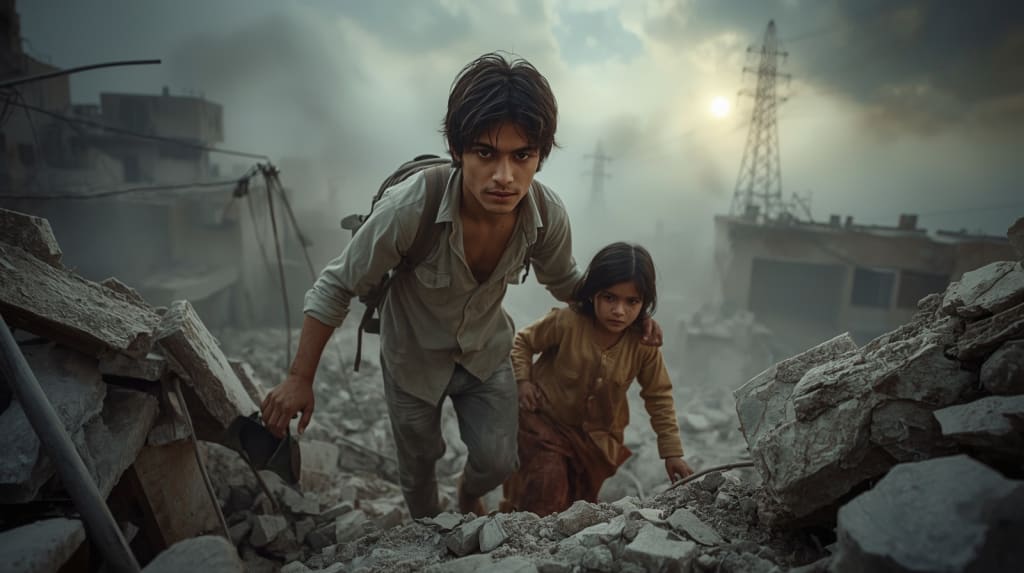
The Story:
The early morning air was unnaturally still in the city of Petropavlovsk-Kamchatsky, nestled in Russia’s far east. Sarfaraz had just returned from his night shift at the bakery, a job he had taken on temporarily while he pursued his degree in structural engineering. As he sipped his tea by the frosted window, he felt the floor tremble gently beneath his feet. A slight vibration—nothing too unusual for a region known for seismic activity.
But then came the roar.
It started deep, like the growl of an ancient beast rising from the core of the Earth. The walls began to shake violently, and Sarfaraz’s cup shattered on the floor before he could even stand. Within seconds, the ground was heaving, groaning, screaming.
The earthquake struck with devastating force—measuring 7.8 on the Richter scale. Buildings crumbled like sandcastles against an angry tide. The air filled with dust, screams, and the endless, deafening sound of collapse.
Sarfaraz didn’t remember how he got out of the apartment alive. He only remembered grabbing his backpack, yelling his roommate’s name, and stumbling through the stairwell as it caved in behind him. Outside, chaos reigned. People were crying, searching, bleeding. A mother clutched her lifeless child. Sirens howled in the distance—distant, but coming. Still, there was no comfort in their approach.
For the next several hours, Sarfaraz became something he never imagined he could be: a rescuer. His engineering knowledge kicked in automatically. He warned people not to lean against cracked walls, helped organize a makeshift triage zone, and calmed a little girl who wouldn’t stop asking where her father was.
There was no time to cry. No time to reflect.
By nightfall, the freezing air returned, and with it, silence. The shaking had stopped, but the damage was done. Thousands were injured. Hundreds were dead. Power was out. Roads were broken. Communication lines were down.
Sarfaraz lit a small fire using splinters from a broken fence and a discarded piece of clothing. Around him, a group of survivors huddled, clinging to any warmth—physical or emotional.
Among them was an old man named Yuri. His leg was badly injured, but he kept whispering, “My wife… She’s still inside.” Sarfaraz knew the building Yuri pointed to—it was the same gray concrete block he had walked past every day for three years. Now, it was nothing more than a broken skeleton.
The next morning, against warnings from emergency officials, Sarfaraz and two others ventured into the collapsed building. They moved slowly, cautiously, calling out every few steps. And then, faintly, from beneath the rubble—they heard a voice.
It took four hours to dig her out. Her name was Valentina. She was bruised, dehydrated, and cold, but she was alive. When Yuri saw her being carried out, he wept—not out of sadness, but out of disbelief and joy.
That night, Sarfaraz sat alone, looking up at the bruised sky. Stars shimmered through the dust. His hands ached. His legs trembled. His heart was heavier than it had ever been. And yet, for the first time in his life, he felt something profound: purpose.
He hadn’t saved the world. He hadn’t prevented the destruction. But he had mattered. He had done something.
Days later, rescue crews arrived in full. International aid followed. Temporary shelters were set up. Families reunited. The rebuilding began.
When a journalist interviewed Sarfaraz, asking him why he risked his life when he could have just waited for help, he said, quietly:
“Because I know what buildings are made of. But now I know what people are made of too.”
The earthquake took many things—homes, lives, memories. But it also revealed strength, courage, and humanity hidden in the cracks.
Sarfaraz stayed in Kamchatka long after his school reopened. He helped redesign safer structures, led training workshops for disaster response, and became a local symbol of resilience.
And though the ground beneath them had broken, the spirit above it stood tall.
About the Creator
Keep reading
More stories from The voice of the heart and writers in Humans and other communities.
The Shield of Borders
Introduction In a landmark policy shift, the United Kingdom has introduced a global sanctions regime aimed at dismantling networks that facilitate terrorism, human smuggling, and organized crime under the guise of immigration. This is not just a national move—it is a diplomatic and geopolitical message to the world: aiding illegal migration with links to crime and violence will no longer be tolerated.
By The voice of the heart8 months ago in Humans
Flirting Men Often Use Body Language Subtle Cues And Humor
Flirting refers to a natural and in most cases a mischievous manner in which individuals express romantic or personal interest. Most men show their attraction not just by means of words, but also body language, acting hints, and jokes. These actions aid in building a comfortable and interesting environment and also gives them an opportunity to check if they are interested. Flirting can be rather playful, but it does not lack substance as it can convey feelings and intentions. This knowledge of signals would enable individuals know when someone is interested and how to respond to it and build social bonding and romantic potential.
By Willian James7 days ago in Humans


Comments
There are no comments for this story
Be the first to respond and start the conversation.