
Australian feral cats a problem?
In Australia, cats are a notoriously invasive species.


In Australia, the cat is an unmistakable invasive species.
The isolated island of Australia did not evolve felines under a combination of complex factors such as earth plate movements and species evolution. Due to the low number of hunters, it also became a natural paradise for marsupials.
But in the late 17th and early 18th centuries, the British brought cats into Australia. As with many invasive species stories, it took only a short generation or two to go from domesticated to wild to ubiquitous.
A Persian cat exhibition in Australia in 1923
Biologists estimate that as early as around 1910, cats covered 99% of all of Australia's land. From the most remote mountainous areas to the dense rainforests, feral cats are found throughout Australia. They can even survive in deserts where there is almost no water, relying on the blood of their prey for all the moisture they need.
Felines are natural top hunters, and Australia's feral cats, also have the widest range of recipes in almost all of Australia. Mammals such as wallabies, reptiles such as venomous snakes, and birds of all kinds are all targets of their hunting.
Since Europeans brought cats to Australia, 22 species of endemic mammals have been hunted to extinction by feral cats. As a result, Australia has also earned the rather unpleasant title of "Global Mammal Extinction Center".
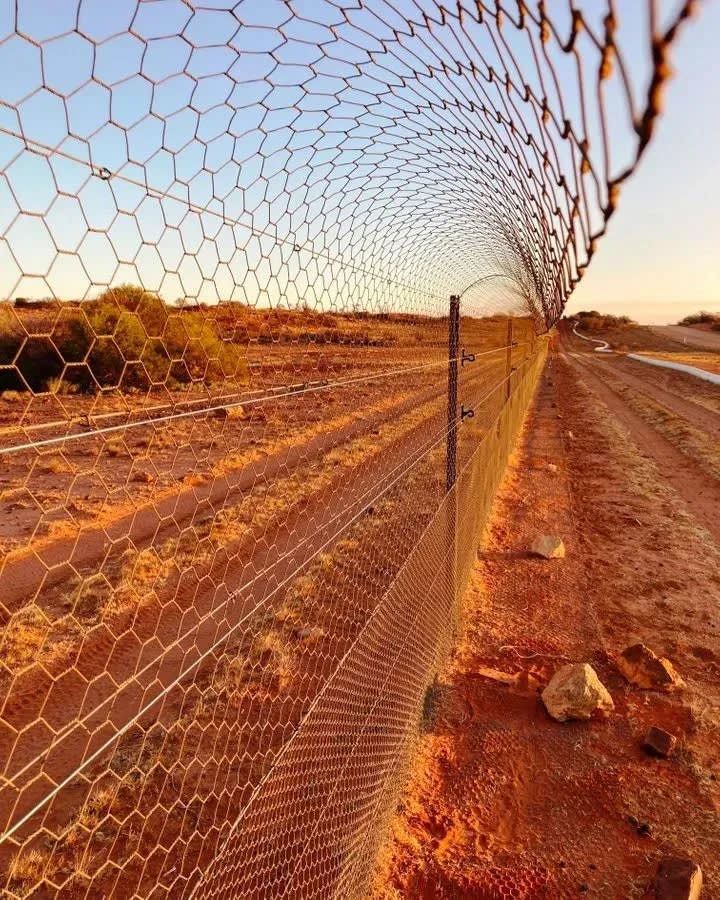
In 2018, to protect endangered animals, the Australian Wildlife Federation completed one of the world's longest cat-proof (and fox-proof) fences in central Australia.
Foxes are also an invasive species in Australia
The 44-kilometer-long fence creates a 94-square-kilometer "safe zone" for local animals to escape the terrifying threat of feral cats and give their populations time to thrive.
After the fence was built, conservationists trapped and removed about 50 feral cats already present in the area and then reintroduced 11 endangered species that had been killed off in the area.
The fence, which is soft at the top and hard at the bottom, basically ensures that feral cats and foxes will not find a way to cross or burrow through it for a long time
The Wildlife Conservation Society plans to create a safe "feral-free zone" by using increasingly sophisticated bait and trap, and even genetic-level technology, to drive out feral cats. Interestingly, they also reject any hunting of feral cats.
When interviewed in 2018, the organizers planned to expand the fenced area from 94 square kilometers to 700-1,000 square kilometers.
Ironically, it seems that the environment inside the fence is "natural" without invasive creatures, while outside the fence is "unnatural" - because it is full of cats and foxes, many native animals cannot survive.
In contrast to the compassionate plans of animal protection groups, the central government of Australia has chosen to be much more brutal and efficient. In 2015, they announced that they would kill 2 million feral cats by 2020.
How exactly do they do this? Poisoning, trapping, and hunting, a three-pronged approaches.
First, have zoologists develop poisoned sausages that feral cats can hardly refuse, and then send planes directly to airdrop them. It is estimated that the Australian government has been dropping nearly 500,000 poisoned bait in the wild bush every month, taking out 211,560 cats in the first year of the announced cat extermination program.
But cats are extremely intelligent animals, and while poisoned sausages have always worked for foxes, they don't always work for cats.
So in addition to poison, it is also necessary to cooperate with the scientific team of trapping and hunting hunters.
Even so, many scientists often mention their own experiences of being tricked by wild cats. Wildcats are almost impossible to capture the same way twice, which makes it difficult to study them. And hunters have found that once they track a feral cat but miss a shot, it is essentially impossible to find it again.
One cat called Barnaby on Kangaroo Island had escaped while being radio-collared by ecologists, but they couldn't get it back after that anyway. More interestingly, as the research team trapped and studied the feral cat all over the island, its signal kept appearing intermittently around the team, as if it was tracking and studying the behavior of these humans.
In the process of dealing with the feral cats, the scientists had their work cut out for them, but found the job increasingly difficult. But at the same time, it also enlightened them.
At the root of the problem, what caused the native Australian species to be easily hunted to extinction by feral cats and foxes? From a biological perspective, it was the lack of co-evolution between predator and prey.
To put it bluntly, feral cats are too smart, and native Australian animals are too stupid. Mom, dad, and grandparents were all eaten, and when they saw the big monster, they couldn't run.
"Looking for me for something?"
And what have people in Australia been doing for decades? Protecting and isolating native species, while hunting and killing feral cats in large numbers. In a sense, these actions to protect the species by excluding predators will not exacerbate the infantilization of native species, and even further degrade them.
So slowly, some scientists began to shift the focus of their research to "improving native species". Then they found that there are already some reference cases in this regard.
In 2008, 66 small kangaroos (Bettong) dug their hole and escaped outside the reserve. Amazingly, the colony survived for three years in the area with cats and maintained its population.
However, around late 2011 and early 2012, a fox entered their living area. Then, this "dumb population" became extinct just a year later.
Yes, you read that right, this thing is also a species of kangaroo. And many of its close relatives were predated by cats and foxes to extinction!
In the past, this case only reinforced the idea of researchers about the need to completely isolate and protect endangered species as soon as possible, because it was felt that they really could not fight against invaders.
But now, through a series of animal experiments in which scent-added models of cats and foxes were introduced, a small number of feral cats were introduced, and the "survivors" were released into the wild for observation, scientists have found that Australia's native animals do have a high potential for evolution.
The "specially trained" mammals will be more alert to the scent of predators in their range, and birds will maintain a longer flight duration to allow time for careful observation of potential hazards on the ground. Some researchers are slightly embarrassed to say that they used to trap and capture wild cats, and now they are the ones who put the cats back a little.
Scientists preparing to drop model foxes and scare the local dumb critters
Of course, the evolution of animals will take a hundred years or so, but it's worth it.
And according to the latest news, some of the more radical scientists are already working on a project to "assist evolution" through genetic means.
Gene-editing animals may be able to solve the problem of predator and prey lack of co-evolution overnight, but will not stir up a new basket. Perhaps only time will give us the answer to this question.
About the Creator
Fester Hammer
We soon believe what we desire.
Keep reading
More stories from Fester Hammer and writers in Humans and other communities.
What The Heck Is Creativity?
Before diving into details of what is creativity and ways you can achieve that, let me ask you first. What do you think is creativity? Stop reading this article right away. Start your favorite word processing software and write down your pearls of wisdom about creativity. Go ahead.
By Fester Hammer3 years ago in Humans
Miss Persephone's Manual to a Seemingly Ordinary Life
Miss Persephone was found at the dining table, her blue eyes swollen, her tears arriving and retreating like the tides of the ocean. Earlier that day, her family had visited her in the retirement home where she had lived for eight years. It was her eightieth birthday.
By Imola Tóth2 days ago in Fiction


Comments
There are no comments for this story
Be the first to respond and start the conversation.