
Are the kids alright? Kid-centric film and TV in the 21st century and what it means
“Mare of Easttown.” “Cry Macho.” “Sharp Objects.” “News of the World.” What do these films and T.V. shows have in common? They’re all marketed toward adults, and they’re all centered around children.


Obviously, this comes about in different ways in each work. In the limited series’ “Mare of Easttown” and “Sharp Objects,” for example, the murderer ends up being a teenager. Both are rated TV-MA.
THERE ARE SPOILERS IN THIS ARTICLE. CONTINUE FORWARD AT YOUR OWN RISK.
In “Cry Macho” and “News of the World,” the whole plot centers on a quest to get a teenager home, in both instances by older men who lost their families tragically. Both are rated PG-13.
With the exception of “Mare of Easttown,” all of these movies are based on books. “Cry Macho” was published in 1975, “Sharp Objects” was published in 2006 and “News of the World” was published in 2016.
I can see the appeal of “Cry Macho” and “News of the World.” After all, who doesn’t love a good quest?
I think it’s worth noting that in “Cry Macho,” the teen who leads Clint Eastwood’s Miko simply leads him to his happily ever after with Natalia Traven’s Marta, whereas in “News of the World,” the teen who leads Tom Hanks’ Captain Kidd ends up being his happily ever after. He takes her in as his daughter.
At this point, I can only speculate, but I imagine that the difference in endings for Hanks’ and Eastwoods’ characters has to do with the time they were written in. In 1975, the nuclear family and romantic partnership were embraced as the American dream. But now, in the 2010s and 2020s, the idea of found family is much more embraced. Having a spouse and romantic love is slowly but surely being edged out as the be-all-end-all, with it becoming more and more common to find happiness in other areas of life.
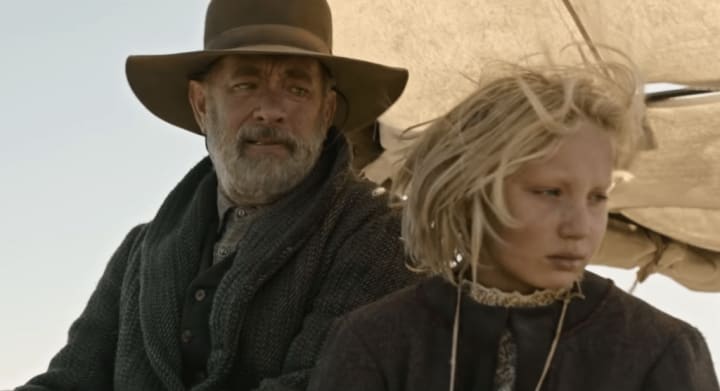
Honestly, it isn’t hard for me to understand why “Cry Macho” and “News of the World” are a part of a new generation of movies for adults where children are the focal point. After all, kids are kind of the point of life. Procreation is what keeps the species alive. We literally wouldn’t exist without kids. And western society is slowly starting to realize that the“seen and not heard” way of being that has been historically embraced for children is not really realistic. Because while children may not be able to legally drive or drink or vote, they’re still people who not only have interesting inner lives, but also greatly enrich the lives of adults.
What tripped me up is the number of media pieces that feature child murderers, like “Sharp Objects” and “The Mare of Easttown.” Don’t get me wrong, they’re both great shows, but the first time I saw “Sharp Objects,” the ending quite honestly shocked me.
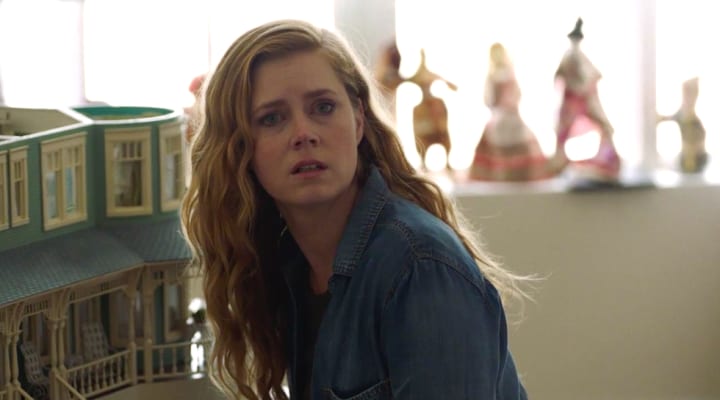
“Sharp Objects” is perhaps more shocking than “Mare of Easttown” because the murders committed by its child killer are a lot more gruesome and calculated. In the former, Adams’ 13-year-old half-sister, Amma, is revealed to be a serial killer who not only murdered multiple girls around her age and let her mother take the blame, but also pulls out the teeth of her victims to use for the floor in her doll house, which is a mirror of her mother’s.
Meanwhile, in “Mare of Easttown,” the murderer is 13-year-old Ryan Ross, who shoots his father’s 17-year-old lover whom he happens to share a kid with. As a lover of true crime and fictional thrillers, “Sharp Objects” was the first time I saw a child be the serial killer. And then when I saw that a child was the killer in “Mare of Easttown,” I was intrgued by the pattern.
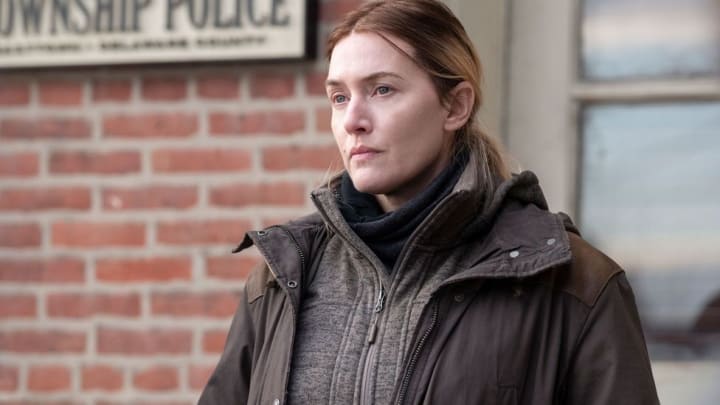
After a lot of thought, I have a couple hypotheses for why this trend seems to be emerging. As I mentioned earlier, kids are becoming seen more and more as complex humans who are just as full of emotional depth as adults. I think “Sharp Objects” and “Mare of Easttown” are reflections of that.
Specifically, I think they are reflections of how a toxic home life can effect children. In both shows, the 13-year-olds in question are from volatile homes. In “Sharp Objects,” Amma’s mom has Munchausen syndrome by proxy and is alluded to being responsible for the death of Amma’s older half-sister, Marian, which hangs over the family like a dark cloud throughout the story.
In “Mare of Easttown,” Ryan is from a home where his father has not only cheated on his mother, but cheated on her with someone only a few years older than him. To say that both he and Amma are under a lot of pressure and have dysfunctional role models is an understatement.
I think both of these shows can deeply speak to the negative side of what children can be capable of and why we need to stop turning a blind eye to their homelives and the effect those homelives can have on their emotions and eventually, their actions.
I don’t think it needs to be repeated, but, just in case: kids are humans and deserve our full attention.
About the Creator
Kasey Faur
I am a freelance writer and photographer based in Butte, MT. I write non-fiction stories and essays and reported pieces. I love writing about everything from mental health to pop culture to parenting.
Keep reading
More stories from Kasey Faur and writers in Humans and other communities.
Things you can do to make your partner feel loved, Valentine’s Day and every day
Even if you’re with your soulmate and things are easy and fun, no couple can survive on that alone. At least, not forever. Several years ago, I read the quote: “A person who feels appreciated will always do more than is expected.” -Anonymous
By Kasey Faur4 years ago in Humans
I Saved My Family from a House Fire
It was November, and it had been just a handful of weeks since I’d moved up to senior school. I was only eleven and wouldn’t be twelve until the following June. I had spent the recent long summer holidays, carefree, happy, and, for the last time, playing with my old friends. But my twin brother and I were both ecstatic to have left junior school far behind us.
By Chantal Christie Weissabout 11 hours ago in Humans
How to Succeed at the Benson Directory®
Congratulations and welcome to the Benson Directory® employee #22391! As our newest call handler, you will have the privilege of speaking with dozens of unique and interesting people on a daily basis as well as the opportunity to earn bonuses for high performance. Contained within this handbook you will find a set of ease to follow instructions designed to help you settle in to your new role and begin paving the way to success.
By S. A. Crawford3 days ago in Fiction




Comments
There are no comments for this story
Be the first to respond and start the conversation.