
Amer never slept well. He was constantly anxious. Recurring dreams tortured him with seductive memories of Afghani landscapes, music, spontaneous laughter and freedom.
In the still of each night he could smell the sea and the earth from his uncomfortable single bed. It was always deafeningly quiet. His breathing, the rustle of the course acrylic sheets, the metallic creak as he turned on his rudimentary bed took on screaming proportions in the still, humid nights.
Every night he woke at 3.00am. He no longer fought to retrieve sleep. Instead, he’d gather his mobile phone, tobacco, and notebook from the bedside table and confidently find his way in the dark to the camp’s recreation area. There he waited cloaked by a high dark sky, listening to the rush of the ocean, and feeling a cool lifting breeze on his proud and once happy face.
He sat by a high, wire fence, on a cold metal bench inside The Christmas island Refugee Detention Centre surveying the lush rainforest silhouetted against the night sky. He breathed in the scent of the dense forest floor, listened to the breeze rustling through the trees and counted the stars as he patiently waited for the arrival of his friend.
His knowledge of the island was limited to the confines of the refugee centre governed by Australia. The most north western tip of that vast continent lay more than 600 kilometres south of Christmas Island. Indonesia was closer and that’s where he’d begun the third leg of his disastrous journey to freedom.
It was a thwarted exodus, in a dilapidated boat crammed with more than 70 desperate asylum seekers. That journey stole the lives of more than 48 men, women and children when submerged rocks ripped the bow and raging seas spewed people and remnants against impenetrable rocks cliffs near the Christmas Island settlement of Flying Fish Cove.
Tonight, six years later he was still waiting for faceless men and women in a place called Canberra, to approve his asylum seeker status and grant a temporary visa so he could live and work on the Australian mainland. His hopes of celebrating his 30th birthday as a free man in a land of plenty were now dashed.
As he did every night he sat quietly, patiently waiting for his friend to call. He sucked on a harsh cigarette rolled from cheap tobacco smuggled into the centre by more compassionate guards. It was for many, one of life’s small pleasures.
The food on the island was very bad. Amer, a chef by trade, constantly fought to expel thoughts of food and instead turned his mind to writing a diary, short stories, and musings on the unfathomable extremes of his exile.
None of the inmates could understand or comprehend how the Government of such a free and prosperous country would spend $400 million to imprison people fleeing the dangers of their home countries.
” Why”, they would constantly plead, “was the processing taking so long?”
“ Why were the people so cruel? Why were the facilities so barren? What have we done to deserve this treatment? Are we not human? Oh Allah, what have we done to deserve this?”
Their movements were limited to the spartan confines of their prison. They would never enjoy the infinite beauty of the surrounding island, its lush volcanic mountain, its biological diversity including many rare species of animals and plants, the refreshing caress of calm pristine seas at long white beaches, and crystal clear pools in coastal coves. That paradise was not for them to enjoy.
Sitting on the cold seat, wrapped in his sheet Amer listened to the mosquitoes circling and landing on his exposed legs. He would not swat nor crush them. Violence toward any living creature was not in his nature.
And then he heard it. “Book Book” came the call almost directly above him and ever so much closer than his friend had ever dared to venture before. Amer rose to his full height raised his arms, cupped his long fingers around his full lips and gently, ever so gently imitated the call of his most precious ally.
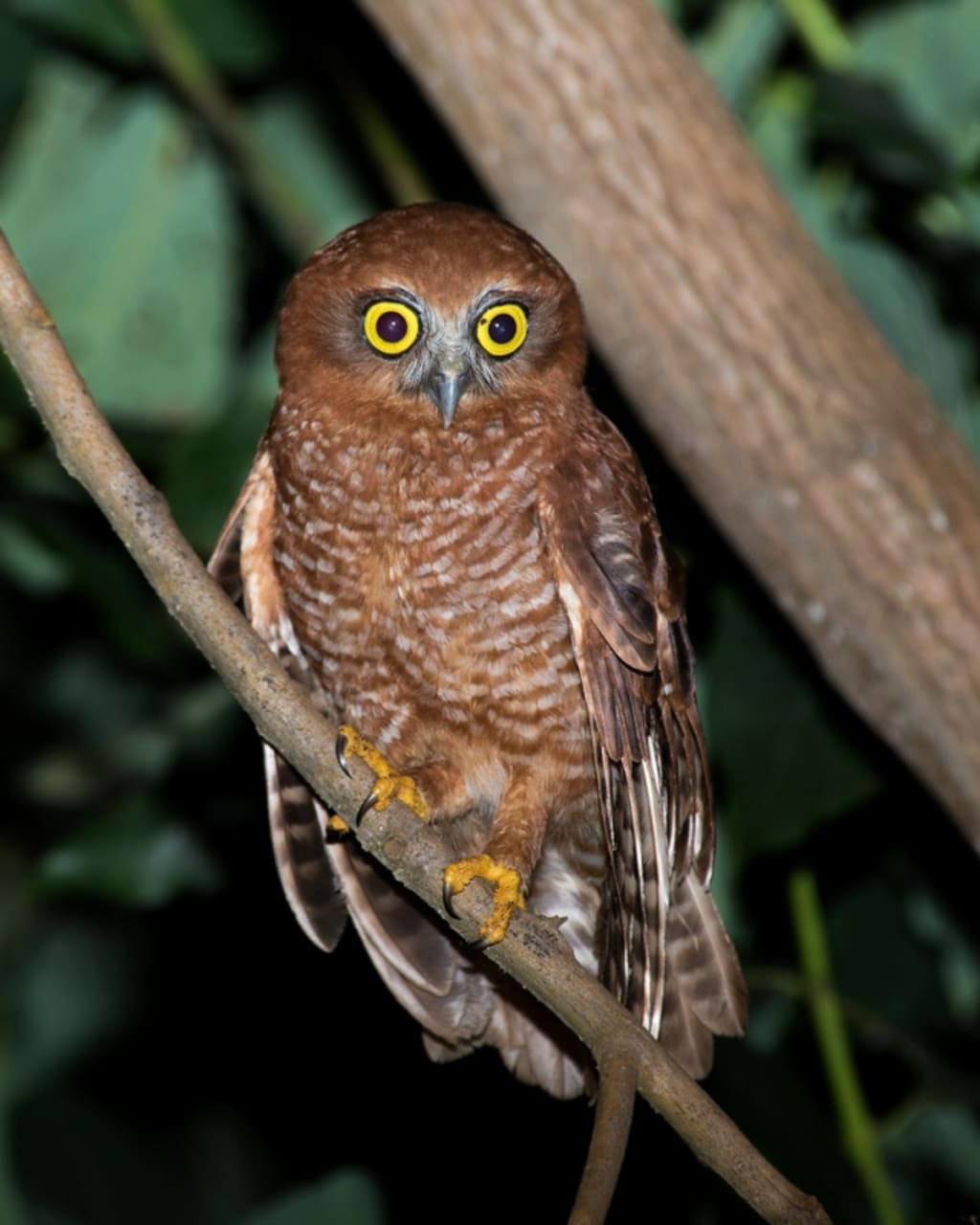
“Book Book” he replied. His imitative skills were extraordinary. The bird, a Christmas Island Night Owl, one of the rarest of its kind, in the world, opened its bright yellow eyes, fluttered its tawny brown and orange plumage and proudly displayed its orange and white undercarriage and strong orange talons.
The man and bird greeted one another with a short nod. Tonight the bird was no more than a metre from the fence. Its eyes looked soulful, speaking to Amer with compassion and beauty – two rare commodities in this young Afghani’s callous estrangement.
Amer always had an affinity with animals of the land and sky. He could speak to them and they would hear. His mother said they could see to his soul -a gentle and kind soul that relieved others of their burdens while in his presence.
Amer could tell his friend was lonely too.
They met regularly. Amer would unburden himself talking to the bird in his native tongue, sharing his most intimate feelings and dreams. He knew to speak his dreams would keep them alive.
Their interludes were broken by the first rays of the slow, red rising sun.
With the night owl’s departure Amer ritually completed his prayers and focused on an hour of stretching and muscle building before returning to the inner camp to share pale, tasteless coffee with other early risers.
Some inmates did not leave their beds. Their bodies and minds withered in the humid equatorial heat. Children did not grow as they did when free and mothers fretted for the mental and physical well-being of their families both there and abroad.
One day talk around the camp centred on the looming migration of the Christmas Island Red Crabs. Every October or November those tiny creatures, instinctively prompted by precise rainfall and tides, marched from their humid land burrows to the sea to mate and release their eggs. Some said this migration is one of the most incredible natural processes in the world. This inedible species of crab has a vast population of almost 50 million across the Christmas and Cocos Islands despite their depredation by another tiny creature called the yellow crazy ant.
The preparation for the annual migration has captured the hearts, minds, generous budgets and time of the Australian Federal Government, Christmas Island National Park and the local community. Each year temporary barriers are erected along roadsides to funnel crabs toward specially constructed permanent crab bridges. Signs are erected and roads closed to protect the crab’s migration from their forest homes. Every effort is made to ensure they are safe and protected.
At that time every year, many detention centre inmates wished that they too were red crabs.
Amer wanted to be an owl.
About the Creator
Sonia Smirnow
Throughout my writing career I've churned out content for a swag of PR clients. Now its time for My Voice to carry readers on a gentle tide of emotions, suspense and surprise. No shouting. Leave them wanting more. The journey has begun.
Keep reading
More stories from Sonia Smirnow and writers in Humans and other communities.
When True Love Never Questions Your Soul
“And she’s going to learn that this life will hit you, hard, in the face, wait for you to get back up, just so it can kick you in the stomach but getting the wind knocked out of you is the only way to remind your lungs how much they like the taste of air.” — Sarah Kay’s Poem — If I Should Have a Daughter
By Chantal Christie Weiss4 days ago in Humans
The Hidden Valentine part three
Some nights are never meant to be remembered. They carve themselves into the mind, replaying without mercy, resurfacing when you least expect them. They become the dividing line between who you were—and who you are forced to become.
By Ahmed aldeabella3 days ago in Humans
The Pride Flag and the Diversion
For nearly a decade, the LGBTQIA Pride Flag rippled in the wind at Christopher Park, a kaleidoscope of color staked into the soil of America’s first national monument to LGBTQIA+ liberation. That flag came down this week. Federal officials, citing new guidance from the Trump Administration, silently lowered the rainbow flag from its pole across the street from the Stonewall Inn. The birthplace of the modern gay rights movement now flies only the United States flag.
By Tim Carmichaela day ago in Pride



Comments
There are no comments for this story
Be the first to respond and start the conversation.