
AI Stole My Dream Job So I Asked It to Help Me Build a New Life
The day my Google Doc turned into a gravestone

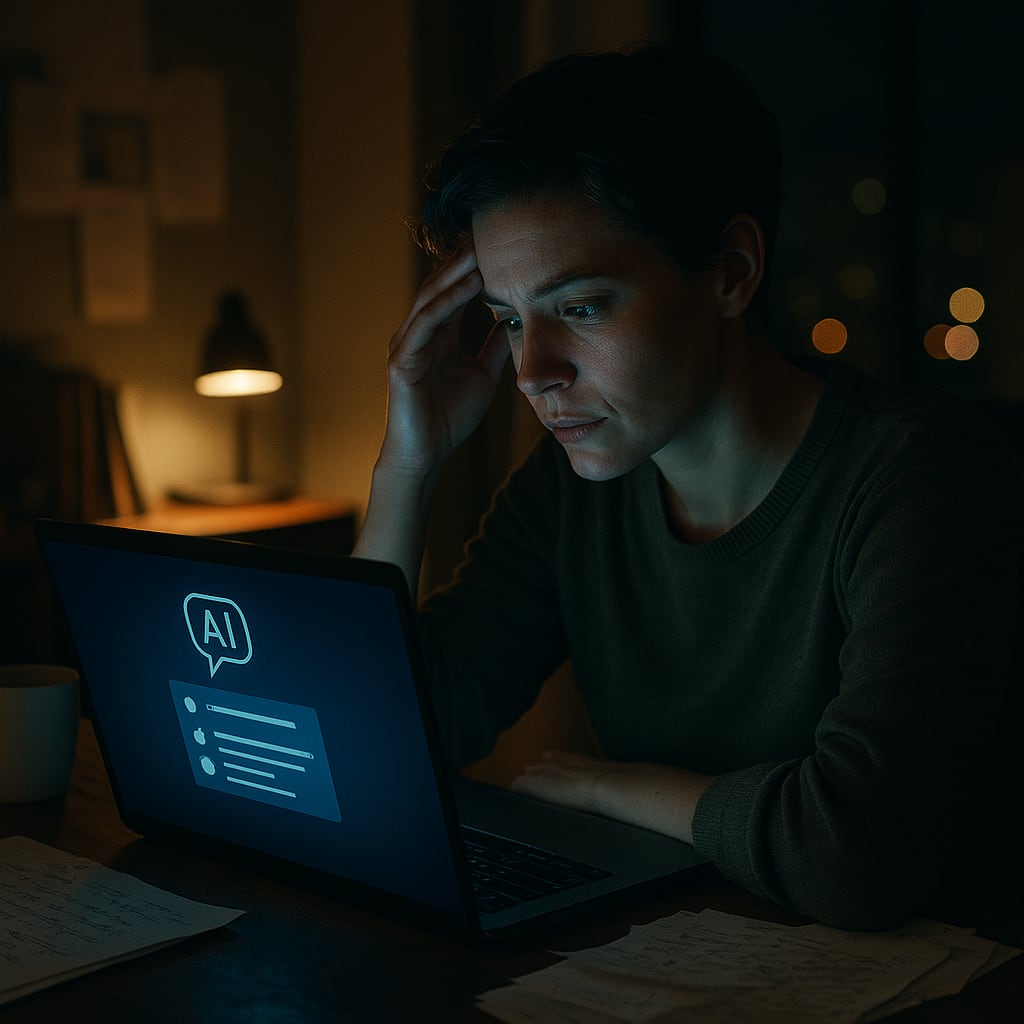
The day my Google Doc turned into a gravestone
The email came on a Thursday, six minutes after I’d finished polishing a client draft.
I remember because the cursor was still blinking on the word “authentic.”
It was a brand story about how humans crave connection in a digital age.
The subject line said: “Restructuring Update.”
That’s corporate for “The life you built is about to stop existing.”
I clicked.
“We’ve decided to transition the majority of our content production to AI-assisted tools…”
Then the phrases: “no longer align,” “role redundancy,” “effective immediately.”
I read it three times before it landed.
The thing I’d been using as a tool—chatbots, AI content generators, all the shiny toys I’d tested out of geeky curiosity—had quietly become the replacement.
I stared at the line about “AI-assisted tools” like it was a new colleague I was supposed to welcome.
Except this colleague didn’t take lunch breaks, didn’t get tired, and didn’t ask for a raise.
My first thought wasn’t noble or philosophical.
It was: “Oh. I just got fired by something that can’t even feel bad about it.”
When your “future-proof” career suddenly expires
I was one of those smug people who thought my job was safe from automation.
I wasn’t flipping burgers or doing data entry. I was a writer and strategist.
I wrote brand voices. Campaign ideas. Human-sounding words.
Every article about “jobs safe from AI” back in 2022 put creative work near the top.
I’d even said it out loud to friends:
“They can’t replace this. Not the weird brain part. Not the intuitive stuff.”
In fairness, I wasn’t completely wrong.
They didn’t replace the intuitive stuff.
They just decided most companies didn’t value the intuitive stuff enough to keep paying for it.
What they wanted was volume, speed, and “good enough.”
Machines are very, very good at “good enough.”
Watching my own skills get automated in real time
The first time a client casually mentioned they were “trying AI for ideation,” my stomach twitched.
No big deal, I told myself.
AI was just a brainstorming buddy. I started playing with it too.
I used it to outline articles, generate headline variations, even to help me avoid repeating the same openers over and over.
It was helpful, like having a junior copywriter who never ran out of ideas.
Then brands started quietly asking for lower rates.
“We’re using AI for drafts,” one said. “We’d love for you to just polish and add your magic.”
My magic now cost 40% less.
Another sent over AI-generated blog posts and said, “Can you humanize this?”
I remember staring at the screen thinking,
So I spent ten years learning how to write, just to become a spell-check with feelings?
The work got cheaper, smaller, less interesting.
And the part I loved—the deep thinking, the blank-page terror, the slow build of a voice—that part was now “optional.”
I didn’t quit.
I did what most of us do: I tried to adapt without admitting how much I was losing.
The grief no one talks about when AI takes your job
There’s this weird shame when a robot makes you obsolete.
If I’d been fired because of budget cuts, I could have told myself: “They’re struggling too.”
If I’d walked away by choice, I could’ve said: “It no longer fits who I am.”
But this?
This was: “We found something cheaper and faster than you, and it doesn’t complain or get stuck or ask questions.”
It wasn’t just money.
It was identity.
I wasn’t just unemployed. I felt… outdated.
Like one of those iPods in a drawer—still technically functional, but no one would choose it on purpose.
That grief didn’t show up as sobbing on the floor.
It showed up as scrolling job boards for hours, reading posts that sounded increasingly similar:
“Must be experienced with AI content tools.”
“AI literacy required.”
“Able to leverage AI to increase content velocity.”
My old job title, “writer,” had quietly grown an extra word: “AI-assisted.”
Soon it felt like my options were:
Compete directly against AI, pretending I could beat it on speed and cost.
Or figure out a way to work with it that didn’t make me hate myself.
I tried option one for exactly two weeks.
It was miserable.
The moment I asked the thing that replaced me for help
One night, out of a mix of spite and desperation, I opened an AI chat window and typed:
“You just took my job. Show me what I can do that you can’t.”
I fully expected some corporate safety answer like:
“As an AI, I’m here to assist humans, not replace them.”
Instead, it spit out a list.
Things like:
“Have lived experience.”
“Build trust in real time.”
“Perceive nuance in other humans’ reactions.”
“Decide what actually matters.”
I rolled my eyes, but something in me loosened.
Then I wrote:
“Help me design a career where you are the intern and I am the boss.”
Was I talking to software? Yes.
Did it feel like something else? Also yes.
It started generating ideas: roles that combined human judgment with AI speed.
Creative director who uses AI as a drafting tool.
Strategist who uses AI to simulate audiences.
Consultant who teaches teams how not to sound like robots when using AI.
Most of the ideas were mid-level boring or impossible.
But two questions it asked me landed hard:
“What parts of your old work felt the most like you?”
“What problems do people still trust humans with?”
I copied those into a notebook.
For the first time since the layoff, I felt less like a victim of “the future” and more like someone standing in a workshop, surrounded by unfamiliar tools.
I had no idea how to use half of them.
But they were still tools, not gods.
Sorting myself into “robot food” and “human-only” work
Over the next month, I did something I wish I’d done years earlier.
I made two lists.
On the left: work I’d done that could easily be automated.
On the right: work that was messy, human, hard to scale.
Robot food:
– SEO blog posts on generic topics
– Product descriptions
– “Top 10” listicles
– Routine email sequences
– Social captions for campaigns no one cared about
Human-only (for now):
– Deep-dive brand messaging
– One-on-one client workshops
– Naming products and companies
– Sensitive stories (mental health, identity, grief)
– Coaching people who were terrified of writing
Then I added a third list: stuff I’d never been paid for, but loved.
– Helping friends rewrite dating profiles
– Editing people’s “About” pages until they sounded like themselves
– Talking anxious creatives off the ledge when AI headlines freaked them out
That third list felt almost embarrassing.
It didn’t look like a business plan. It looked like personality traits.
But under it all was a question that wouldn’t leave me alone:
If AI is going to eat the easy work anyway, what if I stopped clinging to it and leaned fully into the work that scared it?
Turning the machine into my loud, weird assistant
I decided on a small experiment.
I’d treat AI like a new intern on their first day.
Super fast, very eager, occasionally unhinged.
I set some rules:
– It could handle first drafts, research, and tedious formatting.
– I would handle voice, judgment, what not to say.
– It could suggest ideas, but it didn’t get the final call on anything that touched another human.
I used it to brainstorm workshop outlines.
To draft boring contracts and invoices.
To turn my messy audio notes after a client call into clear bullet points.
When I started offering “AI-safe brand voice” sessions to small business owners, I used it to generate examples of what bad AI output looks like—flat, generic, lifeless copy.
Then I’d show them what happened when a human with taste led the process.
“How can I use AI without sounding like AI wrote it?” one client asked.
That became my quiet thesis:
I wasn’t competing with AI. I was competing with people who used AI badly.
I started positioning myself not as “a writer who also uses AI,” but as a translator between human voice and machine efficiency.
I thought it would be a temporary pivot, a way to pay rent.
It turned into the foundation of an entirely new life.
What building a new life with AI actually looked like
From the outside, it might have looked like I “leaned into the future” and reinvented myself overnight.
From the inside, it felt more like stumbling through a power outage with a flashlight.
Here’s what actually happened, unromantic version:
I raised my rates for high-touch, human-heavy work—brand voice, story coaching, messaging workshops.
At the same time, I stopped saying yes to assignments that could be knocked out in five minutes by a chatbot.
I used AI to:
– Generate 50 headline variations in seconds, so I could spend my energy choosing the one that hit hardest.
– Create rough drafts of sales pages, then rewrite them in my clients’ real voices.
– Build simple systems—onboarding emails, intake forms, follow-ups—that I’d been “meaning to set up” for years.
The surprising part?
Using AI for the parts of the job I secretly resented gave me energy back for the parts I loved.
I had more emotional bandwidth to actually listen to people.
More time to sit with a client’s story and ask the uncomfortable questions:
“Is this really what you want to say?”
“Are you hiding behind brand-speak because you’re scared to be specific?”
The more I did that, the more obvious it became:
The real value wasn’t the words on the page.
It was the space I held with someone while they figured out what they actually meant.
No algorithm in the world wants that job. It’s chaotic, slow, and full of uncertainty.
Which, apparently, is where I belong.
The thing AI can’t steal from you
I used to think my dream job was “getting paid to write.”
What I actually wanted was something scarier and harder to name:
To feel necessary in a world that automates everything.
Losing my job to AI stripped away the illusion that my value lived in deliverables.
It forced me to ask: If they can generate a hundred variations of what I do in seconds, what’s left that is unmistakably mine?
It wasn’t a particular tool.
It wasn’t a platform, or a title.
It was how I notice people.
What I amplify. What I refuse to flatten.
AI didn’t take that.
If anything, the presence of this relentless, efficient machine made those human edges more visible.
I won’t pretend this is tidy.
The anxiety still flares up when I see headlines about the next breakthrough model, the next wave of automation.
I still have days where I wonder if I’m just rearranging deck chairs on a melting iceberg.
But here’s the quiet, unglamorous truth I’ve landed on:
AI didn’t “steal” my dream job so much as it exposed how fragile that dream was.
It pushed me—rudely, without consent—into a version of my work that is more honest:
Less “Look at how much I can produce.”
More “Here’s what only I can see from where I’m standing.”
If AI took your job, read this part twice
If you’ve watched software creep into your job description like an uninvited roommate, you’re not crazy for feeling angry or scared.
You’re not “resistant to change” because you don’t want to be measured against a machine.
What helped me crawl out of that shame spiral wasn’t positive thinking or hustle porn.
It was three very unsexy shifts:
Admitting what was already hollow.
There were parts of my “dream job” that I clung to because they paid the bills, not because they lit me up.
Those were the first bits the machines took. That stung, but it also freed up room.
Deciding to be the one holding the tools—not the one being measured against them.
The moment I stopped treating AI as my competitor and started treating it as my overcaffeinated intern, my brain loosened.
I got to set the rules, even if the world didn’t care about my rules yet.
Doubling down on the work that is still undeniably human.
Listening deeply.
Witnessing people’s stories.
Navigating the weird, embarrassing, vulnerable parts no one wants to feed into a data set.
AI can draft a convincing apology email.
It cannot sit next to you while you decide whether you actually mean the apology.
There’s still a life to be built in that gap.
It might not look like the title you had before.
It might not impress the version of you from five years ago.
But it can be real and alive and necessary in a way that “future-proof” careers rarely are.
AI stole the version of my dream that was easy to outsource.
What’s left, for now, is the part that feels most like me.
If the machines keep getting smarter, I’ll keep asking the same rude question I asked that first night:
“Show me what I can do that you can’t.”
So far, the answer is always some variation of this:
You can sit in the mess with another human and not look away.
As long as that’s true, there’s still a life to build.
Maybe not the one you planned—but possibly the one you were supposed to live.
About the Creator
abualyaanart
I write thoughtful, experience-driven stories about technology, digital life, and how modern tools quietly shape the way we think, work, and live.
I believe good technology should support life
Abualyaanart
Keep reading
More stories from abualyaanart and writers in Humans and other communities.
10 Best Sugar Mommy Dating Sites in 2026 That Actually Work
Finding genuine connections in the modern era has evolved drastically, and for younger men search for mutually rewarding connections with wealthy, mature women, utilizing the best sugar mommy dating sites is absolutely essential in 2026. Gone are the days when such connections were hushed secrets whispered about in exclusive circles; today, these platforms provide a secure, transparent, and highly effective way for successful women to meet ambitious younger men. The digital landscape has adapted to cater specifically to this niche, filtering out the noise of traditional matchmaking to focus purely on relationships defined by clear expectations, mutual respect, and financial or lifestyle enhancement. Whether you are a college student looking for mentorship and support or a young professional desiring the luxurious lifestyle that a successful older woman can provide, the internet now holds the key to unlocking these unique dynamic partnerships.
By Willian James4 days ago in Humans


Comments
There are no comments for this story
Be the first to respond and start the conversation.