
AI and Ethics: Confronting Bias, Privacy Issues, and Control Mechanisms
AI and Ethics

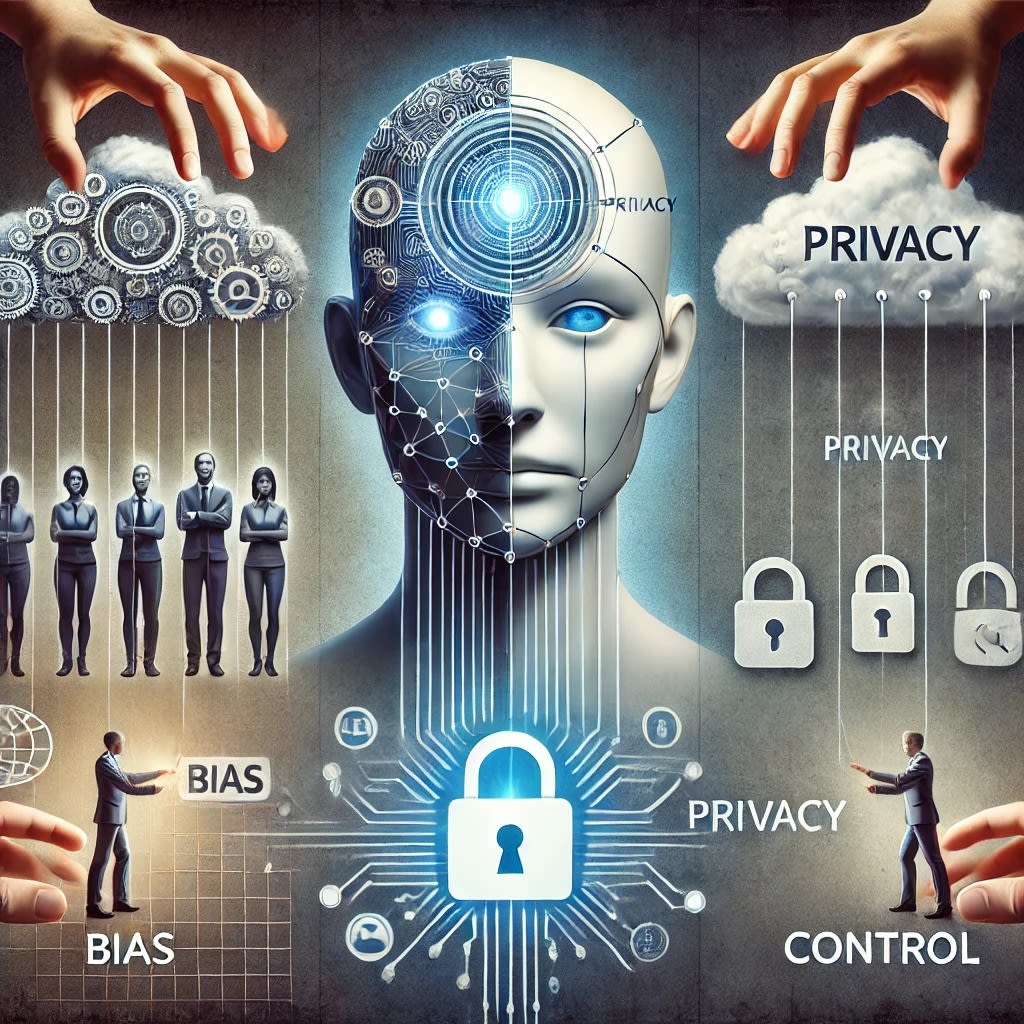
Artificial Intelligence (AI) is transforming industries and reshaping our daily lives. However, with its rapid advancement come significant ethical challenges. Concerns about bias, privacy, and control raise questions about how we should regulate and manage AI systems. Let's explore these dilemmas and their implications in simple terms.
The Problem of Bias in AI
AI systems learn from data. If the data is biased, the AI can also develop biases, leading to unfair outcomes. For instance:
- Job recruitment tools may favor certain demographics over others.
- Facial recognition software may misidentify individuals based on race or gender.
- AI in law enforcement may disproportionately target minority groups.
Bias in AI often stems from historical data reflecting societal inequalities. When AI models are trained on such data, they may unintentionally amplify these biases, causing harm. Developers must ensure diversity in datasets and adopt fairness checks to prevent discrimination.
Privacy Concerns in AI
AI systems collect and analyze massive amounts of data to operate effectively. This data often includes personal information, leading to privacy risks. Examples include:
- Smart devices listening to conversations.
- AI-powered advertising tracking online behavior.
- Facial recognition systems monitoring public spaces.
While AI can improve services, the misuse of personal data can lead to identity theft, surveillance, and loss of privacy. Strict regulations, such as the General Data Protection Regulation (GDPR), aim to protect user privacy. Companies must prioritize data security and transparency to build trust.
Who Controls AI?
Another critical dilemma is control. Who decides how AI systems operate, and who is accountable for their actions? Questions arise, such as:
- Should AI systems be allowed to make decisions without human oversight?
- Who is responsible when AI makes a mistake?
- How do we ensure AI aligns with human values?
Without proper oversight, AI systems could become unpredictable or be misused. Governments, organizations, and researchers need to establish clear guidelines to regulate AI development and usage. Ethical frameworks must prioritize accountability and human oversight.
Striking a Balance
AI offers incredible benefits, from improving healthcare to making transportation safer. However, ethical considerations must guide its development. Developers and policymakers should:
- Implement fairness audits to detect and address biases.
- Strengthen data protection laws to safeguard privacy.
- Ensure transparency in AI decision-making.
- Promote collaboration between governments, researchers, and tech companies.
Ensuring Human Oversight and Control
Determining who controls AI systems and holds accountability for their actions is a complex ethical issue:
Decision Autonomy:
Allowing AI to make decisions without human oversight can lead to unintended consequences, especially in critical areas like healthcare or criminal justice.
HARVARD NEWS
Accountability:
Establishing responsibility when AI systems err is challenging, necessitating clear guidelines and ethical frameworks.
Alignment with Human Values:
Ensuring AI systems operate in ways that reflect societal norms and values requires continuous monitoring and regulation.
Implementing robust oversight mechanisms and fostering collaboration among stakeholders can help maintain control over AI systems.
Balancing Innovation with Ethical Responsibility
While AI offers substantial benefits, addressing its ethical challenges is imperative:
Fairness Audits:
Regular assessments can help detect and rectify biases in AI systems.
Data Protection:
Strengthening laws and practices to protect user data builds trust and ensures compliance with ethical standards.
Transparency:
Open communication about AI decision-making processes enhances accountability and user confidence.
Collaborative Governance:
Engaging governments, researchers, and tech companies in dialogue promotes the development of balanced and effective AI regulations.
By integrating ethical considerations into AI development, we can harness its potential while minimizing risks, ensuring that AI technologies serve the broader interests of society.
Final Thoughts
AI’s potential is undeniable, but ethical dilemmas surrounding bias, privacy, and control cannot be ignored. As AI continues to evolve, addressing these challenges is essential to build trust and ensure fairness. By balancing innovation with ethics, we can create AI systems that work for everyone.
What are your thoughts on AI ethics? Share your views in the comments below.
About the Creator
Ayesha Rasheed Rajpoot
Video Editor & Content Creator || Expert in Web Content & Blog Posts || SEO Specialist || Social Media & YouTube Management || Handling Social Media Profile & Pages
Keep reading
More stories from Ayesha Rasheed Rajpoot and writers in Humans and other communities.
AI in Everyday Life: From Siri to Self-Driving Cars
Artificial Intelligence (AI) is no longer a futuristic concept. It has already become an essential part of our daily lives. From talking to virtual assistants like Siri and Alexa to experiencing the innovation of self-driving cars, AI is transforming how we live, work, and interact with technology. But what exactly is AI, and how does it impact our routines? Let us explore AI in simple terms and see how it is making life smarter and easier.
By Ayesha Rasheed Rajpootabout a year ago in Humans
The CEO of Everything
They say "jack of all trades, master of none," but they forgot to mention the part where the jack of all trades is also the camera woman, the makeup artist, and the person currently yelling at a tangled Wii microphone cable in a her own bathroom while recording herself singing and trying to make it look realistic and professional. (As professional as you can make it with nothing but a cell phone camera and a mic that doesn't work)
By Sara Wilson4 days ago in Humans
Shadow of the Crown
In the heart of the ancient kingdom of Eldoria, where golden spires kissed the clouds and rivers shimmered like molten silver, there lived a dog named Arion. Unlike ordinary dogs, Arion was no mere pet; he was the companion of the royal family, a silent witness to their triumphs, tragedies, and secrets. His coat was a deep, glossy black that reflected the sunlight like polished onyx, and his eyes, a piercing amber, seemed to understand every whispered word and unspoken emotion of those around him. Arion had been born in the royal kennels, a litter of five pups, but even as a young puppy, he showed signs of extraordinary intelligence and loyalty. While the other pups played and tumbled, Arion would sit quietly near the throne room, listening intently to the council meetings and royal discussions. The courtiers joked that he was born to serve the crown, not just the family, and as he grew, this joke turned into truth. The king, a stern yet fair man named King Alaric, noticed Arion’s unique nature. Unlike the other dogs, Arion would sit by his side during state matters, resting his head on the king’s knee during long discussions and accompanying him through the castle corridors with a sense of purpose. Over time, Arion became more than a companion; he became a guardian, a confidant, and a symbol of loyalty that transcended words. It was during the Festival of the Silver Moon that Arion’s loyalty would be tested like never before. Eldoria had long been a peaceful kingdom, but whispers of unrest had begun to echo from the northern borders, where a rival lord, Lord Malric, coveted the throne. He was cunning and ruthless, and many feared that he would strike during the festival, when the city would be crowded with nobles and merchants. King Alaric, aware of the threat, had fortified the palace and strengthened the guards, yet he could not shake a growing unease. Arion sensed it too. On the eve of the festival, the dog patrolled the palace halls tirelessly, sniffing for danger, his tail low and tense, his ears twitching at every unfamiliar sound. That night, Arion had a vision of what could come—a shadow creeping through the halls, a dagger glinting under the torchlight, a scream swallowed by silence. When the festival began, Eldoria’s streets were alive with music, laughter, and the scent of roasted meats and sweet pastries. The nobles danced, children played, and the king presided from the balcony of the royal palace, smiling and waving to his people. Arion, however, remained ever watchful. He slipped through the corridors, his paws silent against the marble floors, his eyes scanning for the slightest hint of danger. It was then that Arion noticed him—a cloaked figure moving with unnatural stealth among the servants. The dog’s hackles rose as the figure approached the throne room. Without hesitation, Arion leapt from the shadows, his growl deep and threatening. The would-be assassin stumbled, surprised by the sudden attack. Arion’s teeth clamped gently, yet firmly, on the cloak, pulling the intruder back from the throne. The king, alerted by the commotion, rushed forward, and the guards quickly restrained the intruder. It was Lord Malric’s most trusted assassin, sent to kill the king and plunge Eldoria into chaos. King Alaric knelt beside Arion, patting his loyal companion’s head. “You have saved Eldoria,” he said, his voice thick with gratitude. “And you have saved me, old friend. No reward could ever match your loyalty.” But Arion’s trials were far from over. That same night, under the cover of darkness, a group of Malric’s soldiers infiltrated the palace. Their goal was simple: kidnap the heir, Princess Liora, and use her as leverage against the king. Arion, sensing danger even before the soldiers reached the princess’s chamber, intercepted them in the long, torch-lit corridor. The battle that followed was one of cunning and courage. Arion was outnumbered, yet he moved with precision, barking loudly to alert the palace guards while fending off the attackers with swift, calculated bites and relentless determination. The soldiers, unprepared for the dog’s ferocity and intelligence, were soon overwhelmed. Arion had managed to protect the princess until reinforcements arrived. Princess Liora, though frightened, knelt beside him, stroking his head. “You are more than a dog,” she whispered. “You are the heart of Eldoria.” From that day on, Arion was no longer seen merely as the royal dog; he became the kingdom’s silent guardian, the protector of the throne, and the symbol of unwavering loyalty. Years passed, and Arion grew older, his movements slower but his spirit undimmed. King Alaric aged, too, and eventually, it was Princess Liora who ascended the throne. Yet Arion remained by her side, guiding her through the challenges of leadership, comforting her during times of doubt, and warning her of dangers before they arrived. Tales of the royal dog spread far and wide, inspiring songs, poems, and paintings, each depicting the black-coated guardian with amber eyes, standing resolutely by the throne. One fateful winter, the kingdom faced its greatest threat: a devastating fire that swept through the castle’s northern wing. Arion, despite his age, ran into the flames, rescuing trapped servants and guiding them to safety, refusing to leave until the last soul was accounted for. By the time the fire was extinguished, Arion was found lying near the royal chambers, exhausted but alive, his coat scorched and his eyes weary yet proud. King Alaric and Queen Liora, tears in their eyes, embraced the dog who had given so much for the kingdom. “You are the soul of Eldoria,” the king said. “And your legacy will never fade.” In honor of his bravery, a statue of Arion was erected in the palace courtyard—a black dog with amber eyes, forever watching over the kingdom. Even in death, Arion’s influence remained. Generations of rulers would come and go, but the story of the royal dog of Eldoria endured. The people spoke of his courage, his intelligence, and his unbreakable loyalty, teaching their children that true nobility was not only in blood and crown but in heart and devotion. And so, Arion’s shadow lingered over the kingdom, not as a ghost of fear, but as a beacon of hope and protection. In every loyal dog, in every act of bravery, in every quiet moment of guardianship, the spirit of Arion lived on—a reminder that sometimes, the most extraordinary heroes wear no crown, speak no words, and serve with a heart that knows no bounds.
By The best writer 2 days ago in Humans


Comments
There are no comments for this story
Be the first to respond and start the conversation.