
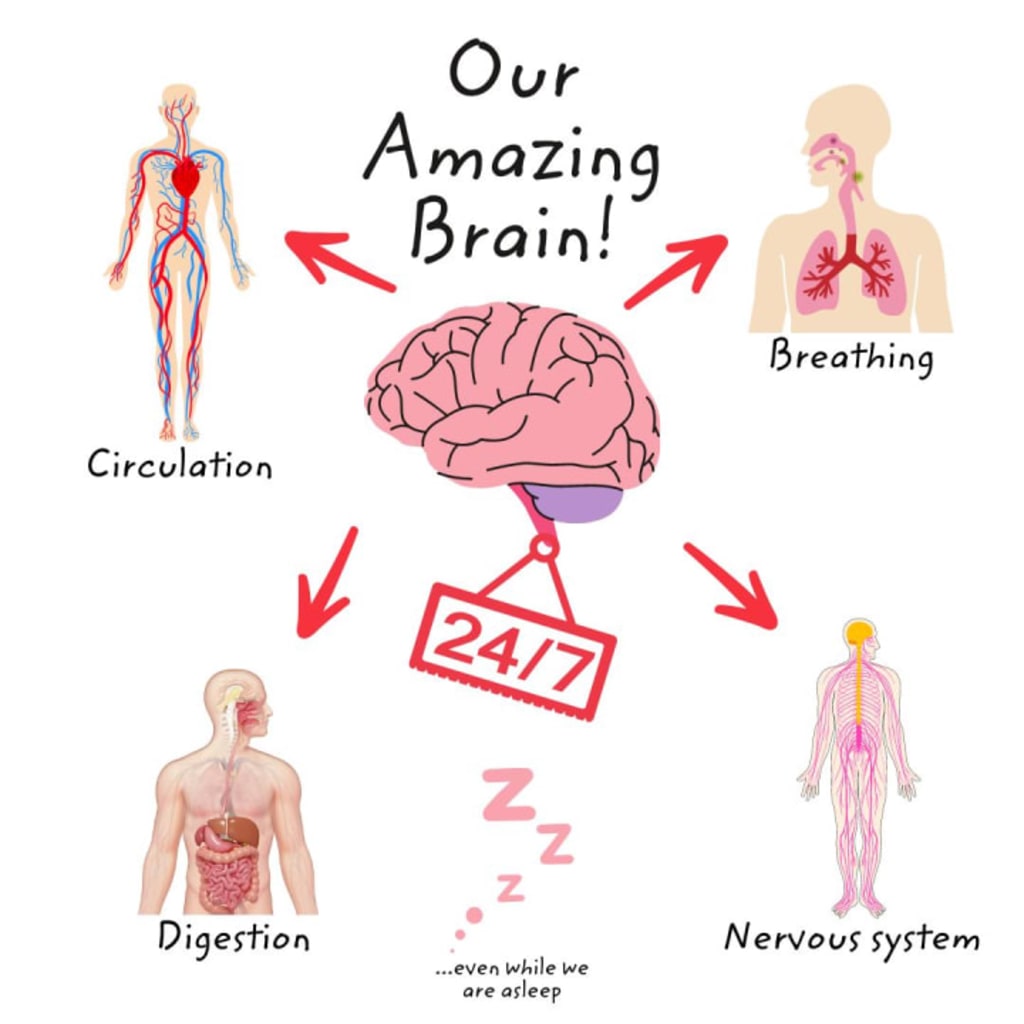
Brains are one of the most misunderstood body parts. And a lot of the brain facts you grew up hearing about are wrong. Your brain is always busy, and most of its work is unnoticed and unappreciated: breathing, digesting, and stuff like that. None of this would happen without your brain. Now, some areas of your brain are more active at any one time than others, but unless we have brain damage, no one part of your brain is just absolutely never working. And what about the idea that brain damage is always permanent? That's false. There are different types of brain damage, and they are not created equal. Your brain can recover from a minor injury, like a concussion, pretty well. Most people who experience a mild brain injury do not end up with a permanent disability. Severe brain damage can be irreversible, but your brain is an incredibly resilient fighter, and it can circumvent damaged neurons by building new pathways. Areas of the brain can learn new functions, too. And speaking of functions, alcohol has not been proven to kill brain cells, and that is great news, you know, for some of us. No brain cells were harmed in the making of your last drinking binge. Alcohol can, however, damage dendrites, resulting in problems as your neurons try to talk to each other. And this damage is mostly reversible.
Listening to Mozart will not make your child a genius, despite the popular belief dating back to the 1950s and popularized in the 90s. Psychologist Gordon Shaw conducted a study where he played Mozart for 36 students before an IQ test, suggesting improvement. However, no one has been able to replicate those results. While music can enhance certain abilities, simply hearing it is not enough. Therefore, listen to Mozart for enjoyment rather than expecting genius-level results. Subliminal messages are also ineffective for learning. In 1957, James Vicary claimed to have inserted snack-related messages into a film, resulting in increased sales. However, he was lying about the results and coined the term "subliminal message." Despite these debunked myths, we continue to discover fascinating facts about the brain, such as Transcranial Direct Current Stimulation (TDCS), which involves stimulating the brain for improved performance.
It is a myth that everyone loses the ability to recall information as they age. Not all adults will experience difficulty remembering information as they get older. Additionally, adults often improve certain aspects of their memory, such as visual and spatial memory, as they age. While short-term memory may be more commonly affected, it is important to consider the increased responsibilities that come with age, such as caring for children, grandchildren, and work obligations. Occasionally forgetting something is natural and does not necessarily indicate a serious issue.
It is commonly believed that brain plasticity decreases as we age. However, like a muscle, the brain requires regular exercise to maintain its strength and agility. When we challenge our brains by learning new things or approaching tasks in different ways, we can actually increase its plasticity, even though it may not remain as high as it was in our younger years. To enhance brain plasticity, engage in activities like playing tennis and other sports. These activities can boost your brain's coordination and strategic thinking. Another option is to solve Sudoku or other puzzles which can strengthen verbal skills, memory, and repetition. You can also use math and memory-focused apps to stimulate your brain's adaptability and the development of new neural pathways.
And last but not least, Women’s brains do not work the same way as men’s brains. We often hear that men and women do not think the same way. And that is one myth that is false: since all brains are made the same way, women and men think the same way. Women can be as good at maths as men, for example, it is just a question of how the brain is used by everyone.
About the Creator
Keep reading
More stories from Jennifer B.C. and writers in Humans and other communities.
The Best Way To Read A Book
There are three formats to consider when reading books: physical books, ebooks, and audiobooks. All three formats can be viable for reading, depending on the individual's preferences and the purpose of reading. It is important to examine the purpose for which we read, as there are four main reasons why we pick up a book. The first is for relaxation and escapism, simply to enjoy reading. Another reason is to expand our knowledge and learn about various topics. Additionally, we may read to understand a specific subject deeply. Lastly, reading for reference and research is done when we need to extract information from a book to apply it to our own endeavors. The best format for reading depends on personal preference. The advantages of each format are slight. The format that you enjoy and will stick to is the best overall routine. For reading for escapism and fun, physical books are generally considered the best format. Research suggests that people who read physical books are better able to remember the order of events in a story. The tactile sensations of turning pages and remembering where you were in the book may contribute to better memory. Ebooks, especially when read on tablets, can be distracting with access to additional information and activities. Audiobooks can also be enjoyable for fun reading. When I'm doing things like riding my bike walking to work or doing chores around the house, I typically listen to audiobooks. During these activities, I am somewhat distracted and may not pay full attention to the entire story. For example, I might have to navigate a road crossing and miss some parts of the story. Regarding escapism-style reading, paper books are better because they allow for complete immersion. Now, let's consider widening your knowledge base. Being a T-shaped person means having deep expertise in one area and also reading to expand knowledge across various topics. Audiobooks have a slight advantage over other forms of media for expanding knowledge. The need for complete immersion is less important in this context. I, personally, prefer audiobooks because they allow me to multitask. Throughout the day, I can listen to podcasts or music, but I can also choose to listen to an audiobook and gain shallow yet interesting knowledge on a topic. For instance, during my lunch break at work, I listened to Bill Bryson's book on the human body. I don't require an in-depth understanding; I simply want to learn for the sake of learning. Audiobooks are perfect for this purpose. However, when it comes to learning in general, there isn't a significant advantage of ebooks or physical books. Ebooks have certain advantages over physical books. One advantage is the ease of obtaining them on a whim, especially through library programs. Ebooks are particularly useful for research and reference purposes, as they allow for easy searchability. Highlighting and taking notes is also simpler with ebooks, as they can be easily accessed and collected in a centralized location. Some apps, like Readwise, even allow for exporting highlights to other platforms for further organization. Personally, I use Readwise to transfer my Kindle book highlights to my Notion database. I can add notes and use synced blocks to bring highlights and passages into my research area. There is a Readwise app for mobile devices that allows you to take a picture of a printed page and create a highlight. However, this process is slower and more cumbersome compared to creating a quick highlight in the Kindle app. Lastly, reading for deep understanding involves building a vertical bar of knowledge on a specific topic, as opposed to a horizontal breadth of understanding. Paper books have an advantage over ebooks when it comes to maintaining focus and avoiding distractions. This is especially true when reading for deep understanding rather than conducting research. Recently, a friend gave me the ebook version of Alex Hormozi's "$100M Offers." In the first chapter, Hormozi mentions a trick he uses where he listens to the audiobook while following along in the print or ebook version. He claims that this helps him read faster and pay attention to the ebook for longer periods of time. However, it's important to note that this method may not actually increase reading speed objectively. Ebooks are typically narrated at an average speed of 150 words per minute. Skilled readers, on the other hand, can read silently at a speed of 200 to 400 words per minute without losing comprehension. Reading an ebook at a faster speed, like 2x, may not be pleasant. Therefore, reading an ebook may actually be slower compared to silent reading. However, ebooks have an advantage over print books in terms of accessibility. They allow for easy adjustments to font size and dark mode. Ultimately, the best format for reading is the one that is most accessible and enjoyable for the reader. The format of the books is not the most important factor in developing a reading habit. Building a reading habit can be challenging but achievable. One effective tactic is a 90-day reading challenge, where progress is tracked and accountability is established. There are other tricks and strategies for building long-term habits, such as taking a habit-building class. If you have a habit you want to build or have been trying to build without success, and you want effective strategies to make it stick, this class will be beneficial. I have personally taken this class and believe it would be enjoyable for other readers as well.
By Jennifer B.C.2 years ago in BookClub
Lifestyle Solutions To Manage Stress And Balance Career With Love
Contemporary professions tend to be time consuming, high performance and 24/7 jobs. Although ambition and professional development matters a lot, these strains have a tendency to overflow into personal relationships. Work stress can result in irritability, emotional distance, or lack of attention to a partner. This imbalance may dissolve emotional bond between two individuals over the course of time. The knowledge about the impact of career stress on relationships is the initial step to establishing a healthier balance between professional life and romantic relationships.
By Robert Smith7 days ago in Humans



Comments
There are no comments for this story
Be the first to respond and start the conversation.