
A Symphony of Love and DISCORD: The Gustav Mahler and Alma Schindler Relationship
Meet Gustav Mahler and Alma Schindler, a couple whose love story reads like an opera—complete with soaring highs, tragic lows, and enough drama to fill a Wagnerian overture.


Behind every great composer, there’s often a tale of passion, heartbreak, and the occasional creative clash. Meet Gustav Mahler and Alma Schindler, a couple whose love story reads like an opera—complete with soaring highs, tragic lows, and enough drama to fill a Wagnerian overture. Their relationship was a whirlwind of genius, ambition, and personal sacrifice, leaving an indelible mark on the world of music and art.
Let’s dive into this melodious yet turbulent partnership, where love met art, egos collided, and a legacy was born.
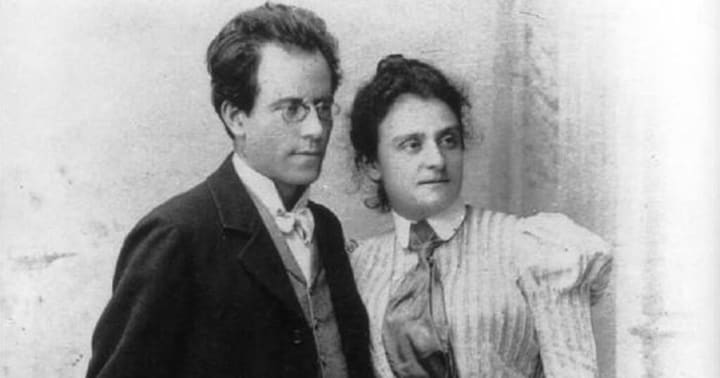
Act I: The Meeting of Minds (and Melodies)
When Gustav Mahler met Alma Schindler in 1901, it was a collision of two extraordinary worlds. Alma was the stunning, witty daughter of a renowned Viennese artist, a talented composer in her own right, and a woman who could charm anyone in a room. Gustav, on the other hand, was already a towering figure in the world of music—a conductor and composer whose symphonies were reshaping classical music.
Alma was immediately captivated by Mahler’s genius and intensity. Mahler, 19 years her senior, was equally struck by Alma’s beauty, intellect, and artistic potential. Their romance blossomed quickly, and in December of that same year, they were engaged.
But this wasn’t your typical love story. From the beginning, their relationship was steeped in complexity—and compromise.
Act II: The Marriage Contract
In a move that could rival the most audacious plot twist in opera, Mahler presented Alma with a written ultimatum before their marriage. He demanded that she abandon her own musical ambitions to devote herself entirely to supporting his work. In Mahler’s words, there could be no “competition” between them.
For Alma, this was a gut-wrenching decision. She was a gifted composer, with pieces admired by the likes of Alexander von Zemlinsky. But in a society where women’s creative pursuits were often dismissed, and under the shadow of Mahler’s towering reputation, Alma agreed to his terms.
Their marriage in 1902 marked the beginning of a partnership that was equal parts inspiring and stifling. Alma became Gustav’s muse, managing his personal affairs, proofreading his scores, and offering feedback on his work. But the creative flame she had nurtured within herself was dimmed—a sacrifice she would come to resent deeply.
Act III: Love, Loss, and Mahler’s Music
Despite the sacrifices, their marriage wasn’t devoid of affection. Alma inspired Mahler’s Symphony No. 5, particularly the tender Adagietto, widely interpreted as a love letter to her. This piece remains one of Mahler’s most celebrated works—a hauntingly beautiful testament to the depth of his feelings for Alma.
Gustav Mahler - Adagietto | Leonard Bernstein (4K)
But their marriage was far from harmonious. Mahler’s obsession with his work, combined with his perfectionist nature, left Alma feeling neglected and unfulfilled. The cracks in their relationship deepened in 1907 when tragedy struck: the death of their eldest daughter, Maria, at just four years old, followed by Mahler’s diagnosis of a severe heart condition.
Grief and illness pushed Mahler into an even deeper focus on his music, leaving Alma to navigate her own pain largely alone.
Gustav Mahler - a biography: his life and his places (Documentary)
Act IV: Alma Finds Her Voice
By 1910, Alma’s dissatisfaction reached a crescendo. She began an affair with Walter Gropius, a young architect who would later found the Bauhaus movement. The affair shattered Mahler, forcing him to confront the fragility of their relationship.
In a desperate bid to save their marriage, Mahler sought the counsel of Sigmund Freud. Yes, that Freud. During a now-famous session in Leiden, Freud reportedly helped Mahler understand Alma’s frustrations and the need to appreciate her individuality.
The couple reconciled, but their renewed bond was tragically short-lived. In 1911, Mahler passed away at the age of 50, leaving Alma widowed at just 31.
Act V: Alma’s Second Act
After Mahler’s death, Alma returned to her own creative pursuits and became a central figure in the cultural world of early 20th-century Europe. She married Walter Gropius in 1915, divorced him in 1920, and later married novelist Franz Werfel. Alma’s love life was as eventful as her artistic career, earning her the nickname “the muse of the modernists.”
Despite her many relationships, Alma remained fiercely protective of Mahler’s legacy. She played a pivotal role in championing his music, editing his scores, and ensuring his symphonies achieved the recognition they deserved.
Legacy of a Complex Love
The relationship between Gustav Mahler and Alma Schindler was as layered as a symphony—filled with moments of beauty, dissonance, and resolution. While Mahler’s brilliance often overshadowed Alma’s talents, her influence on his work is undeniable. Likewise, Mahler’s support—flawed though it was—shaped Alma’s trajectory, even as it limited her.
Their story is a reminder that even the most brilliant partnerships come with challenges, and that love, like music, is often a blend of harmony and discord.
In the end, their relationship wasn’t just about two people—it was about art, sacrifice, and the enduring legacy they left behind. As Gustav Mahler once said, “What is best in music is not to be found in the notes.” The same could be said of their love: its most profound moments lived not in words or deeds but in the passion and creativity it inspired.
About the Creator
Keep reading
More stories from Marveline Merab and writers in Humans and other communities.
REBEL Queen: The Untold Love Story of Princess Pingyang and Emperor Taizong
Forget roses and candlelit dinners—some love stories involve revolutions, battle cries, and the founding of entire dynasties. The tale of Princess Pingyang and Li Shimin, one of China’s most legendary couples, is as dramatic as a palace intrigue novel. Set during the birth of the Tang Dynasty, their partnership wasn’t just about romance—it was a meeting of two brilliant minds that would change the course of history.
By Marveline Merababout a year ago in Humans
OpenAI CFO Announces Annualized Revenue Surpasses $20 Billion in 2025
In a landmark announcement that has reverberated throughout the global tech industry, OpenAI’s Chief Financial Officer revealed that the company has achieved annualized revenue surpassing $20 billion in 2025. This milestone not only marks a dramatic rise in OpenAI’s financial performance but also signals a broader shift in how artificial intelligence is driving economic growth, industry transformation, and innovation worldwide.
By Aarif Lashariabout 6 hours ago in Humans




Comments
There are no comments for this story
Be the first to respond and start the conversation.