
"A Name on an Empty Chair"
Echoes of Loss, Memory, and the Spaces We Leave Behind"
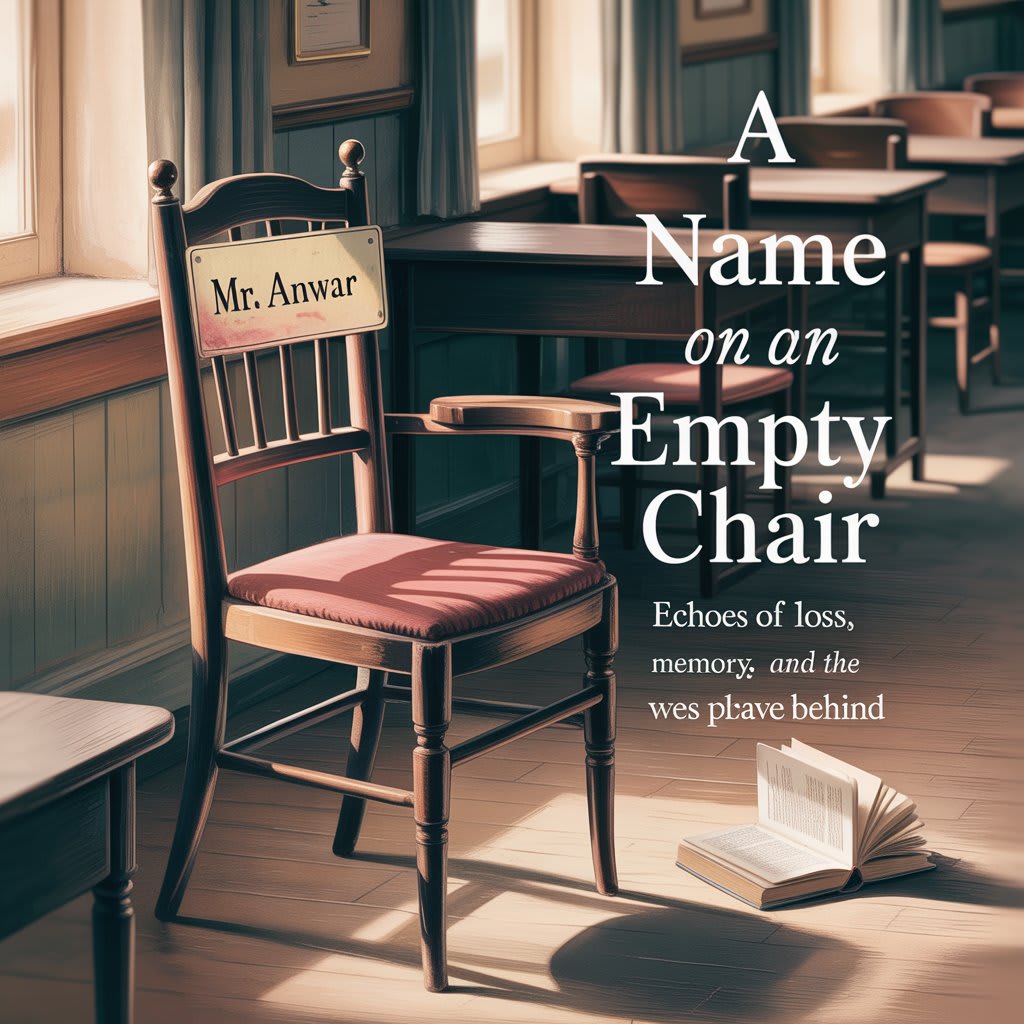
Every morning at 7:45, before the school bell rang, the staffroom buzzed with the usual clinks of teacups, the rustle of lesson plans, and soft chatter of weary teachers preparing for the day. But there was always one chair that remained untouched—a plain wooden chair with a faded red cushion, tucked neatly in the corner, beside the coat rack.
Pinned to the backrest was a laminated card that simply read:
“Mr. Anwar”
No one sat in Mr. Anwar’s chair. No one dared to move it. And no one had replaced the name tag in over four years.
To the newer staff, it was a curiosity. To the students, a mystery. To the senior teachers, it was sacred.
Miss Zoya, a young literature teacher fresh from university, noticed the chair on her first week. It was her first real job, her dream to teach poetry and prose in the very school she had once attended as a student. She remembered Mr. Anwar, albeit vaguely. He taught history—an older man with silver-streaked hair, kind eyes, and a voice that commanded respect without effort. But that was years ago. She remembered, more than anything, the way he listened.
One rainy afternoon, as thunder echoed through the halls and students hurried home, Zoya lingered behind in the staffroom, watching the chair. Curiosity gnawed at her. She turned to Mr. Kaleem, the veteran science teacher and one of the oldest staff members.
“Sir… can I ask something? Why does no one use Mr. Anwar’s chair?”
Kaleem smiled gently, as though expecting the question.
“Because some spaces aren’t meant to be filled,” he said, sipping his tea. “They hold stories. And Mr. Anwar’s story still echoes here.”
Zoya sat beside him, intrigued. “What happened to him?”
Kaleem paused. “He didn’t die, if that’s what you’re thinking. He left.”
“But why keep the chair?”
Kaleem set down his cup and leaned back. “Let me tell you something that wasn’t in your textbooks.”
---
Mr. Anwar wasn’t just a history teacher. He lived history. A refugee child from a war-torn land, he had grown up believing that education was the only weapon against hate. His lessons were legendary—he didn’t just teach dates and revolutions; he made students feel the weight of a soldier’s letter, the fear behind a dictator’s speech, the silence after a gunshot in the name of peace.
But more than that, he listened.
He once sat for two hours after school with a boy whose parents were divorcing, just listening. He convinced a dropout to come back to class. He helped a single mother’s son apply for scholarships, even paying his exam fees quietly. His chair wasn’t just a seat—it was a sanctuary for the troubled, a post for the patient, and a pulpit for the wise.
Then one day, he left.
The war in his homeland had reignited. Mr. Anwar took a sabbatical to aid refugee children in makeshift schools across the border. “Just for a year,” he had said. But the year became two, then four. Letters came for a while, filled with stories of courage and suffering, of teaching under trees and building hope from rubble. Then the letters stopped. No one heard from him again.
The staff tried reaching out, but the trails had grown cold. Rumors ranged from martyrdom to quiet retirement. Yet no one dared remove his chair.
“It reminds us,” Kaleem said softly, “that teaching is more than curriculum. It's presence. It's care. It’s sacrifice.”
Zoya looked at the chair with new eyes. It wasn’t just a memorial. It was a message.
---
Months passed.
Zoya made it a habit to sit near the chair during breaks, grading essays or sipping coffee. Occasionally, she’d share stories with students about the man behind the name. Her classroom slowly transformed—not just in decor, but in tone. She listened more, stayed late for troubled students, and began leaving anonymous notes of encouragement in lockers, just like Mr. Anwar had.
One winter morning, as snowflakes dusted the school grounds, a letter arrived. Addressed simply to “The Staff of Crescent High School,” it was yellowed with time, but unmistakably in Mr. Anwar’s handwriting.
It read:
> “If you’re reading this, it means I’ve not returned as planned. Know this: teaching here was the honor of my life. The chair—keep it, not for me, but for what it stands for. Let it remind every teacher who walks in that their job isn’t to fill minds, but to hold hearts.
With love,
Mr. Anwar”
There was silence in the room that day. Not sadness. Reverence.
---
Today, new teachers still ask about the empty chair. And someone always tells the story. Not just about a man who taught history, but one who made history—quietly, daily, with nothing but chalk, patience, and a heart that believed one kind word could change a life.
Because sometimes, a name on an empty chair is louder than a voice in a crowded room.
---
End.
About the Creator
Keep reading
More stories from Wasif islam and writers in Humans and other communities.
The Silence Between Us: A Story of Love, Loss, and Letting Go
Silence can be comforting, terrifying, or even louder than words. Between two people who once loved each other deeply, silence can say everything that words fail to. It lingers in the spaces once filled with laughter, arguments, whispers, and dreams. “The Silence Between Us” is not just the absence of sound—it's the story of a relationship that once thrived, slowly unraveling in the quiet.
By Wasif islam8 months ago in Humans
System Failure
The email arrived at 2:14 AM. I know the time because I wasn't sleeping. I was refreshing. There is a specific kind of insomnia that comes when you are waiting for a system to decide your future. You wake up at odd hours. You check the phone. You check the spam folder. You check the junk.
By Edward Smithabout 8 hours ago in Humans
Belle of the Bayou
Bad move, cher. Not just the slip of her kitten heel on the rainy February cobblestones in the Fourth Ward. She got caught snooping. Detective Deleon clucked and strutted like a rooster in his rush to clear her from the scene, waving cigar smoke to and fro as he gesticulated amid the thick air of the speak easy. An experienced crime reporter, Marie knew better than to let the coppers catch her on the wrong side of the line, but curiosity had gotten the better of her.
By Maia Gadwall the metAlchemist6 days ago in Fiction




Comments
There are no comments for this story
Be the first to respond and start the conversation.