
A Mosaic Among the Ruins of Conflict and War
Syria’s Largest Archaeological Discovery in Over a Decade Unveils an Ancient Depiction of the Trojan War.

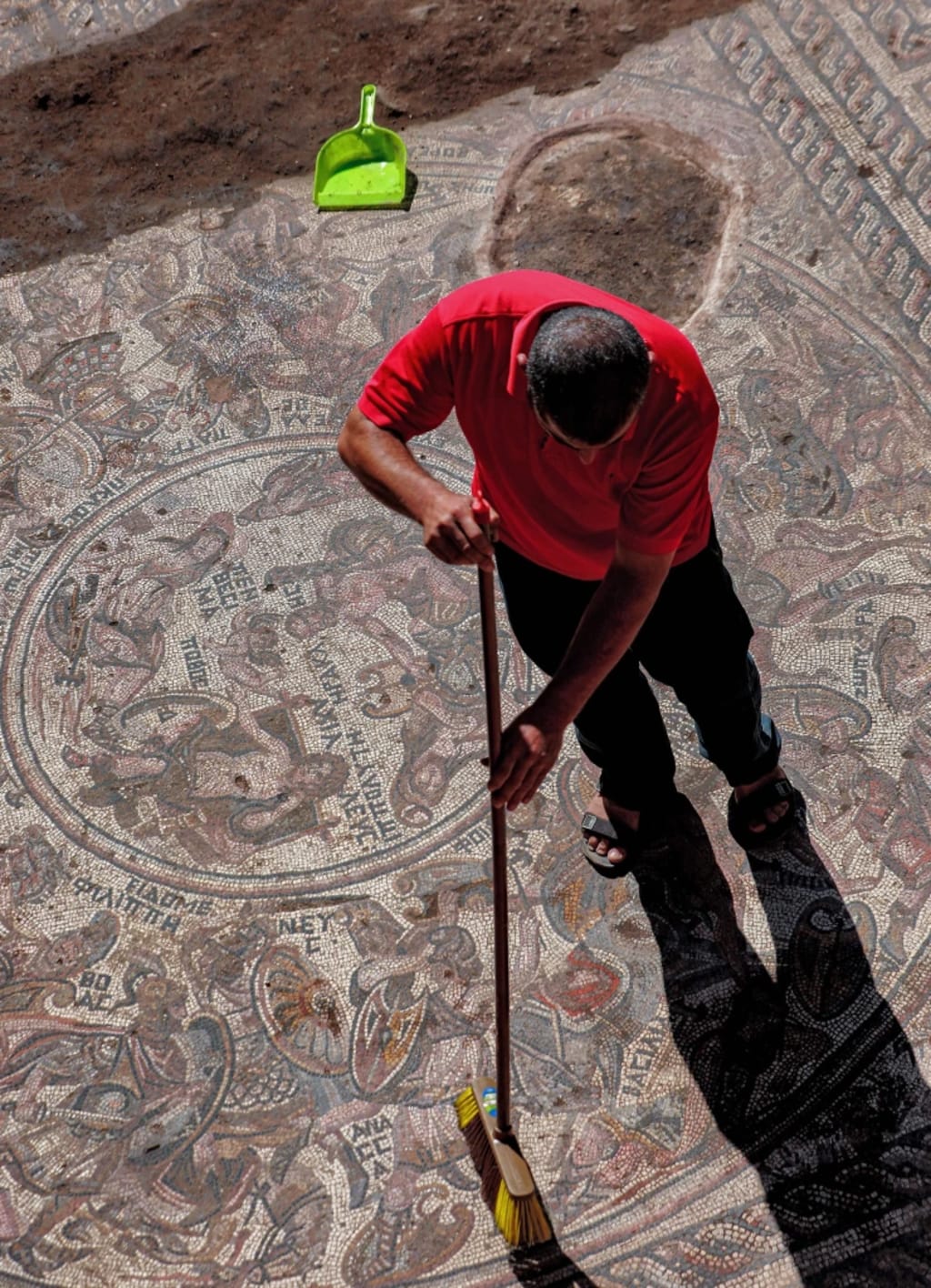
Syria has revealed the discovery of a stunning 1,300-square-foot Roman mosaic—the country’s most significant archaeological find since the outbreak of civil war in 2011. Unearthed in the town of Rastan, a city that was under rebel control until 2018, the mosaic offers a rare glimpse into the region’s rich cultural heritage amid the devastation of war.
Important cultural heritage sites have been destroyed around the nation during the past 11 years, and the Islamic State destroyed Palmyra's antique art after the city was besieged in 201. The Islamic State and other factions engaged in widespread antiquities looting throughout the Syrian civil war, and some of those artefacts have since been sold all over the world. Despite the attempt to sell the mosaic, it was protected by the locals and by archaeologists like Dr. Humam Saad.
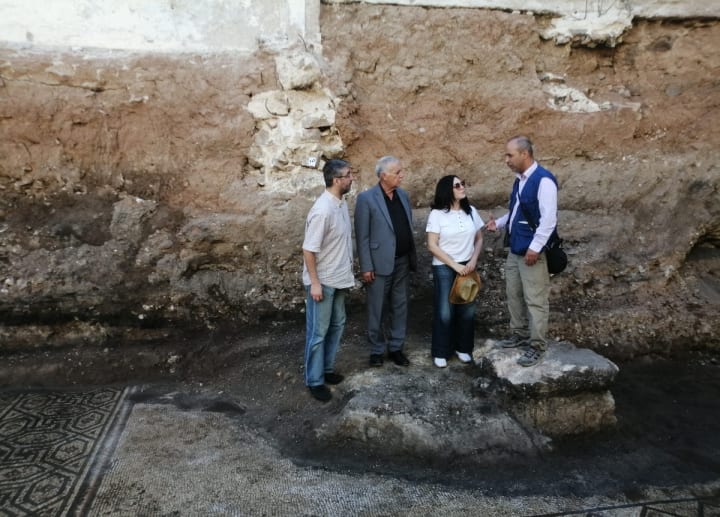
A Forgotten Masterpiece Rediscovered
The mosaic was displayed to journalists in the central town of Rastan, which is close to Homs, Syria's third-largest city.
Mistakenly, the Associated Press, along with other news organisations that the discovery was depicting the Roman god Neptune and his 40 mistresses, and Hercules killing the queen of the Amazons, Hippolyta. It actually depicts the scenes of the story of the Trojan War, when the Amazons, came to Troy to defend the city against the Greeks. Amazons were the legendary fierce women warriors, with their leader Hyppolita killed by Hercules. Poseidon or Neptune, the same god, with different names, the first one Greek name and the other one Roman. Is not depicted at all in the mosaic, we can only see some of Neptune's like Galatia. Nevertheless, the description of the mosaic and its characters Neptune and his 40 mistresses, is far way from the truth, and it is best for these journalists to avoid misinformation by doing better research and checking their sources.
Nevertheless, I will emphasize the details regarding the mosaic and not on journalistic incompetence. So, the mosaic can be divided into two parts, or be raised better in two circles.
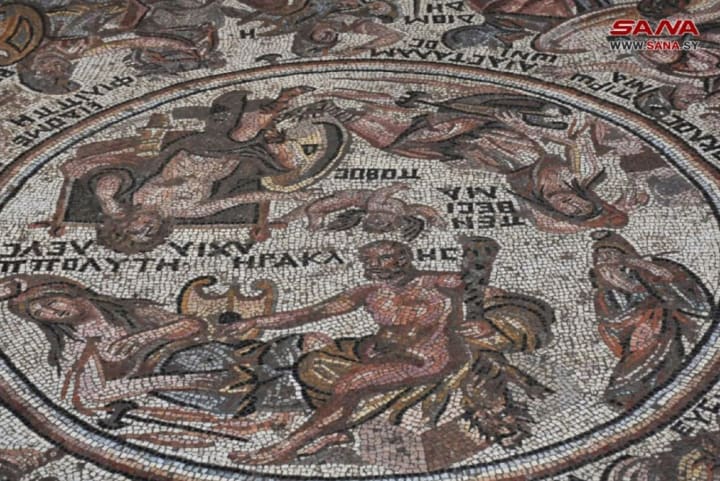
As shown in the picture, the inner circle, at the centre of the mosaic we can see two scenes. The first one is Hercules killing Hippolyta, the Amazon warriorness. While the second one shows Achilles killing Penthecilia. Another Amazon warriorness. but here, we have one more detail. In between the names of Achilles and Penthecilia, we can see a Greek word "pothos", which can be translated as passion, accompanied by a Cupid, the Roman symbol of love, used even today. This word, even though that it has a complicated meaning, is especially used by Plato, in many of his dialogues. The Mosaic is just describing the love story between Achilles and Penthecylia. In the myth, it says that Achilles, after killing Penthecilia, and after Petentialia's helmet fell into the ground, revealing her face, he instantly fell in love with her, feeling devastated that he killed her. This part of the myth has an interesting story of how in battle, two warriors fell in love, especially after only one of them was already killed.
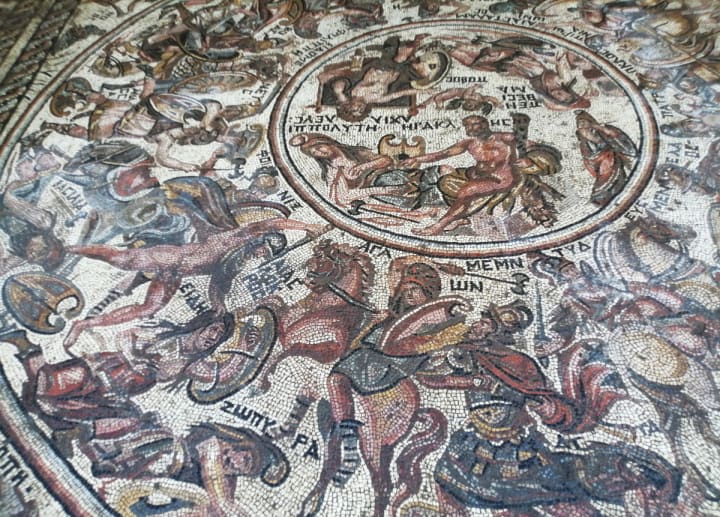
In the outer circle of the mosaic, we can see the rest of the fight with some second and first-tier characters. Like Menelaus, the husband of Helen, who has been kidnapped by the Trojan Prince Paris.
What Lies Ahead?
Even though many old artwork did not survive the Syrian civil war, yet this amazing mosaic did. Sulaf Fawakherji, a well-known Syrian actress and board member of the Nabu Museum, expressed her desire to purchase other structures in Rastan, which she claims is teeming with undiscovered cultural heritage sites and relics.
Fawkherji told the AP, "There are additional structures, and it's obvious that the mosaic stretches much beyond. "Rastan is a historically significant city and has the potential to be a major heritage travel destination."
Syria offers a wealth of archaeological riches because it has served as a "melting pot" for numerous civilizations throughout the centuries, including the Canaanites, the Umayyads, the Greeks, the Romans, and the Byzantines.
Unfortunately, the conflict that started in 2011 led to the destruction of many of these artefacts. In the city of Homs, the Khalid Ibn al-Walid Mosque was destroyed, the Umm al-Zinar Church was set on fire, and Rastan's mosaics were taken.
But as this discovery proves, some remnants of Syria’s past remain intact, waiting to be uncovered. Perhaps, in time, the full extent of the mosaic—and the stories it holds—will be brought to light, offering a symbol of resilience amid the ruins of war.
Written by Sergios Saropoulos
About the Creator
Sergios Saropoulos
As a Philosopher, Writer, Journalist and Educator. I bring a unique perspective to my writing, exploring how philosophical ideas intersect with cultural and social narratives, deepening our understanding of today's world.
Keep reading
More stories from Sergios Saropoulos and writers in Humans and other communities.
The Greek filmmakers in the pantheon of International Cinema.
Greece, a relatively small country, with an enormous background in culture and history. And while many people only reminisce about its ancient past, and I do not blame them. Culturally Greece has offered a lot and it still does. From great poets like Seferis, Kavafis, Ritsos and many others, to filmmakers. But let me talk to you today about the filmmakers with a promise of talking about poetry and more culture in the future. I would like to offer just two examples of Greece’s greatest filmmakers. Two examples with enormous global recognition that remains vivid to these days. I am talking about Costas Gavras and Theo Angelopoulos.
By Sergios Saropoulos3 years ago in Humans
Multinational Crisis Part 4: Who Cares?
“Frankly, my dear, I don’t give a damn!” Facebook. Silent. TikTok. Silent Instagram, Threads, Lemon8, and every other social media, are not concerned with what is happening to you, women and men, on their platforms. They care only, for the mighty dollar and statistics.
By Alexandra Grantabout 9 hours ago in Humans
The Devil's Cut
“Comrade, finally you’re awake.” The voice was smooth, sensual. A flickering incandescent bar was all that lit the white, sterile room. All Vladimir remembered was everything going black. He tried to move his arms and found them strapped to the gurney.
By Matthew J. Fromm6 days ago in Fiction


Comments
There are no comments for this story
Be the first to respond and start the conversation.