
A Letter of Love and Irony: When an Urdu Statesman Writes to His Fiancée
When love, sarcasm, and eloquence intertwine — a political man’s letter that reads like a piece of art.

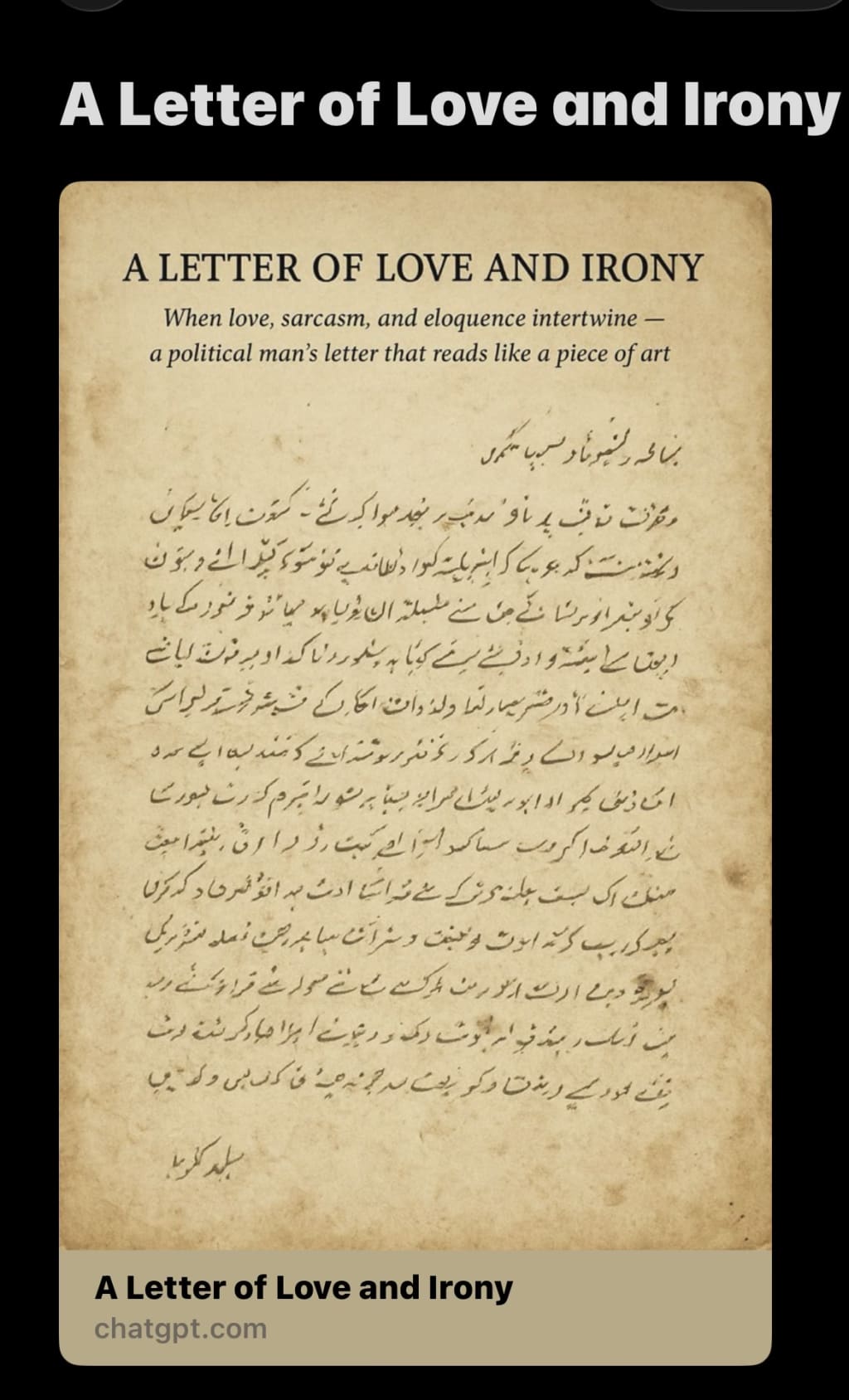
Introduction
Love letters are often tender, emotional, and sweet. But this one — from an Urdu statesman to his fiancée — is something entirely different.
It’s not just a letter; it’s an artwork. A perfect blend of affection, satire, irritation, and literary brilliance.
In this letter, love doesn’t speak softly — it teases, it corrects, it mocks, and yet somehow, it still loves. The statesman’s words show that love, when expressed through wit and wisdom, can turn even reproach into poetry.
⸻
“You Have Suffered Great Wrongdoing…”
The letter begins not with endearment, but with a jab:
“You have suffered a great deal of wrongdoing, which you, unfortunately, call a love letter.”
The tone is immediately ironic — and yet, strangely intimate. This isn’t the voice of a romantic poet; it’s the voice of a lover who values precision as much as passion. His fiancée’s clumsy writing has become, to him, a source of both amusement and exasperation.
⸻
“If You Can’t Write, Then Ask Someone Who Can”
He continues, with the kind of affectionate sarcasm that only love can afford:
“This letter was just like your previous ones… If you can’t write, then get someone else to write for you.”
Here, the frustration turns poetic. He doesn’t simply criticize — he performs it. The letter becomes a mirror of his mind: a mix of irritation, humor, and an undercurrent of longing.
⸻
Of Movies, Mothers, and Misunderstood Lyrics
At one point, his fiancée apparently quotes a film song to praise him. The statesman, ever the realist, can’t help but correct her:
“What you wrote in my glory — it’s not a movie, it’s from a movie. And you probably don’t know that the hero sings that song for his mother.”
It’s comical and deeply human. He’s not mocking her lack of sophistication — he’s teasing her, exposing the gap between cinematic romance and real love.
⸻
The Pan Stains of Love
Then comes one of the most memorable parts of the letter — the critique of pan stains:
“Eat less. The spots of pan are clearly visible on the letter. If you can’t write, at least wash your hands when you do.”
This line alone could make the letter immortal. It’s absurd, honest, and oddly affectionate. Even his annoyance feels intimate. He’s not just preserving linguistic purity; he’s defending the dignity of both love and language.
⸻
“Fresh”? A Butcher’s Name, Not Yours
In the next section, the statesman scolds his beloved for signing her name incorrectly:
“You were told to write your name properly. What’s ‘Fresh’? It sounds like a butcher’s name or a milkman’s. Just write ‘Crown.’”
Here, humor meets authority. It’s as though the politician in him momentarily takes control — correcting not just her grammar, but her identity. It’s funny, but beneath the laughter lies a strange tenderness. He wants her to be better — not just for him, but for herself.
⸻
“I Fear This Love May Ruin My Urdu”
Toward the end, his tone softens. The sarcasm fades into confession:
“The poem you wrote, then the scriptures you copied… oh my God! I fear this chain of love from you will spoil my Urdu.”
It’s both humorous and heartbreaking. The man who guards his language so fiercely finds it threatened — not by enemies, but by affection.
⸻
Conclusion
This is not a love letter — it’s a literary performance.
Through satire and sharpness, the Urdu statesman reveals something profound: love is not always gentle. Sometimes, it’s corrective. Sometimes, it scolds. But in every word, there’s care.
The letter reminds us that true affection doesn’t only praise; it also refines. It teaches us that between the ink stains and the laughter, between irritation and intimacy — there lies a love that is utterly, beautifully human.
About the Creator
Voxwrite ✍️
“Hi, I’m wordwanderer . Science lover, deep thinker, and storyteller. I write about the universe, human mind, and the mysteries that keep us curious. 🖋️
Keep reading
More stories from Voxwrite ✍️ and writers in Humans and other communities.
The Silent Witness.
The law classroom was quiet that morning. The students sat ready, notebooks open, waiting for their professor to begin. Without a word, the professor walked in, his eyes scanning the room until they stopped on one student seated in the middle row.
By Voxwrite ✍️ 3 months ago in Humans
Valentine’s Day Chat Up Lines That Get Replies Not Ghosted
Valentine's Day adds strain. Messages are more important. With one lousy opening, the conversation dies. We've all seen it. A dry greeting. A copied line. There was silence afterwards. Attention is quickly gained and lost by Generation Z. That's why Valentine's Day chat lines require more than just charm. They require timing, tone, and genuine intent.
By Relationship Guide4 days ago in Humans


Comments
There are no comments for this story
Be the first to respond and start the conversation.