
Writing: A Woman Scorned
How "Petals on the Wind" writes the revenge arc


In the the final moments of the infamous Flowers in Attic, Cathy escapes the clutches of her evil grandmother and sadistic mother with her smitten brother and traumatised sister in tow - all carrying severe mental scares, but Cathy vows to get vengeance on her abusers.
Petals on the Wind would be a challenging book to adapt for anyone, especially with the timeline spanning twelve years and multiple storylines running parallel. With this in mind, screenwriter Kaya Alpert condenses the key plot points after a ten year time jump, aging up the characters and giving the narrative a more linear structure. The film follows the surviving Dollanganger children—Cathy, Chris and Carrie—ten years after escaping the attic. Despite attempting to move on with their lives, after multiple failed attempts and tragedies occur, Cathy decides it is time to take revenge on her mother.
Looking at the Woman Scorned Trope, we mainly see this arc of a female character cheated on or betrayed. What's interesting about Cathy's revenge arc is that she is this is a character going after the Evil Mother, slowly becoming a villain in that mission to seek justice for her damaged childhood and lost innocence. So, how does V.C. Andrews and Kaya Alpert tackle the revenge arc? Cathy in the screenplay goes through a multitude of transformations as she builds towards this ultimate revenge - something she believes she wants, but is it what she truly needed?
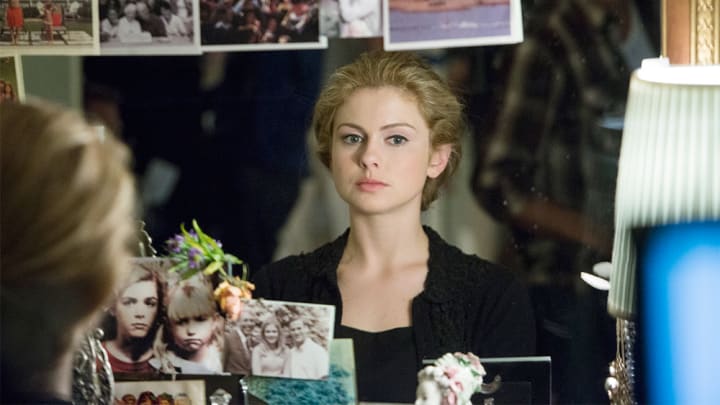
Cathy's arc starts in the wake of the funeral of her adoptive father, Paul Sheffield, who took her and her siblings in after the attic escape. They are still traumatized by their grandmother's abuse and their mother's betrayal, which led to the death of Carrie's twin, Cory. Yet despite this, Cathy still reaches out to Corrine - still craving that motherly presence, only to have the phone hung up on her.
After this second rejection from her mother, Cathy determines to have her own identity away from the horrors of the attic. On the night before she leaves for New York to audition for a ballet company, Cathy and Chris admit that they still have feelings for each other and give in to their forbidden passion, making love. However, Cathy insists they must find others to love and live normal lives. The conversation reveals that Cathy was pregnant with Chris' child, conceived from their first sexual encounter while they were imprisoned, but miscarried.

Cathy's sexuality is more prominent in this film - with a grandmother who scorned femininity and a mother who played into her feminine attributes for attention or achieving her goals - Cathy falls somewhere in the middle, initially uncomfortable by it but slowly using it in the ways her mother did.
Cathy is still haunted by Corrine, even after escaping an abusive relationship and having a child of her own. Her revenge is only ignited when her younger sister, Carrie commits suicide after Corrine openly denounces her as her child in public. This sets in mother her Woman Scorned arc - now having lost both of her younger siblings that in many ways were like her own children, finally bringing to the forefront her long suppressed trauma.

How should one go about seeking revenge? Well, personally I would have Cathy go through the law - outing Corrine's murderous and abusive sins, including court proceedings and DNA tests to prove Chris and Cathy are her biological children. Alas, this is a V.C. Andrews adaptation - Cathy's plan involves seducing her unsuspecting stepfather and outing her illicit affair to Corrine, breaking Corrine's picture-perfect image. Here we see Cathy completely using her sexuality to achieve this, becoming very Corrine like in her seductions - dumbing herself down to appear more desirable. What she doesn't plan on is getting pregnant again with Bart's child.
Her revenge is almost brought to a shattering halt when she confronts her bed-ridden grandmother. This initially makes Cathy more confident in her anger and allows her to confronts her about her religious hypocrisy and abuse towards her and her siblings. Yet, the pair soon fall back into those roles when she was a child - Cathy finds herself on the verge of attacking her grandmother, her words echoing the horrors of her past.
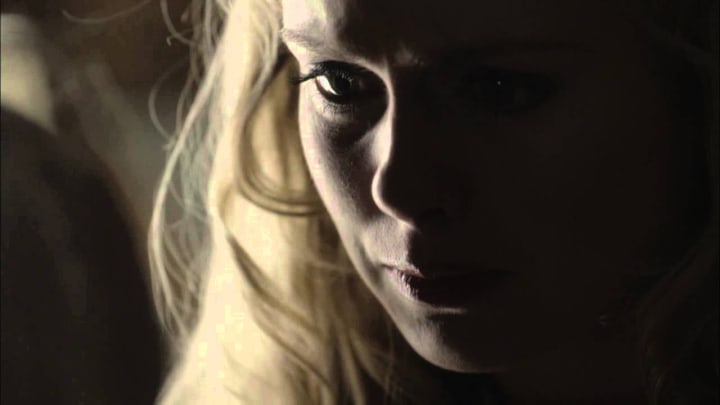
In the second draft of Petals, this scene climaxes to this point slightly differently than the final cut when the Grandmother's abuse drives Cathy to grab a pocket instead of a sliver crucifix, about to give into her anger:
GRANDMOTHER: Go ahead. Do what you want. I’m dying anyway.
Cathy gathers her courage, raises the poker higher... The grandmother just sneers.
GRANDMOTHER (CONT’D) : But my blood will still be running through your veins. And Corrine will still be your mother. You are who you are. Who you will always be... the devil’s spawn.
CATHY : I’m not like my mother! Like any of you. Blood or not, you’re nothing to me. Nothing.
Angry, she throws down the poker and turns to leave. But the grandmother grabs Cathy’s sleeve, hoists herself close to tell her one last thing. Calmly... knowingly.
GRANDMOTHER : You can leave Foxworth Hall. But you will never escape this family.
This has been the secret truth Cathy herself has been trying to hide from - the knowledge that she cannot escape her family's past. She has time to back out of this plan, but is more determined than ever now.
During the party, Cathy reveals her identity and her mother's crimes to the stunned guests. Corrine initially denies everything, but Bart is suspicious and Olivia refuses to defend her. Corrine finally admits to everything, but insists she never intended to kill Cory or have the children put in the attic, defending her actions on the basis that her father would have rejected her and left all of them out of his will. Cathy then publicly reveals her pregnancy caused by Bart.

Yet, Cathy is unfulfilled by this revelation. Instead of feeling set free, she is wrecked with guilt as the fallout of this ends in heartbreak and death. In the final scenes, Cathy has in more ways than one become just like her mother - the exact woman she was trying so hard not to be. Here we see that tiny look of uncertainty as she plays the dutiful wife and mother, hiding her darkest secret about the true nature of her and her "husband's" relationship. This is not the happy ending she envisioned for herself, but it is the one she is trying to find a new identity in.
Corrine is committed into a mental hospital, forced to relive the horrors of her past - just as her children have. The Woman Scorned got her revenge, but the aftermath sees this character facing a life of uncertainty... who is Cathy without her hatred for her mother? That question is left open to the viewer/reader - until they decide to watch/read the rest of the series. However, Cathy is an example that a Woman Scorned can be more complex and not entirely driven by spouse jealousy - with childhood trauma having more devastating effects in adulthood for your character.
About the Creator
Ted Ryan
Screenwriter, director, reviewer & author.
Ted Ryan: Storyteller Chronicles | T.J. Ryan: NA romance
Socials: @authortedryan | @tjryanwrites | @tjryanreviews
The Author Diaries #1: The Storyteller’s Curse — Exclusive Prologue Reveal
Author’s Note: Dear Readers, Thank you for being here — for reading, subscribing, and stepping back into the world of The Storyteller Chronicles. When I finished Book One, I truly thought the story was done. Silas was defeated. The grimoire was safe. Lauren had saved the day — in two worlds — and her family were reunited.
By Ted RyanExclusive • 6 months ago
Where's the Glory?
In breaking news, rehabilitated Republican Senator Johnnie Johnson (Pronouns: HE, HIM, HIS) called a press conference from the Men’s room of the New Orleans Louis Armstrong International Airport, Concourse B, across from the Ignatius Reilly’s Lucky Dog stand. The Senator had just returned from a sexual reorientation rehabilitation program in Memphis, TN after being publically disgraced at a Buckee’s Truckstop restroom soliciting sex from an undercover cop three months ago. He is a founding member of the Reformed Christians for Christ, a conservative, pro-family and ex-gay advocacy group. In the spirit of being reborn, Senator Johnson invited reporters to marvel at his plans for a major remodeling of airport bathrooms.
By Cathy Schieffelin6 days ago in Humor


Comments
There are no comments for this story
Be the first to respond and start the conversation.