
Whispers of a Fictional Horror
A Tale of Madness and Ink

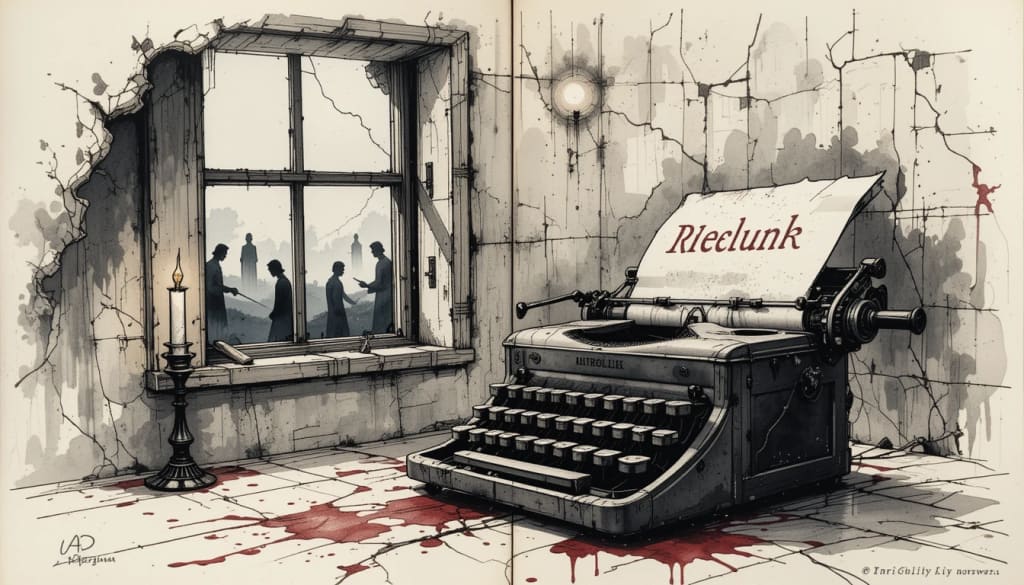
In the fog-draped town of Hollowmere, nestled in the English moors in 2023, the line between reality and fiction blurred like ink on wet paper. For Nora, a 29-year-old writer seeking solace from her unraveling life, Hollowmere’s isolation was a refuge. But the crumbling manor she rented held secrets—whispers of a horror born from stories never meant to escape the page. This is the tale of Nora’s descent into a nightmare woven from her own words, and the chilling truth that some fictions are too alive to stay bound.
Nora arrived in Hollowmere with a battered suitcase and a half-finished manuscript. Her debut novel, a psychological thriller, had earned praise but left her drained, her marriage fractured, and her mind frayed by writer’s block. Seeking escape, she leased Blackthorn Manor, a decaying estate on the town’s edge, its gothic spires looming like skeletal fingers. The locals warned her—old tales spoke of the manor’s last tenant, a reclusive author named Edgar Crane, who vanished in 1973 after writing a cursed book. Nora dismissed the stories as folklore, eager to lose herself in her work.
The manor was a labyrinth of creaking floorboards, dusty tomes, and portraits with eyes that seemed to follow. Nora set up her typewriter in the attic, where a single window framed the moors’ endless gray. At night, the house whispered—soft, unintelligible murmurs that seeped into her dreams. She wrote feverishly, her new novel taking shape: The Hollow Ones, a story of shadow creatures born from a writer’s nightmares, feeding on fear. The words flowed, but each night, the whispers grew louder, echoing her characters’ voices.
Her only connection to Hollowmere was Elias, a 40-year-old librarian with a quiet demeanor and a love for obscure books. He delivered supplies to the manor, his weathered face softening when he saw Nora’s exhaustion. “Be careful,” he warned, handing her a coffee. “This place has a way of getting inside you.” Nora laughed it off, but Elias’s stories about Crane intrigued her. He’d been writing a horror novel, The Whispering Void, when he disappeared, leaving behind pages that no one dared read. Curiosity piqued, Nora asked to see them, and Elias reluctantly agreed, bringing her a locked box from the library’s archives.
The box contained Crane’s manuscript, its pages brittle and stained. As Nora read, her skin prickled—the story mirrored her own, down to the shadow creatures and their hunger. The whispers in the manor grew distinct, chanting names from her novel: Erynn, Thane, Lysa. She tried to stop writing, but her fingers moved as if possessed, the typewriter clacking through the night. Objects shifted—a pen on the floor, a door ajar—and shadows danced in her peripheral vision, their forms too familiar. Nora’s sleep became a battleground, her dreams filled with the Hollow Ones, their eyes glinting like ink.
Desperate, she confided in Elias. He revealed more: Crane had claimed his characters were real, speaking to him, demanding life. The townsfolk found his study smeared with ink, his typewriter shattered, and no trace of him. Elias urged Nora to leave, but she couldn’t—her novel was nearly done, and abandoning it felt like abandoning herself. “I need to know how it ends,” she told him, her voice hollow. Elias, torn, stayed close, checking on her daily, his presence a tether to reality.
One stormy night, Nora found a hidden room behind the attic’s bookcase. Inside, a cracked mirror reflected not her face but Erynn’s, her novel’s protagonist, her eyes pleading. The whispers roared, and the room filled with shadows—tall, sinewy, their claws dripping ink. Nora screamed, clutching Crane’s manuscript, and saw his final note: “They write themselves. Burn it.” She realized the truth—her story, like Crane’s, was a conduit, giving life to the Hollow Ones. Her words were summoning them, blurring the veil between fiction and reality.
Nora tried to burn her manuscript, but the pages wouldn’t catch, the ink seeming to writhe. She fled to Elias, who helped her barricade the manor. Together, they devised a plan: rewrite the ending to trap the Hollow Ones within the story. Nora typed through the night, her hands shaking, as the shadows pressed against the windows, their whispers a cacophony. Elias read aloud from Crane’s notes, his voice steadying her. She crafted a new ending—Erynn sealing the creatures in a fictional abyss, sacrificing herself. As Nora typed the final word, the whispers stopped, and the shadows vanished.
But the cost was steep. Nora’s manuscript, now complete, felt alive, its pages heavy with an unnatural weight. She locked it in Crane’s box, vowing never to publish it. The manor was silent, but Nora’s mind bore scars—flashes of Erynn’s face, whispers in quiet moments. Elias, shaken but loyal, helped her move to a cottage in town. “You’re stronger than Crane,” he said, his hand on hers. Nora wasn’t sure—she felt the Hollow Ones lingering, waiting for another pen to set them free.
In 2024, Nora stood in Hollowmere’s library, the box buried in its archives. She wrote no more horror, turning to poetry, her words soft and safe. Elias became her friend, then more, their bond forged in the manor’s terror. The town still whispered of Blackthorn, but Nora’s story remained unwritten, a secret kept to protect the world. The last whisper of her fictional horror faded, but its echo lingered, a reminder that some stories are too dangerous to tell.
About the Creator
Shohel Rana
As a professional article writer for Vocal Media, I craft engaging, high-quality content tailored to diverse audiences. My expertise ensures well-researched, compelling articles that inform, inspire, and captivate readers effectively.
Keep reading
More stories from Shohel Rana and writers in Horror and other communities.
The House That Hummed
I found the house by accident. It was one of those old Victorian homes with too much character and not enough insulation. The kind that looks haunted, even on a sunny day. The rent was suspiciously low, but I was tired of roommates, tired of the noise, and tired of explaining why I wanted silence. This house promised solitude.
By Shohel Rana8 months ago in Horror



Comments
There are no comments for this story
Be the first to respond and start the conversation.