
Where the Brume Waits
Sometimes the mist hides more than sorrow—it holds on to love.
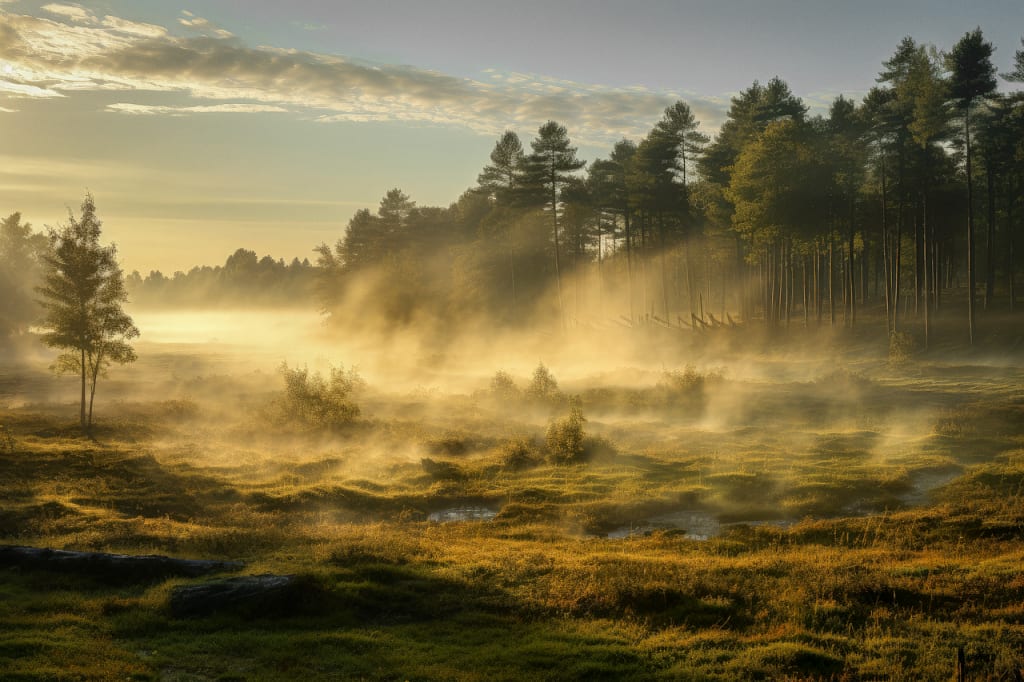
In the quiet cradle of the hills, where time moved like honey and the seasons spoke in whispers, there sat the village of Eldenmoor.
It wasn’t marked on most maps just a patchwork of moss-covered roofs, crooked chimneys, and meandering stone paths. But those who lived there knew it wasn’t the kind of place you found.
It was the kind of place that found you, often when you were searching for something you couldn’t name.
Every morning, like a ritual, the village was wrapped in brume a soft, silver mist that drifted down from the highlands before dawn. It moved like breath, exhaling across the fields and hugging the earth.
The brume was a blanket of mystery, a gentle veil that turned trees into shadows and the lake into glass. It slowed everything. And in its stillness, it held secrets.
One such secret was Elias.
He was a tall, willowy man, now bent by the years, though his eyes still carried the startling blue of his youth. Every morning before the church bell rang, before the baker opened his shutters, Elias walked the curved trail through the woods to the lake.
Always alone. Always silent. Always waiting.
Decades ago, Elias had been a violinist. He once played under the open sky, his music echoing off the hills, drawing birds from trees and lovers from their windows.
That was how he met her Alina a girl with fire in her veins and a voice that could still the wildest storm.
She had come to Eldenmoor from somewhere else no one knew where with nothing but a blue dress and a silver hairpin shaped like a crescent moon. She danced like she belonged to the wind, and she listened to Elias’s music like it was water in the desert.
They met by the lake, where the brume was thickest.
She once told him she loved how the mist made everything softer. How it made the world feel like it hadn’t yet decided what it wanted to be.
“Maybe that’s what I am,” she said, cupping the fog in her hands. “Half here, half not.”
They fell in love in the quiet way that things bloom: unseen by most, but impossibly vivid to those who are paying attention.
Every morning, they’d walk through the mist, hand in hand, sometimes speaking, sometimes silent. She would dance through the brume, spinning until it curled around her like silk.
“You found me here,” she’d laugh. “Maybe one day I’ll disappear back into it.”
He told her that would never happen.
But one morning, after the longest night of winter, the brume came down heavy so thick it blanketed the village well past noon. And Alina did not come.
She wasn’t in her cottage. She wasn’t at the lake. Her footprints led to the edge of the water and vanished.
No note. No sound. Just absence.
Some said she drowned. Others believed she ran. But Elias never believed either.
He stopped playing music. He stopped speaking.
But he never stopped walking to the lake.
Every morning.
Even in storms.
Even when the fog came down so dense you couldn’t see your own feet.
He walked the same trail, carrying a satchel that now held only a faded scarf and a silver hairpin the crescent moon one she used to wear.
The villagers grew used to the sight of him Elias, the ghost of the lake, wrapped in brume and silence. They pitied him. Children whispered that he talked to the fog. That he had gone mad.
But none of them ever dared follow him too far.
Because some mornings just some when the mist was deepest and the sky just beginning to pale with light, laughter could be heard by the lake. A light, lilting sound like wind chimes and waterfalls.
Alina’s laugh.
And Elias would stand at the water’s edge, eyes closed, a faint smile on his lips, as if listening to a song only he could hear.
“Alina,” he would whisper. “Are you still hiding in the mist?”
There were tales, of course. Older than Elias himself. Whispered by grandmothers with shaking spoons and by firelight in the winter when the wind howled against the shutters.
The brume, they said, was alive.
Not in a monstrous way no fangs, no claws but in the way of things older than language. It remembered. It watched. It chose.
Some spoke of people who had vanished into it wanderers, the grieving, the brokenhearted. And sometimes, if the mist liked you if it felt your heart cracking like frozen glass it would offer you a way into something else.
Not death. Not quite life.
A place between.
Elias never believed those stories when he was young. But as the decades passed and he aged while Alina did not return, the lines between myth and memory began to blur.
There were days he swore he felt her fingers brush his, fleeting as fog. Nights he’d dream of her face, but when he woke, he couldn’t remember her voice. It terrified him the forgetting.
So he kept walking.
Even when his legs trembled.
Even when the villagers begged him to rest.
Then came the morning.
Thicker than any before, the brume rolled down the hills in great silent waves. It flooded the fields. Swallowed the barns. Even the church steeple vanished beneath its weight.
No one left their homes that day.
Except Elias.
He did not return.
They searched, of course. When the mist lifted late in the afternoon, the villagers took up lanterns and torches, combing the forest, calling his name.
At the lake, they found nothing no satchel, no scarf.
Only a wooden cane, standing upright in the soil near the edge of the water.
Beside it, half-buried in the dew-wet grass, the crescent moon hairpin gleamed.
No footprints.
No sound.
No wind.
Just mist retreating as if satisfied.
Since then, Eldenmoor has never spoken his name aloud.
Not out of fear.
Out of reverence.
And on mornings when the brume is heavy so heavy it silences even the birds villagers light a single lantern and place it by the lake.
And wait.
Some claim they’ve seen them Elias and Alina drifting hand in hand just beneath the surface of the mist. Not ghosts, not exactly human. Something gentler. Something at peace.
Others say they hear a violin’s slow, mournful tune rising through the fog.
But most, especially the old ones, simply close their eyes and whisper:
Let the brume keep what it loves.
About the Creator
Keep reading
More stories from Terence Lisher and writers in Horror and other communities.
The Last Light
The Last Light – A Story of “Luminous” There was once a village wrapped in quiet hills and thick, whispering woods. It was a place time had mostly forgotten. The world beyond it rushed ahead with noise and invention, but the people of Velden lived slowly, holding onto rhythms older than clocks.
By Terence Lisher6 months ago in Fiction


Comments
There are no comments for this story
Be the first to respond and start the conversation.