
What We Buried in the Attic
Some memories are best left in boxes. But not all ghosts agree.
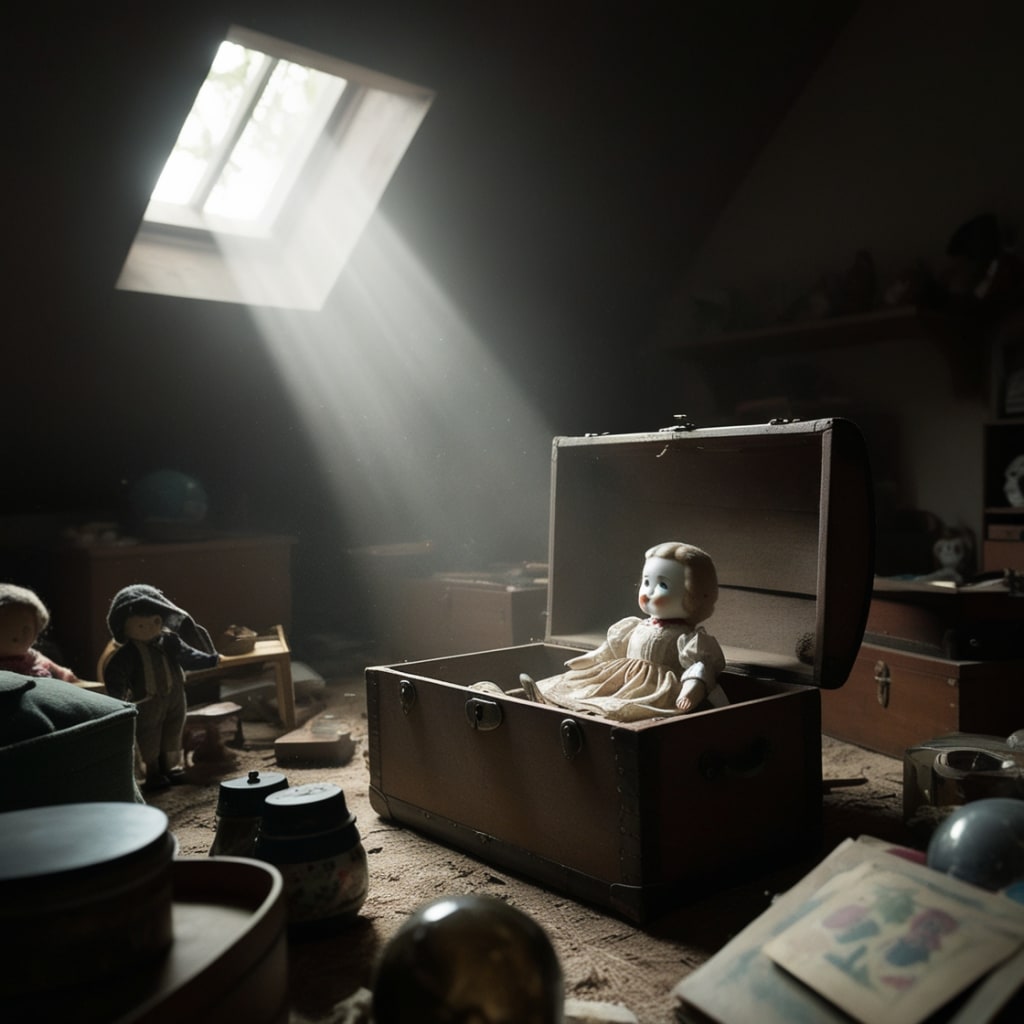
We returned to the house after our father died.
Not because we wanted to—neither of us had spoken to him in years—but because someone had to clean out the place.
The old colonial stood at the end of a gravel road in a forgotten part of Pennsylvania, its shutters warped, roof sagging slightly. A "FOR SALE" sign leaned half-collapsed in the weeds. It looked exactly the way I remembered it, like the past had been preserved under a thick sheet of dust.
Ben arrived first. I found him standing in the foyer, staring up at the staircase.
“Smells the same,” he said, without turning.
I nodded. Musty wood, dried paper, and something else. Something metallic.
We didn’t speak much that first hour. We drifted from room to room, each absorbed in our own layer of memory. My old bedroom was still pale blue. His still had the faded superhero wallpaper. Our father had kept everything, but touched nothing.
It wasn’t until the second day, in the late afternoon when sunlight slanted golden through the cracked windows, that we climbed into the attic.
The door groaned in protest as we pulled it open. Dust exploded in shafts of light. The stairs creaked beneath us like old bones.
Everything was still up there. The rocking horse. The broken globe. The wardrobe that used to scare Ben as a child. And, in the far corner, the old trunk.
The one he swore he’d never open again.
Ben froze. “I forgot that thing was still here.”
I hadn’t. I’d dreamed of it more times than I could count.
He walked toward it slowly. The lock was rusted, but still intact. The same brass latch with the same tiny initials carved into it—ours.
W + B
Will and Ben.
Back when we were kids and believed secrets could be hidden in padlocks.
“We shouldn’t,” he said.
“We have to,” I said.
He sighed. “You always did like digging up graves.”
I didn’t reply. Instead, I knelt, ran my fingers over the latch, and opened it.
Inside: letters, drawings, Polaroids, and cassette tapes wrapped in faded plastic. All ours. All untouched. It was like stepping into a freeze-frame of our childhood—until the bottom layer.
There, beneath a worn Superman cape and a journal with our mother’s name written on the inside cover, was something I didn’t remember putting there.
A doll.
Porcelain. Pale.
Eyes open wide, lips parted like she was in the middle of whispering a secret.
“Is that…?”
Ben’s voice broke. He took a step back.
I picked her up carefully. She wore a blue dress. One of the buttons was missing.
“That’s hers,” he whispered.
The air seemed to thicken.
We were six and ten when it happened.
Her name was Emily.
She lived three houses down.
She came over that day to play hide-and-seek.
Ben had found the perfect hiding place—inside the old wardrobe in the attic.
We didn’t know she was afraid of small spaces.
We didn’t know how long she’d be inside.
We didn’t know how quiet a child could die.
We didn’t tell anyone.
The adults thought she wandered off. Search teams came and went.
Two weeks later, a neighbor’s dog found the smell.
They blamed the house. Not us.
No one ever asked.
And our father never said a word.
He burned the wardrobe.
But we had taken something before that.
The doll.
Ben wanted to bury it.
I convinced him to lock it away instead.
“Why is it still here?” Ben whispered.
“She never left,” I said.
The air shifted, as if the attic exhaled. One of the boxes toppled over. Tapes spilled across the floor. A faint hum filled the silence.
“Do you hear that?” I asked.
He nodded. “Sounds like… a girl.”
I turned toward the trunk again.
The doll was gone.
We found it five feet away, sitting perfectly upright on the edge of the rocking horse. Its head tilted slightly. Smiling.
Ben stepped back. “No. No, this isn’t real. This is some stress-induced—”
“She’s angry,” I said. “She’s been waiting.”
“For what?”
“For us to remember.”
The rest happened quickly.
The attic door slammed shut.
The temperature dropped.
Our mother’s journal fluttered open on its own.
And then the cassette player — untouched for decades — crackled to life.
A child’s voice, soft and faint, spilled out:
“Don’t leave me. It’s dark in here. I want to go home.”
Ben sank to the floor. I could see the years folding in on him. The guilt he’d swallowed down like old medicine. The ache we buried so deep it became part of our bones.
He started to cry.
“I’m sorry,” he said to the doll. To the room. To the memory.
I sat beside him. My hand found his. And for the first time since we were boys, we let ourselves feel it all.
The fear. The shame. The grief.
The doll blinked.
Just once.
And then she crumbled into dust.
We stayed in the attic until sunrise. The house felt lighter when we came down. Like something had been lifted.
Before we left, I put the journal in my bag. Ben took the letters. We didn’t talk about the doll again.
But that night, in the motel, I dreamed of Emily.
She was standing in a field of sunflowers, her hand outstretched, smiling.
And I knew then —
What we buried in the attic wasn’t just a secret.
It was a soul waiting to be remembered.
And at last,
she was.
About the Creator
Keep reading
More stories from Abuzar khan and writers in Horror and other communities.




Comments
There are no comments for this story
Be the first to respond and start the conversation.