
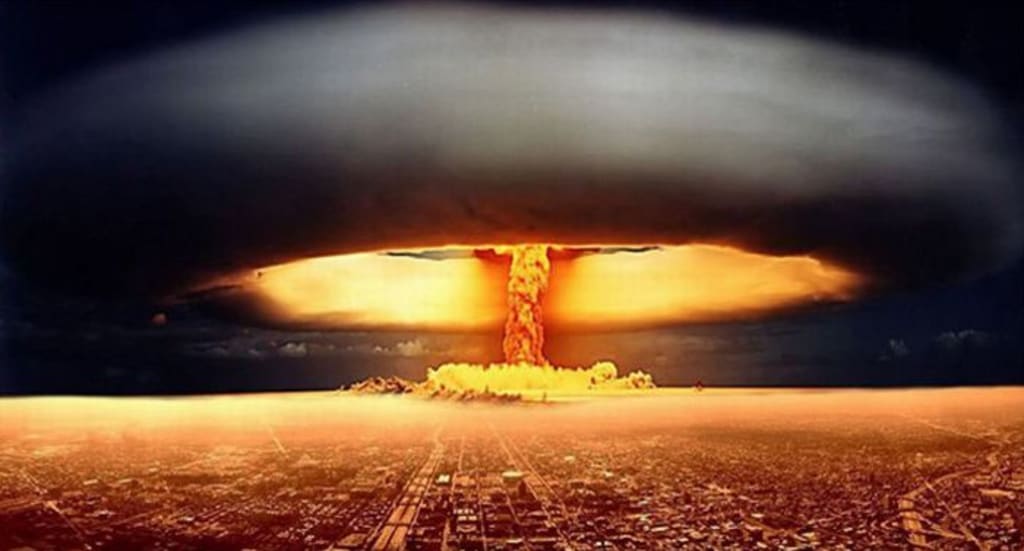
Was there a nuclear bomb in the city of Sodom and Gomorrah in ancient times?
There are no historical records or archaeological evidence to prove that a nuclear explosion occurred

The origin of Sodom and Gomorrah
The origin of Sodom and Gomorrah, according to biblical accounts, is related to the cities mentioned in the book of Genesis in the Old Testament. These cities are described as part of the region known as the Jordan Valley, located in the ancient region of Canaan, in the area that today corresponds to Israel and Jordan.
According to the Bible, Sodom and Gomorrah were cities inhabited by people who lived in sin and moral corruption. This wickedness would have been so great that God decided to punish these cities with destruction.
However, it is important to note that, from a historical and archaeological point of view, there is no conclusive evidence that proves the existence of these cities or the occurrence of specific events related to their destruction. The biblical accounts are an important part of religious tradition, but they cannot be considered verifiable historical records.
The exact location of Sodom and Gomorrah is also uncertain, and various theories and hypotheses have been proposed over the years. Some scholars suggest that these cities could be located in areas currently submerged in the Dead Sea, while others point to different locations in the Middle East region. In summary, the origin of Sodom and Gomorrah is related to the biblical narratives, but their location and the veracity of the events described are still subject to debate and scholarly investigation.
It is important to mention that the story of Sodom and Gomorrah is set in the context of the religious and cultural tradition of the Old Testament. According to the biblical narratives, these cities were mentioned in relation to events and characters such as Abraham and Lot.
Sodom and Gomorrah are described as sinful cities, where injustice and immorality were prevalent. The destruction of these cities is believed to have occurred as a divine judgment against their wickedness. The story of Sodom and Gomorrah also served as a moral lesson and an example of consequences for those who indulge in corruption.
However, it is important to note that the interpretation of these stories can vary according to different religious traditions and academic viewpoints. While some people consider these accounts to be literal historical events, others see them as myths or allegories with religious and moral purposes.
From an archaeological point of view, so far no conclusive evidence has been found to confirm the actual existence of Sodom and Gomorrah or the occurrence of the events described in the Bible. The exact location of these ancient cities also remains uncertain.
Therefore, it is critical to approach these stories with a critical approach, taking into consideration both the religious perspective and academic research. Understanding the origins of Sodom and Gomorrah involves careful analysis of the biblical texts as well as consideration of ongoing debates and archaeological research.
There are no historical records or archaeological evidence to prove that a nuclear explosion occurred in the cities of Sodom and Gomorrah in ancient times. Stories about the destruction of these cities are found in the biblical accounts of the Old Testament, specifically in the book of Genesis. According to the biblical narrative, Sodom and Gomorrah were destroyed because of their moral corruption and sinfulness. The destruction is described as a rain of brimstone and fire from heaven. However, these descriptions are considered as allegories or religious myths by many scholars, and not as actual historical events. Therefore, there is no concrete basis to claim that there was a nuclear bomb involved in the destruction of these ancient cities.
It is important to note that biblical narratives often use figurative and symbolic language to convey religious messages and teachings. The description of the destruction of Sodom and Gomorrah can be understood as a poetic way to express the severity of the divine punishment on these cities according to religious tradition.
In historical and archaeological terms, there are no records or findings that support the existence of a nuclear bomb or any other form of similar explosion during ancient times. The destruction of Sodom and Gomorrah, if it did occur, was probably the result of some natural event, such as an earthquake, volcanic eruption or fire, commonly associated with geologically unstable regions.
It is important to consider that the interpretation of these accounts must be based on different perspectives, taking into account historical, religious and cultural aspects. Understanding the biblical stories involves both faith and religious interpretation and critical analysis of the available historical records and archaeological evidence.
There are different explanations and interpretations as to why the city of Sodom and Gomorrah was no longer producing plants or drinking water, according to the biblical accounts. However, it is important to note that these explanations are based on the religious narratives in the book of Genesis and have no historical or scientific confirmation.
According to the Bible, the destruction of Sodom and Gomorrah was attributed to the sin and moral corruption of the cities. It is believed that the wickedness of the inhabitants was so great that God decided to punish these cities with a catastrophe. The destruction is described as a rain of fire and brimstone that came from heaven.
Within the biblical context, some interpretations suggest that the destruction of the cities included a transformation in the natural landscape, making the soil infertile and contaminating the water sources, resulting in a lack of food and drinking water. This interpretation can be understood as a way of portraying the severity and totality of divine punishment.
However, it is important to note that these biblical accounts should be understood within their religious context and should not be interpreted as accurate historical or scientific descriptions. The stories and allegories in the Bible are an important part of the religious and cultural tradition, but they cannot be considered verifiable historical records.
Scientists say meteor and fire from the sky 'melted' ancient city
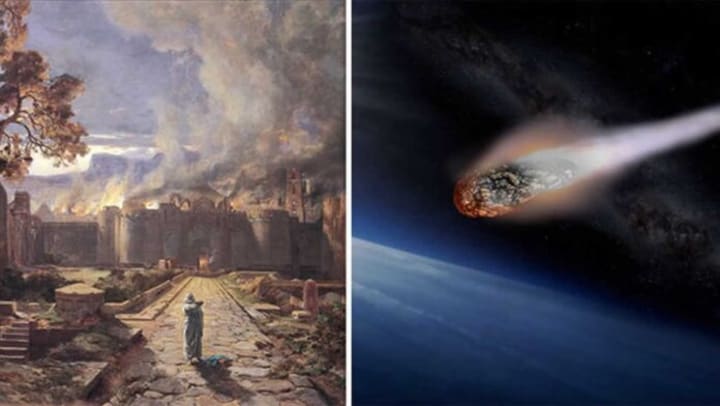
It is important to clarify that there is no scientific evidence to support the theory that a meteor and fire from the sky "melted" the ancient city of Sodom. The Biblical accounts are historical and religious, and the events described in them have not been corroborated by independent historical, archaeological, or scientific records.
The meteor and fire from heaven theory is a speculation based on a literal interpretation of the biblical accounts. However, science requires empirical and verifiable evidence to support a claim. To date, there are no archaeological discoveries or scientific data to confirm the occurrence of a meteorite impact event or the descent of fire from the sky in the area where Sodom and Gomorrah were supposedly located.
It is important to differentiate between religious interpretation of the biblical accounts and scientific investigation. Science seeks to understand natural and historical events based on tangible evidence, while religion deals with faith and spirituality. The scientific explanation for the disappearance of Sodom and Gomorrah may be related to factors such as geological activities, natural disasters, or socioeconomic processes, but requires concrete evidence to establish.
About the Creator
Ricardo de Moura Pereira
I love to read writing and watch many documentaries in history, to have more knowledge in all science.
I work with digital marketing, and create articles for newspapers and marketing content.
Keep reading
More stories from Ricardo de Moura Pereira and writers in Horror and other communities.
Was John´s apocalypse real?
The Revelation of John, also known as the Book of Revelation or Revelation, is a book in the New Testament of the Christian Bible, traditionally attributed to the apostle John. It is a highly symbolic and prophetic text that describes a series of apocalyptic visions and events.
By Ricardo de Moura Pereira3 years ago in Horror
The Animatronics Don’t Power Down Anymore
I’m 17 and I work closing shifts at Chuck E. Cheese. If you’ve never closed one before, let me explain something real quick: the place does not go quiet after the last family leaves. The lights dim, the arcade hums, and everything smells like grease and sanitizer. You hear noises that don’t belong to anyone anymore.
By V-Ink Stories3 days ago in Horror
Rachel Reviews: The Spiral Archive by Pieter Hendrik
It's difficult for me to know where to start with a review of this book as it was, for me, an entirely unique experience and one that I'll probably never have again. I don't want that to be interpreted as unenjoyable but it has left me scratching my head a little and ruminating on its content, its themes and its characters.
By Rachel Deeminga day ago in BookClub


Comments
There are no comments for this story
Be the first to respond and start the conversation.