
Veil of Shadows — The Black Eyed Children: Modern Folklore’s Most Chilling Omen
Masterful Monday Edition

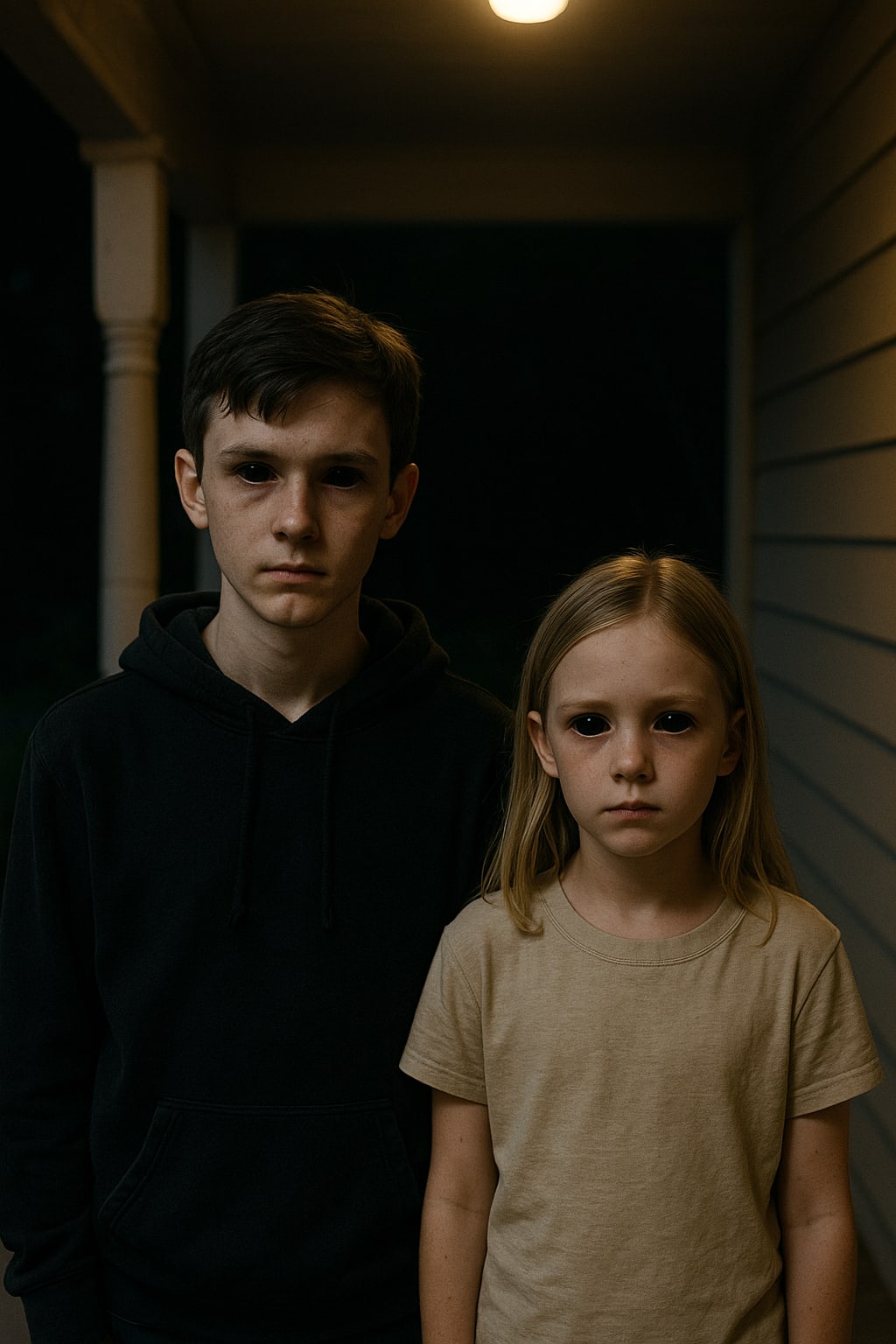
The Knock You Regret Answering
Imagine it’s late... past midnight, past reason. The house is quiet except for the hum of the fridge and the shifting sighs of old wood. Then: a knock at the door. Not frantic, not timid. Just steady. You hesitate, but curiosity wins. Through the glass of the front door you see two kids, maybe twelve or thirteen. Pale faces. Hoodies. Their posture is still, a little too still.
They ask to come inside. Their words are polite, but flat. “We need to use the phone.” “It’s cold out.” You glance at their eyes and freeze. No iris. No sclera. Just black from lid to lid, as if the sockets were filled with ink.
The air feels wrong. Your instincts howl. You grip the doorframe and mutter excuses. Their tone doesn’t change. “We can’t come in unless you invite us.”
What do you do?
That is the question at the rotten heart of modern folklore’s most persistent nightmare: the Black Eyed Children...
Act I: The Birth of a Modern Legend
Though stories of strange-eyed figures stretch back centuries, the modern legend of Black Eyed Children burst into public consciousness in the late 1990s. A journalist named Brian Bethel recounted a chilling encounter in Abilene, Texas: two boys knocked on his car window in a movie theater parking lot, asking for a ride. He nearly agreed, until he noticed their eyes. Black. Entirely. His gut told him that letting them in meant something worse than danger. He fled.
Bethel published his story on early internet forums, and soon tales poured in from across the United States, Europe, and beyond. The details varied slightly, but the core was constant: pale children, jet-black eyes, strange calm, and the need for permission to enter.
Unlike older folkloric beings, these weren’t whispers in oral tradition. They were emails, forum posts, message boards. Born in the age of dial-up, the Black Eyed Children are arguably one of the first truly digital urban legends, and yet they feel older than electricity.
Act II: Their Appearance
Witnesses describe them as children between six and sixteen years old, though rarely at the younger end of that range. Their clothing is unremarkable... hoodies, jeans, sometimes outdated outfits that make them look subtly “off.” Their skin is pale, almost waxen. Hair is typically dark. Their voices are monotone, polite, but unnerving in rhythm.
And then there are the eyes:
- Entirely black, without pupil, iris, or white.
- Glossy, like wet obsidian.
- Unblinking.
Witnesses report that looking into their eyes triggers a primal dread. Not the nervousness of an unexpected encounter, but something deeper. A gut reaction; certainty that what stands before you is wrong. Some describe it as the same chill you’d feel staring into the face of a predator, only worse because the face is human.
Act III: Patterns of the Encounter
The Black Eyed Children follow rules. And rules, as folklore teaches us, are scarier than chaos.
- They knock, or they wait silently nearby. Whether at a house, a car, or occasionally in a public place like a mall parking lot, they never break in or force an encounter. They wait.
- They ask permission. Their phrases vary... “Can we use your phone?” “Can we wait inside until our parents come?” “Please let us in, it’s cold.” But they always seek an invitation.
- They never enter without it. No story exists of them barging past someone. Their power lies in convincing you to allow them entry.
- They never leave immediately. If denied, they linger. Sometimes for minutes, sometimes for hours. Staring. Knocking again. Standing motionless until you retreat or call for help.
This pattern echoes countless older traditions: vampires who cannot cross a threshold uninvited... fae creatures that bargain for consent... spirits that only attach when acknowledged.
And yet, this is wrapped in the uncanny familiarity of childhood. They look like kids. Vulnerable, needing help. That is their weapon.
Act IV: The Dread They Inspire
Accounts agree: the presence of Black Eyed Children triggers overwhelming terror. Not just fear of the situation, but something biological, instinctive, ancient. Witnesses speak of:
- Paralyzing dread. Hearts race, hairs rise, hands sweat.
- Nausea or dizziness. As if standing too close to something toxic.
- Mind fog. Difficulty forming coherent thought, a sense of pressure in the skull.
- A warning instinct. An inner scream that says: If you let them in, you will not survive this.
One man described it as the sensation of standing on the edge of a cliff and realizing the ground beneath him was crumbling. Another said the silence of the night seemed to deepen, as though the world itself was holding its breath.
Act V: Theories of What They Are
Folklore breeds hypotheses like mushrooms after rain. The Black Eyed Children have invited dozens:
- Demons in Disguise. Their demand for permission echoes demonic lore. Pale skin, black eyes, unnatural dread—classic infernal camouflage.
- Vampiric Beings. The rule of invitation ties them to ancient vampire myth. The childlike appearance is a lure; once inside, their true form or intent is revealed.
- Extraterrestrials. Their blank, dark eyes resemble the “black almond” eyes of the Greys. Perhaps they’re hybrids, scouts, or experiments.
- Psychological Mass Hysteria. Critics argue the stories spread because fear spreads, and because shadowy kids at night play into primal protection instincts. But how do you explain the consistency of details across continents?
- Tulpa or Thoughtform. A chilling theory: that by telling the stories, by sharing them online, we created them. That belief gave form to something which now walks the dark, spreading further with each retelling.
Act VI: The Omen Effect
It’s not just the encounter. Many stories link Black Eyed Children with bad luck or tragedy afterward:
- Sudden illness.
- Car accidents.
- Financial ruin.
- Unshakable nightmares for weeks.
Sometimes the dread lingers as if the encounter is unfinished, like a door left ajar. Witnesses describe the sense that they were marked, that something unseen had followed them home anyway, waiting for another chance to be invited in.
This “omen” aspect ties them not just to vampires but to folkloric harbingers like the Banshee or the Mothman. Creatures that signal doom without causing it directly.
Act VII: Folklore Through the Ages
At their core, the Black Eyed Children are a remix of older fears:
- Vampires needing invitation.
- Fairy changelings... children who aren’t children.
- Spirits in disguise.
But by appearing as children in need, they twist the knife deeper. Humans are conditioned to protect the young. The Black Eyed Children turn compassion into vulnerability. They are the ultimate inversion of trust... innocence as predator.
Act VIII: Field Notes — If They Knock
Folklore is a survival manual written in code. Here’s what the Black Eyed Children have taught us, if the knock comes for you:
- Do not invite them in. Ever. Even out of pity. Even if they plead. Especially if they plead.
- Do not look into their eyes too long. The dread deepens the longer you stare.
- Close the door. Physical barriers seem to matter. They do not cross thresholds.
- Trust the fear. If every nerve in your body screams “wrong,” listen. Instinct is folklore’s oldest alarm.
- Do not talk about it; at least not to them. Acknowledgment may feed them. Keep your words for paper, not for them.
Closing Narration: The Knock That Echoes
The scariest thing about the Black Eyed Children is not their eyes. It’s not their persistence. It’s the fact that they wait for you to decide. They give you the rope and dare you to hang yourself with it.
When you hear a knock at night, when pale faces hover in the dark, when small voices ask for kindness, you’ll feel the pull of compassion. You’ll want to open the door.
But if their eyes are black, all black, every instinct in you will turn to stone. That’s the test. That’s the story.
So tonight, when the house sighs and the silence seems to bend, when a knock comes steady and polite, remember this: not every child is what they seem. Some are omens, waiting for your invitation to step inside.
Stay cautious. Stay curious. And never, ever say “yes.”
About the Creator
Veil of Shadows
Ghost towns, lost agents, unsolved vanishings, and whispers from the dark. New anomalies every Monday and Friday. The veil is thinner than you think....
Keep reading
More stories from Veil of Shadows and writers in Horror and other communities.
Veil of Shadows — The Kelly–Hopkinsville Goblin Encounter: A Siege, Not an Abduction
Western Kentucky, August 21, 1955. Night air pressed heavy as a quilt. A farmhouse sat low under a sky alive with cicadas and heat lightning. Inside: family voices, a card game, the long comfort of a Sunday evening. Then the dog started growling at the tree-line; no bark, just a low warning like a rope pulled tight.
By Veil of Shadows4 months ago in Horror
Let's Don't Do This
"I just can't do this anymore..." "Do what?" What can't you do? Put gas in your own car? I swear to God you make me take care of everything, don't you? You know I'm on my way to work right now but that never stops you from bothering me, does it?"
By Shirley Belk7 days ago in Fiction


Comments
There are no comments for this story
Be the first to respond and start the conversation.