
To Wet the Earth With Blood
An Essay on Pagan Subtexts in Slasher Films

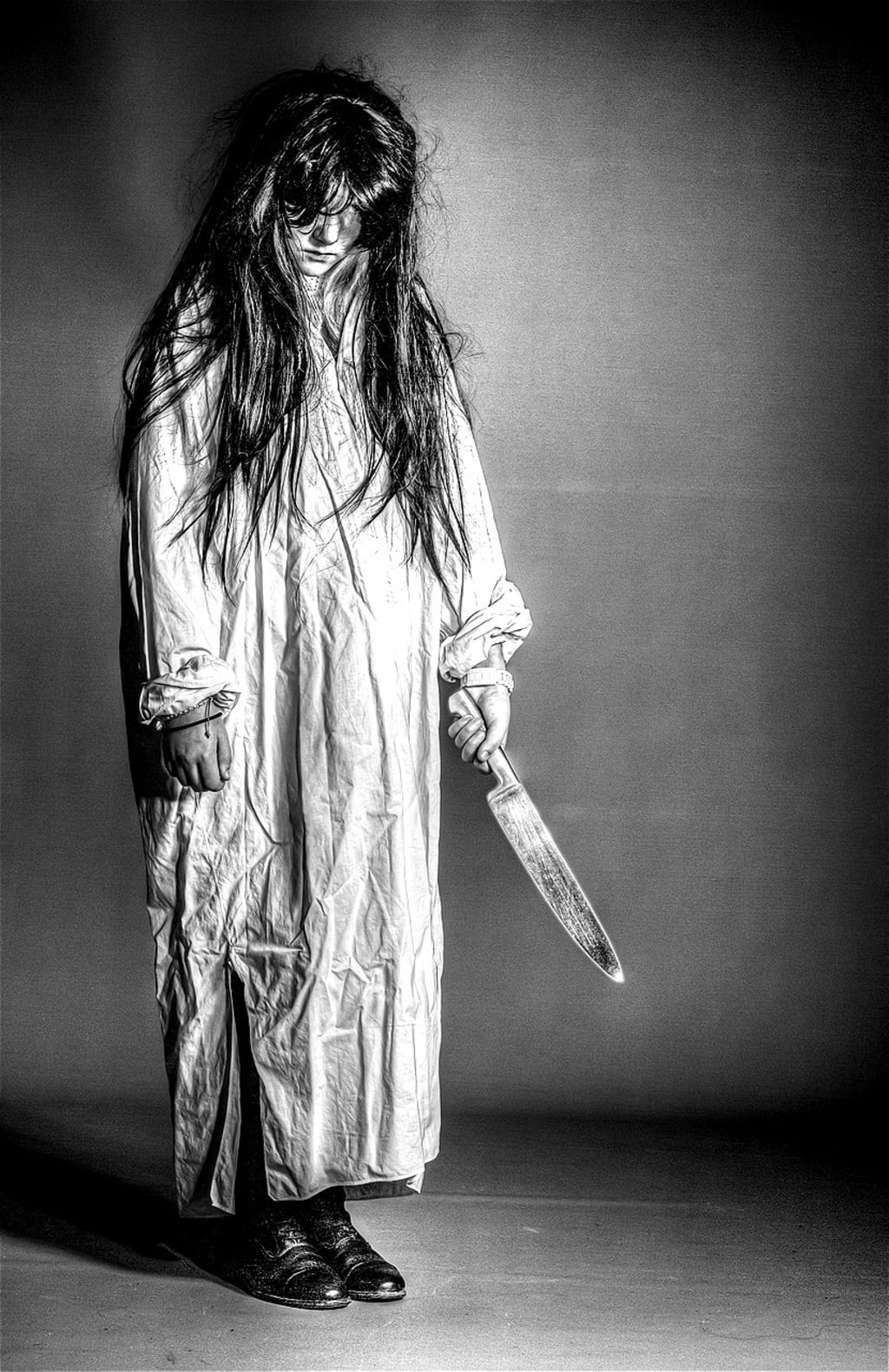
In ancient times, in the lands ruled by Druid and inhabited by Celt, human beings were burned alive on terrific bonfires, often caged (as the famous bad movie depicts) in "wicker men," tall wicker effigies in which they were imprisoned. The fires were to light the pathway of the Sun, as it fell into the kingdom of the Lord of the Dead. This Lord was SAMHAIN, ("Saveen"), and it was on his most unholy of nights when the "Hell-Gate of Ireland" was opened, and the ancient spirits so malevolent to the ursuper man, ushered forth. These creatures had been driven back, once, at the battle of Mortura, into the sea--the ancient Fomor; but, like Lovecraftian hybrids of man and monster, they would return, "when the stars were in alignment," and they needed propitiation. They, in short, demanded BLOOD.
Rust-colored birds flew the night, looking to attack wayward travelers or unsuspecting victims and graves yawned wide, opening the rotten gobs and ushering forth their crepitant beauties to howl in the night. Those moldering old bones, those dry, desiccated husks whose former beauty had long dripped down their skull, might pine for their still-born babes, taken by the Fairies to the Sid, who left in their place, the "demon-child," the "Changeling," a foul, infernal mockery of the real, living babe, hidden away past the veil, in the Fairy Glen, beyond the Hell-Gate, one supposes.
According to Ruth Edna Kelly in the Book of Halloween (1919), such Changelings could be ferreted out and expelled only through the most hideous forms of mockery or abuse. That is instructive. Alternately, one could boil eggshells in their presence, so that the devilish, inhuman tot would jump up, point, and exclaim, "I ain't never seen nothing like that in all my born days!" (Maybe not an exact quote, eh?)
One imagines the Changeling departing in a blast of rotten egg stench.
Halloween (1978)
In Halloween, John Carpenter's original slasher nightmare that set the bar for all other imitators to come, there is indeed a demon-child changeling in the form of the small, jester-suited Michael Myers, who grows up, under the wary eye of the mental health authorities, to escape the captives that have kept his murderous rampage under wraps, and has become the Shape, a silent, featureless, robotic kill-machine hellbent on cleansing the "original sin" committed by bored teenagers on the make.
Halloween is such a perfect film, starring Donald Pleasance as the obsessed Dr. Loomis, who full well knows the depths of spiritual evil Michael has descended to, this Changeling child, that he follows the escaped lunatic (who is now something more than a man) to tiny Haddonfield, Illinois, where teenager Laurie Strode (Jamie Lee Curtis) and her friends (P.J. Soles, Nancy Loomis) are living out normal, boring, bourgeois lives of middle American mediocrity. But it's Halloween, and the veil between this world and the next is at its thinnest, and the pleasant, well-clipped lawns and white picket fences of small-town Elysium are about to be put to a terrifying test.
Laurie sees the Shape behind every bush; he drives menacingly around schoolyards, and lurking playgrounds, a reminder of the very real psychopaths and predators that are a daily danger to children in our society. Little Tommy Doyle gets bullied and pushed down while carrying his pumpkin to school. He quickly runs into the Shape, tears streaming down his face. His smashed pumpkin is a symbol now; the Shape has returned to enact a primal pagan revenge; to be the avenger of Tommy, of all young initiates into the sober secrets of the season.
Halloween (1978) Trailer
Dr. Loomis and the Sherriff attempt to track Michael down. He is at first sought after at a cemetery, the burial ground; a sacred spot he has violated because it is a point of egress from the dark, swirling chaos of the Underworld, the Land of the Dead, the place where unhallowed shades bellow their eternal misery. He has violated the grave of the Sacred Motherwhose bloody sin he must expiate "see Sun to the dissolution and death of Winter season."
His abandoned home, the stark, dour sentinel of the past, the portal way or entry into that which has gone before, is where he is sought. The film tagline assures us that Halloween is the night "He came home!" Did he, or did Home resurrect itself to return to him? Is the scene being set to enact the ritualized bloodletting which is the only form of sacrifice that can expiate the Original Sin (the metaphorical incest at the beginning of the film when Michael stabs his nude sister to death, wearing the disguise of a little jester, a frolicking clown come hidden, with a deadly, pseudo-phallic implement, to enact the ritual of blood)?
Later, Annie (Nancy Loomis) and Lynda (P.J. Soles) are dispatched, one after another, Lynda after the act of making love to her boyfriend, who is likewise punished for his transgression. Michael appears wrapped in a sheet, a representational, humorous Halloween "ghost," but this is another hint of the subtext, of the haunted past coming to reclaim and rectify the future, to strangle it in its crib for its carrying on of the sin of the cursed bloodline.
Laurie Strode babysits on Halloween night. Michael has dispatched her friends and now seeks to murder the children (the offspring, the Future), like a boogeyman from an urban legend, while Laurie is stalked by him around the darkened house, hiding in closets, and at one point, even tearing off his mask, exposing the beautiful face of a young man whose looks seem at odds with the infernal paper-complexioned killing machine that is the Shape (the mask, reputedly, was a William Shatner mask offered at Halloween time, altered for the film). Loomis (Pleasance) happens on the scene just in time to deliver several shots into the midriff of Michael, causing him to fall from a window to his death.
The final denouement? He is not dead. He vanishes into the night, the robotic, nerve-jangling, now classic piano score providing a pulsebeat of terror to the audience, who can leave feeling as if, finally, there is no resolution to the horror they have just witnessed unfold on the screen. The forces of law and order (as exemplified by Annie's sheriff dad, played by Leigh Brackett) have not prevailed; nor have the forces of Reason (the psychiatrist, Loomis). The Shadow Man, the Shape, has disappeared back into the realm of darkness and dreams, the ritual bloodletting stopped just short of the sacrificial tally needed to put to rest the relentless revenge sought by this living golem of skin and bone.
Friday the Thirteenth (1980)
Made just two short years after Halloween, the equally famous Friday the Thirteenth (the first film appearance, by the way, of superstar Kevin Bacon) is a film of raw shock value, much as Halloween, and features the same sort of shambling, shape-like monster or golem, a silent living pagan idol come to life, walking around a disused summer camp, a place in disrepair, presided over by a sleazy caretaker and his retinue of young charges, all of whom commit the same sin as Annie and Lynda in Halloween (Annie being dispatched while wearing only a short, making her sexually vulnerable), the sin of premarital sex, the fornication a reversal of the Rite of Spring, as the Revenant, the Shape, comes to lead the sun to its time of death, dissolution when it will suspend the cycle of life and hibernate under the cold winter night.
At the beginning of the film, in which the viewer is made the perpetrator (somewhat similar to the masked Michael at the beginning of Halloween), we have a young hitchhiker (Robbi Morgan) picked up in a small town and transported out to Camp Crystal Lake, where she will be spending the summer getting the place ready for a new crop of youngsters when the camp reopens. We at first don't realize the menace inherent in this, until the young woman is dispatched unceremoniously in the woods, and left for dead. Our mind flashes back to the era of Ted Bundy and other such serial killers, but we have no idea if the killer is a man or woman, old or young; only that the young hitchhiker was warned by a "crazy old coot" (Walt Gorney), an "Ancient Mariner" as it were, to "stay away from Camp Crystal Lake! It has a curse on it!" Not heeding the Warning at the Threshold, she is dispatched, much as one after another, in a sadistic and hideous fashion.
Friday The 13th (1980) - Official Trailer
The central part of the film is exciting, but it is not on par with the denouement, which reveals a connection between the as-yet-unseen killer, and a mad woman (Betsy Palmer) whose son drowned while camp counselors were busy "making love." This "Sacred Mother" has taken the spirit of her dead child within her, adopting his essence as if possessed, sending his soul, his representation of himself through her flesh, to wreak bloody vengeance in the world. And, amazingly, since he too is mute (the voiceless pagan idol, the golem brought to life), she "speaks" for him. ("Kill her mommy! Kill her!")
The final scene is a shocking reminder that the spirit of this betrayed and doomed child will live on to terrorize every year, greater and greater numbers, wracking up a body count of slaughtered vestal virgins on the cusp of discovering themselves sexually, making them pay for their affront to the forces of Nature.
Sleepaway Camp (1983) and A Nightmare on Elm Street (1984)
Sleepaway Camp is an odd little film that also takes place at a summer camp. A brother and sister are sent to camp, wherein the brother is teased and the sister Angela, refuses to speak. We have earlier seen a scene wherein two children seemed to be killed in a boating accident. Next, we see an upscale neighborhood wherein a mother we assume immediately is mentally ill for her habit of talking to herself in asides (saying such things as, "Yes, yes I believe that's true," and, "No, no that wouldn't do at all!"), prepares the children to leave for camp.
Sleepaway Camp (1983) Official Trailer HD
Camp most predictably becomes another "Camp Blood," wherein people are killed in gruesomely comic ways (including the disgusting pedophile chef who tries to assault Angela), and at the end, we get the surprise twist of finding Angela is a boy, disguised be his mentally-ill mother after his brother was killed in the boating accident. This vaguely homophobic, anti-trans theme wouldn't cut it in today's movie market, but then it was a carry-over from films such as Psycho (based in part on the crimes of Wisconsin serial killer and necrophile Ed Gein). Standing naked, revealed, Angela devolves into a semi-feral animal state, another in the line of silent predatory killers who populate these films as living representations of Nature's wrath.
A different take on the typically silent Slasher is the alternately loquacious Freddy Kreuger, the champion nightmare "Dream Stalker" of the horror-infused late 1980s, a time when societal pressures and American geopolitical concerns coupled with domestic unease (brought about by shifting social mores and economic displacement; i.e. a "trickle down" that never trickled down, but "vacuumed up") brought about a glut of horror entertainment as brooding mass catharsis. There was an enormous amount of media related to horror and killing available on the home video market and even on the small screen, and Freddy (played with classic, sneering, maniacal aplomb by actor Robert Englund) undoubtedly led the pop cultural pack. Reviewers and media analysts could shake their heads, cluck their tongues, and wonder what the hell was happening to society, but teenagers seemed to understand.
A Nightmare on Elm Street (1984) Official Trailer - Wes Craven, Johnny Depp Horror Movie HD
Freddy, unlike his fellow slashers, was witty, with a desire to communicate, and at ease talking (albeit coarsely) with his intended victims, engaging in cat-and-mouse dialogs and setting up satirical nightmare "Set-pieces" wherein common situations, such as watching TV, became absurdist, surrealist horror images such as Freddy growing OUT of the TV, and claiming a victim. The aftermath, however, once shifted back to reality, was always a bloody mess (no pun intended).
Freddy's trademark murder method, slashing with his razor-tipped gloved hand, seemed a surreal snicker, an outgrowth of the industrialization that rendered the mundane Fred Kreuger, the child-molesting murderer of "fifty kids," who was lynched by the parents of the "Elm Street Children," a working-class stiff, a marginal, blue-collar nobody who toiled grievously and waited for his opportunity to avenge himself on Baby Boom society, whose opulence and comforts, class status and social graces he could never hope to achieve. His scars are the scars of a social outcast, his burnt face another clue as to how deeply thrust to the side the quick-witted maniac is. His bizarre one-liners, puns, and mocking sarcasm belie a trickster, a demonic "night hag", whose role as mad slasher seems, once again, meant to expiate the sin--the one committed personally against him; which arguably has tainted the bloodline of all the Elm Street Children, whose placid American Dream he inverts and mutilates with wicked impunity. His claw is an animalistic appendage; yet, made of metal knives. Is it his talon of oppression, turned back upon the society by which he was so condemned?
To Wet the Earth With Blood
Once, long ago, human sacrifices, in ancient oak groves, stained the earth with fresh blood. Blood was needed to propitiate the gods, as an offering to Baalim; the sickle moon reaped the harvest of souls as the Sun went down to fiery death, and the winter raged on. Samhain; "Saveen". "Summer's End."
Guilt and blood and sacrifice and death and rebirth; and the faceless, voiceless fiend, the Flesh Golem from beyond, sent as the mute monster child, belched up from the raging earth, the Mother Goddess, or an entirely older deity, a Primal Mother, demanding retribution for sin, the expiation of guilt, and the removing of the taint of incestuous breeding, the true "Original Sin." Slasher films, with their hulking, silent monstrosities of murderous mayhem, are the modern cinematic equivalent of a very ancient psychodrama, played out in various ways, with subtle changes in tonality and theme, but always with the same message: only killing can remove the guilt and shame of sex, and only the virgin will celebrate Spring. To the harlot lost in the cold, icy climes of the winter snows, here is death, death, DEATH--and nothing more.
Happy Halloween.
About the Creator
Tom Baker
Author of Haunted Indianapolis, Indiana Ghost Folklore, Midwest Maniacs, Midwest UFOs and Beyond, Scary Urban Legends, 50 Famous Fables and Folk Tales, and Notorious Crimes of the Upper Midwest.: http://tombakerbooks.weebly.com
Lideco Ghost Town Vietnam: Inside Hanoi’s Most Mysterious Abandoned City
Approximately 15 km to the west of Hà Nội city center, in Hoài Đức District, is one of the most fascinating ruin sights in Vietnam, which is the remnants of a large housing estate called Lideco Bắc 32. This location does not appear to be a typical residential area to tourists who visit there or those who hear of its existence; it is more of a ghost town.
By Kyrol Mojikala day ago in Horror



Comments (1)
Fascinating analysis. Well done, Tom.