
"'Til Eternity Passes Away"
Time, a Bottle, and the Faces of Death


I should preface this essay by stating that young people believe that life is forever.
Now, indulge us as we speak of ourselves in the "Royal We."
We're lost in the black night of our musings, waiting, ensconced in our tiny world wherein whatever webs we weave are woven and sent out along the aether, to those few eager souls who believe, perhaps rightly, that we can shuffle cardboard rectangles around a table and prophesy, forecast, or otherwise give insight to them on their "future"—i.e., whether or not they're going to be rich or meet Mr. Right or Ms. Wrong, and do the horizontal bop. That's the extent of what so fascinates and compels them to call and talk to yours truly.
Otherwise, we don't speak with other people. They have nothing for us, and we have nothing for them. It's a hard lesson, and one we've learned, piece by agonizing piece, over many a "quaint and curious" year during our long sojourn in this accursed world. We feel more comfortable in the wee hours of the morning, alone, reading cards, when the magic is at its height—when unsuspecting multitudes are rocked in the cold cradle of sleep, what Poe called "those little slices of death."
Faces of Death, directed by John Alan Schwartz as "Conan Le Cilaire," is a 1978 shockumentary examining the various "faces of death"—i.e., the way death is accomplished and dealt with in places as diverse as Africa, Mexico, Asia, etc. It's dated and hokey in spots, and much of it is an admitted "re-creation" in the manner of later shows such as Unsolved Mysteries and other real-life docudramas for TV.
However, a significant portion of it is also actual footage of heart surgery as well as the morgue: the "Mummies of Guanajuato," Mexico; the L.A. County Morgue (including an interview with famed medical examiner Dr. Thomas Noguchi, who performed the autopsy on Sharon Tate); a farm where chickens are beheaded; a slaughterhouse—all the many places death waits perched, eternally hungry, eternally feasting on the cold, bluing flesh of the doomed, of the dying.
It's narrated by "Dr. Francis Gross" (in actuality, Canadian actor the late Michael Carr), and his comfortable tones assure us that this and that face of death, "may be by far the worst. Innocent people were murdered like animals in a slaughterhouse. I personally don't know if this kind of thing can repeat itself, but if it does, we all deserve a life in Hell." He was referring to the Holocaust, and images of that atrocity are provided as stock footage here, alongside bloated cadavers and the images of old autopsies completed long, long ago.
The “Money One Earned, Not Worth a Rolled Dime”
Faces of Death is an infamous picture—or, at least, it was when we were growing up. When we were growing up, horror flicks, death metal, The Misfits, and novels by Clive Barker and Stephen King informed our worldview, compelled us to dream of the Kingdom of Death as a dark palace, wherein we felt spiritually more at home than in the workaday world of "the living," which never invited us with open arms. Faces of Death and such like video provender were part of that.
"Banned in 40 Countries," screamed the tagline on the videocassette box—and whether that was true or not, the film had a legendary aura, a mystique about it. Generations of young people have plunked down their hard-earned cash to catch a glimpse of a nauseating exploitation shocker with bad, even slightly comical recreations (a man beats a monkey in the skull to eat its brains; a death row inmate is electrocuted; a weird California necro cult feasts on the blood of the dead), and a lot of file footage of very gruesome cadavers and what is done to them. Why?
To simply impress their friends? Or to see something that was hidden from them? To confront a reality that they had, hitherto, been encouraged to cover up? That reality is that this life—this "world" we think of as real—is as permanent as a soap bubble that can burst at any time. The lights will be shut off, the world will fade to black (actually, it will be sudden; it won't fade), and you'll discover that "the money one earned is not worth a rolled dime," to quote the poem Dr. Gross recites during one segment of the picture.
Is Faces of Death good? That’s a relative question. It's certainly exploitation. Schwartz confessed that he got the idea for the film when he realized that there was a huge amount of real accident and similar footage available in the public domain and that he could acquire this footage relatively inexpensively. Thus was born Faces of Death, its sequels, and imitators.
A “Distorted Fanatic”?
A "distorted fanatic"—this is how the mild-mannered, coolly reserved Dr. Gross, with his reassuring baritone voice, refers to himself (or rather, how he claims others referred to him), upon his total immersion in the subject of “the many faces of death.”
We wrote a monograph on the subject, The Men Who Loved the Dead (written as C. Augustine), many years ago, beginning the little book in 2015, upon learning of the suicide of a female friend from childhood.
That book can be downloaded at Internet Archive only, currently; it's in an imperfect state. As someone who has already had one POD publishing platform pulled out from under him for unspecified reasons, we’ve balked at republishing it for general sale, as the subject matter is very disturbing and might be considered to violate the terms of service of the POD company we use. (Just the sort of fellow we are to write such a thing, I suppose.)
Faces of Death might not be a good film in the conventional sense, but it is an essential one to view. Actually, it transcends the medium of exploitation film, becoming a kind of intellectual confrontation to a very dark, yet inexorable curtain call—having a sort of compelling spiritual resonance. Director John Alan Schwartz, by the way, has since died.
The title of this essay is inspired by the incredible Jim Croce song, “Time in a Bottle.” If we could all save time in that way, would we not save those precious memories with our friends and loved ones who have passed into that Good Night? Alas, that bottle will remain forever broken, like the bottle stomped on at a Jewish wedding—signaling that death, like the bride represented at the wedding by the glass vessel, waits for us all as the culmination of our dark and private nuptials.
Fin.
Addendum:
Something must be said for the incredible soundtrack to Faces of Death, by musician Gene Kauer, which is one of the most amazing soundtracks ever composed for such a picture—encompassing styles as diverse as folk, country, bluegrass, jazz, lounge, and experimental. The following piece, “Los Angeles County Coroner’s Office / Morgue,” is played during the sequence documenting that place, that particular "face of death." It’s one of our favorite pieces of music from the film and one that has a lot of personal meaning for us.
Faces Of Death Soundtrack 08. Los Angeles County Coroner's Office / Morgue
Note: Due to the graphic content, I can't even post the trailer to Faces of Death here. The entire film can be viewed on YouTube and at Internet Archive.
Below is a link at Internet Archive to my book The Men Who Loved the Dead. I consider it to be in an imperfect state currently. Whether or not I will ever change that and republish it for general sale still remains to be seen.
Warning: Strongly disturbing content.
Connect with me on Facebook
My book: Cult Films and Midnight Movies: From High Art to Low Trash Volume 1.
Ebook
About the Creator
Tom Baker
Author of Haunted Indianapolis, Indiana Ghost Folklore, Midwest Maniacs, Midwest UFOs and Beyond, Scary Urban Legends, 50 Famous Fables and Folk Tales, and Notorious Crimes of the Upper Midwest.: http://tombakerbooks.weebly.com
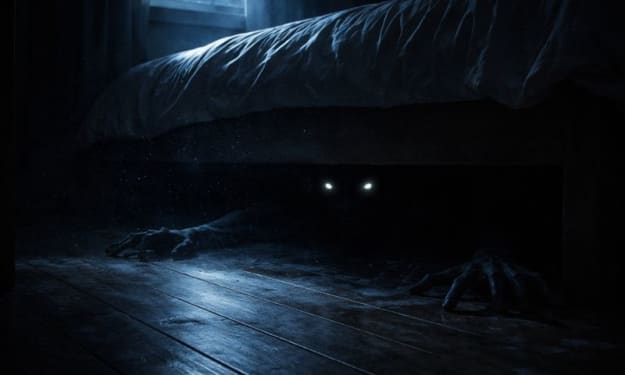
Something Is Living Under My Bed
I used to believe monsters only existed in a child’s imagination. Sharp teeth, glowing eyes, clawed hands reaching from the dark—things parents dismiss with a laugh before turning off the lights. I believed that too, once. Until the night I realized the fear under my bed wasn’t imaginary.
By David John7 days ago in Horror
Smart phones, Humans and Aliens.
WARNING. I will be tapping into one of your favorite creative tensions: The absurdity of humans worshipping their glowing rectangles as if they were tiny oracles. There’s something deliciously poetic about that contradiction, and it lends itself beautifully to an instructive proviso.
By Novel Allen4 days ago in Poets



Comments (2)
May have to look it up. Yeah, I'm twisted. What of it?
Great story once I believed life was forever, growing older was for ever. Then years pass we realise it not nothing last forever at all ♦️🙏♦️