
When the first white explorers crossed the ancient sea, they called it the Great American Desert and promptly set about distancing themselves from it. Later, others came and imposed boundaries in the form of fences. Little communities popped up like mold, flourishing and then dying again in the space of a few nights. Those that survived are a brittle folk, always aware of the encroaching emptiness of the prairie, a kind of existential agoraphobia: for better or for worse, they are alone out there.
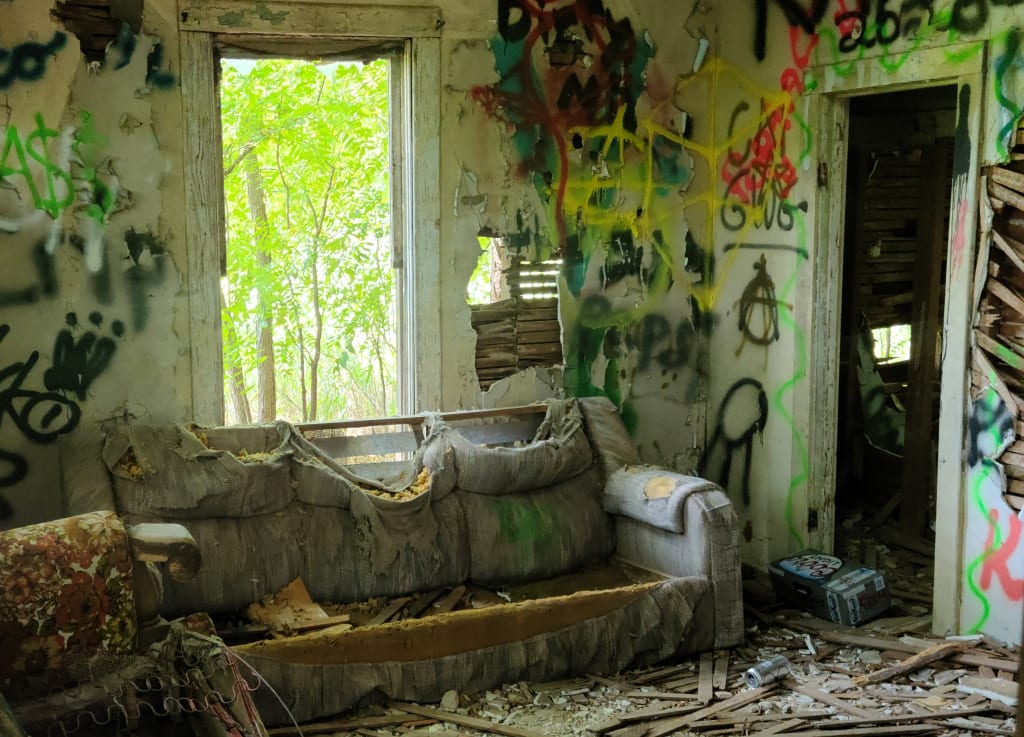
The town sat crumpled and discarded between two tank farms, whittled into an ever more bizarre shape by corporate interests and apathy. Its best days were a hundred years in the past; once there was oil here. Now the rotting, rusty tanks show an apocalypse in slow motion, crumbling back into the earth that birthed them. The houses benefitted from the obvious care given to them, but the signs were there: broken windows, more cars on blocks than zipping around the streets. Most of them were shuttered, including the one that belonged to me.
It was originally a four-room cabin that my great-grandmother acquired. By the time my grandmother came to inhabit it, an additional bedroom and an indoor bathroom had been added. It was never a lovely home, more a place of resignation than comfort. It was easy to imagine, standing in the living room with its faux brick accent wall, that no one here had ever been happy.
Standing on the front porch amongst wrought iron columns that sprouted from the roof but barely supported their weight, I catch my reflection in one of the remaining panes of glass set into the door. I favor my father: a short, swarthy man in his mid-thirties, and look nothing at all like my mother or the two women who had lived here before. But I know this place, I know the decay at its heart as well as I know my own face.
The door shudders on its hinges, but swings open easily. The house has nothing so grand as a foyer and instead opens directly into the living room. A couch, little more than faded blankets thrown over a dilapidated wooden frame, sits in front of a TV, which balances on top of an even older cabinet television set. The plush carpet, rich and nauseatingly fertile, swallows my feet, I imagine, to my ankle. The house is a swamp, and the carpet is the fetid, stinking loam from whence it drags itself. The sick scrape of insects under the floorboards is something I intuit rather than sense. If I let my guard down I will be engulfed, invaded, sullied.
I feel the house’s impatience with me as a tangible force, like the dank sweat oozing down my spine. Here is a home that I choose not to inhabit, and yet neither do I sell it or destroy it. It simply languishes, the walls bloated conduits for more primordial life, poised to burst. Perhaps that is what I want from the house, after all: to watch it die, to delight as it is pulled asunder by its own hulking weight.
Directly before me is my grandmother’s room, and to my left is the seldom-used dining room. The kitchen lay beyond that. Hang another left to access the new addition: a smoky back room where my grandfather spent his last years, rotting from the inside out thanks to rampant exposure to Agent Orange in the South Pacific.
There are pictures in the dining room of people, some of whom are living, some of whom are dead. And some of whom, like me, are both. Little girl lost and the Fisher King. Which words will make my kingdom whole? What do I need to hear to finally be rid of this place?
I make my way through the combination bathroom/laundry room, a room decorated with kitschy porcelain fish with pouty lips and fluttering lashes, balefully feminine gremlins who glare at me with contempt. Their orange, pink, and red paint has faded into a uniform dirty yellow. They peek out from every available surface. An audience, of sorts.
“Do you know how experts are able to retrace the Lewis and Clark expedition through the West?” I ask. “They pick up on mercury deposits in the soil, which they were using to treat diarrhea. We were following their festering bowels through the Americas. Of course, once they reached the west coast, they turned right back around and came back.”
“Meriweather Lewis killed himself,” I add, “three years later.”
The ceiling has dropped out of the back bedroom. Moldering shingles litter the bed and floor.
I was only eight years old when my grandfather died. I do not know if he would have loved me as well after I became a man. Here, in this house, I can imagine that I would have been safe. The walls are as snugly claustrophobic as the prairie is wide.
The sky, turning gray now as the sun sinks beyond the horizon, looks like an open, angry mouth set to devour the house. I know it will not be long now, and possibly it is already happening, that I make this trip for the last time. While I am safe within its walls, the part of me that longs to be devoured will die, will softly crumble into the cracked linoleum of the kitchen floor. Part of me has already died here; I see the curve of her ear reflected in a twist of lace curtain, the swell of her hip in the sagging back door. She is a ghost, and I am the haunted house. You might see her staring from my windows, but she isn’t really there.
About the Creator
Keep reading
More stories from writers in Horror and other communities.
Killing him slowly
There’s an intruder in my house again. He stumbles through the door, wet carrier bags in hand. He’s bought me offerings. I show my appreciation, letting him caress my beautiful body. He wants to touch me. I rub myself against his legs. He sighs, dropping the bags. He can’t resist touching me. Running his hand slowly down my spine, I arch my back towards his caress, let out a low purr. It’s what we both need.
By N J Delmasa day ago in Horror
🅼🅸🅳🅽🅸🅶🅷🆃 🆂🅽🅰🅲🅺🆂
"It's 10 in Tuscon! We all know what that means... It's Time for Midnight Snacks with your man, Gerald Gee! Ready to spend the night together? Me too! I'm full of snacks and can't wait to regurgitate them all back into your hungry ears. Crack a brew! Pop some corn! Anything to get ready for one hell of a show where the talk maybe cheap but the words cut deep...
By Lamar Wiggins7 days ago in Fiction



Comments
There are no comments for this story
Be the first to respond and start the conversation.