
The World’s Most Haunted Diamond
Beauty or Death? The Final Question

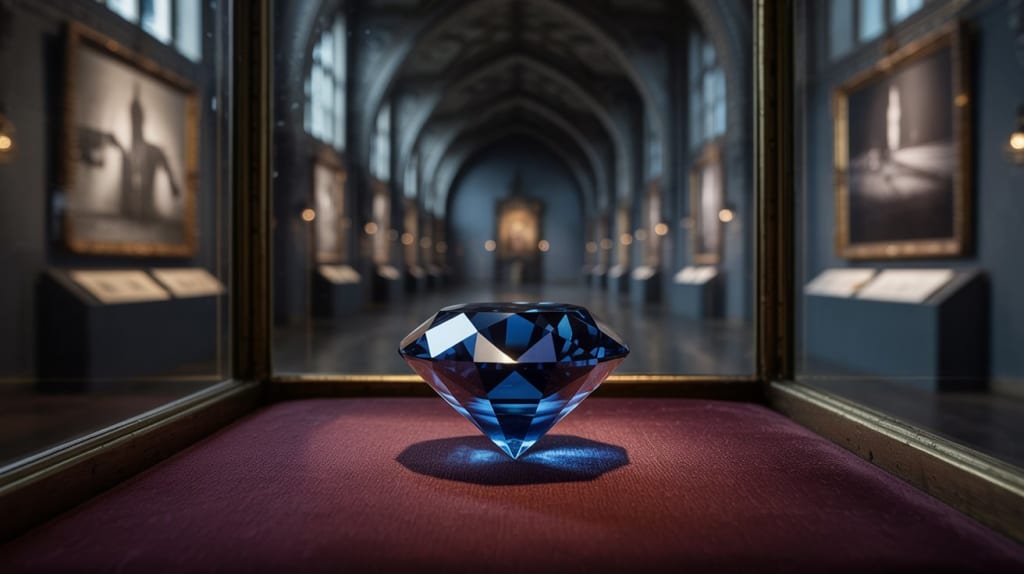
The Hope Diamond’s origins trace back to 17th-century India. Deep inside the famous Kollur mine of Golconda, a large, violet-blue stone was unearthed. At first glance, it was breathtaking—over 115 carats of shimmering brilliance. But local whispers claimed it was stolen from a Hindu temple idol, taken from the very eye of a sacred deity.
The legend says: disturbing a god’s jewel invites divine punishment. And soon, misfortune began to follow the stone wherever it traveled.
The Curse Reaches France:
In the 1660s, the diamond found its way into the hands of a French merchant, Jean-Baptiste Tavernier. He brought it to King Louis XIV of France, who fell in love with its brilliance. The king had the diamond recut into a smaller, yet even more dazzling stone, known then as the “French Blue.”
But fortune did not smile for long. Tavernier, the merchant who first sold it, died in poverty, and some stories claim he was torn apart by wild dogs. King Louis XIV himself faced tragedy—his heirs dying young, his kingdom suffering. His descendant, King Louis XVI, and Queen Marie Antoinette, who both wore the diamond, met the guillotine during the French Revolution. Many came to believe that the diamond was no mere jewel, but a silent executioner.
A Trail of Death and Misfortune:
After disappearing during the chaos of the Revolution, the diamond resurfaced years later, this time in England. It passed from one owner to another, each facing ruin or tragedy.
• A Dutch jeweler who handled the stone was brutally murdered.
• A Russian prince who acquired it was mysteriously killed.
• Wealthy owners saw their families destroyed by accidents, scandals, and early deaths.
• Every transfer seemed to repeat the same chilling pattern: beauty followed by devastation.
The Hope Family and the Diamond’s Name:
In the 19th century, the diamond landed in the hands of Henry Philip Hope, a wealthy London banker. From him, the jewel took its current name—the Hope Diamond. But hope was far from what it brought. The Hope family fell into financial ruin. Generations who inherited the diamond faced bankruptcy, scandals, and broken lives.
By now, the diamond’s reputation as a cursed object had spread across Europe. Writers and newspapers labeled it “the stone of misfortune,” a gem too dangerous to possess.
The American Heiress and Tragedy:
In the early 20th century, the Hope Diamond traveled across the Atlantic. A socialite named Evalyn Walsh McLean purchased it, dismissing the curse as mere superstition. For a time, she flaunted it proudly at parties, enjoying the envy it brought.
But the curse did not spare her. Her daughter died of an overdose, her son was killed in a car crash, and her husband was declared insane. Evalyn herself fell into depression and financial ruin before her death. The once-glamorous jewel had once again drained joy from an entire family.
The Smithsonian’s Darkest Treasure:
After McLean’s death, the Hope Diamond was sold to settle debts. Eventually, famed jeweler Harry Winston donated it to the Smithsonian Museum in 1958. Ironically, the man who delivered the diamond by mail to the museum suffered a string of personal tragedies shortly after.
Today, millions of visitors stare at the Hope Diamond, encased behind glass, glowing with an eerie blue aura. It is one of the most valuable and beautiful gems in the world—yet whispers of its curse still echo through its halls.
Beauty or Death?:
So what is the truth? Is the Hope Diamond truly cursed, or is it a chilling coincidence that so many who touched it met tragic ends? Skeptics argue that stories of the curse are exaggerated, woven to add mystery. But believers know one thing: every time a new hand held this jewel, fate turned cruel.
The Hope Diamond remains both a treasure and a warning. A symbol of how beauty can seduce—but at a price.
Even now, beneath the museum’s protective glass, one can’t help but wonder: does the diamond still wait for its next victim?
About the Creator
Keep reading
More stories from Mr. Jackie and writers in Horror and other communities.
The Enfield Voices – When the Walls Began to Speak
It was August 1977, in the small North London town of Enfield, when the Hodgson family began hearing strange noises in the night. At first, it was nothing more than faint knocking on the walls — soft taps echoing through the rooms of their modest council house on Green Street.
By Mr. Jackie5 months ago in Horror
"Scream 7" (2026): Running out of Fresh Screams
This is the seventh time we’ve had a Ghostface crisis. Scream 7 is the latest edition of the Scream franchise. Sydney Prescott and her family are under attack by another anonymous killer dressed in a Ghostface costume. While having issues with her daughter, Tatum, they run from the bloody murders, trying to determine who is behind it all.
By Marielle Sabbagabout 18 hours ago in Horror



Comments
There are no comments for this story
Be the first to respond and start the conversation.