

P
In a forgotten village at the edge of the Cholistan desert, where the wind spoke in ancient tongues and the dunes shifted like restless spirits, there lived a man named Haroon. He was a quiet schoolteacher, a man of reason, who believed in facts and rejected superstition. The villagers, however, spoke in hushed voices about an old well at the edge of the desert — a cursed place they said was sealed centuries ago to imprison a jinn.
Haroon didn’t believe any of it.
One evening, during summer break, he wandered near the outskirts of the village, curious about the well that had terrified the locals for generations. Guided by a strange pull he couldn't explain, he reached the forgotten structure — overgrown with weeds, half-buried in sand, and sealed with a heavy stone lid. A rusted iron chain was wound around it, etched with verses in ancient Arabic script. His flashlight flickered as if the very air protested his presence.
He knelt and brushed the sand away. That’s when he saw it — the carved face of a creature, half-human, half-smoke, eyes wide and mouth open in eternal scream. Despite the sudden drop in temperature and the uneasy silence, Haroon felt drawn to the lid. He remembered an old verse he once read, supposedly used to “control” spirits. He recited it aloud, laughing at himself.
But the desert did not laugh back.
The wind stopped. The chain trembled.
And then, the seal cracked.
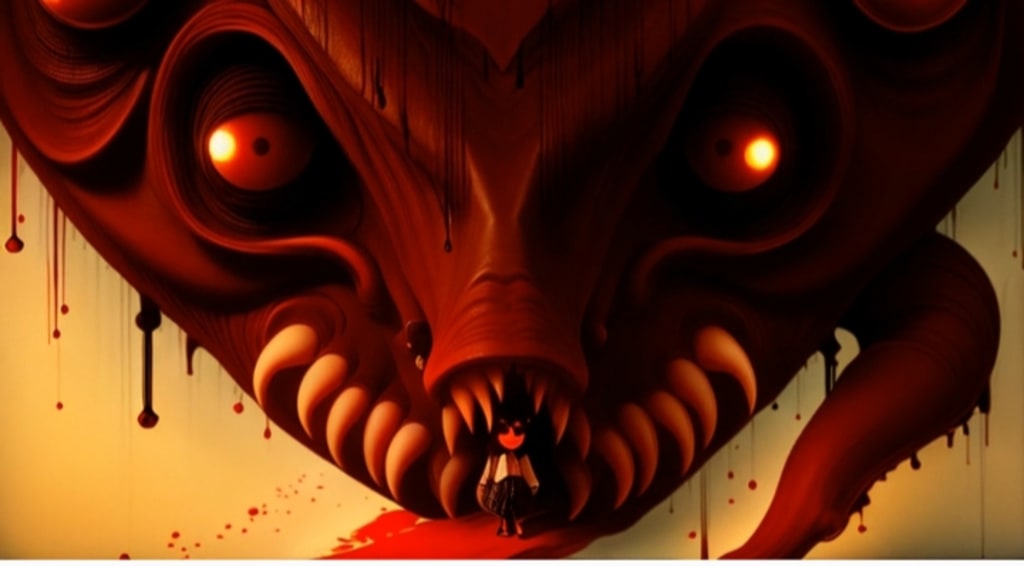
With a deafening roar, the lid burst open, flinging Haroon back. From within the depths of the well rose a swirling column of black smoke, eyes like burning coal, teeth like shards of broken glass. The jinn had been freed.
“You have summoned me,” it hissed. “And now, we are bound.”
Haroon tried to run, but his body wouldn’t move. The jinn hovered before him, changing form — now a man, now a beast, now a shadow. “You broke the seal,” it said. “So I grant you a gift.”
Haroon lost consciousness.
When he awoke in his home, the world felt different. His senses were sharper. He could hear whispers in the walls, see shadows where none existed, and feel emotions that weren’t his own. Over the next few days, he discovered he could make people obey his words, almost without question. His students, once rowdy, were now silent and fearful. Animals ran from him. Mirrors distorted his reflection.
The jinn whispered to him every night — in dreams, in silence, in firelight. “I gave you power,” it said. “Use it.”
But the power came at a cost.
Haroon began to see things. Children with black eyes watching him from alleyways. Trees that bled when he walked past. At night, he heard scratching under his bed, breathing in his cupboards, voices behind the curtains. He tried to resist the jinn, to cast it out, but it laughed. “You invited me in. You cannot unmake what is bound.”
One night, he awoke to find his hands stained with blood. A local boy had gone missing. Haroon remembered nothing, but saw flashes — a cave, fire, chanting.
Terrified, he went to the mosque and begged the village imam for help. The old man looked at him gravely and said, “The jinn are not creatures of mercy. They trick, they torment, they consume. You must return it to the well and seal it with your own blood. Only then will it leave.”
Haroon waited for the full moon. He journeyed to the well again, carrying iron nails, salt, and the imam’s handwritten verses. But the jinn was waiting.
“You wish to imprison me again?” it roared. “After all I gave you?”
Haroon shouted the verses as the wind howled and the sand stung his skin. The jinn fought back, taking the form of his dead mother, then his childhood friend, begging, pleading, taunting. But Haroon did not stop. As the final verse echoed across the dunes, the jinn screamed, and the earth cracked.
He drove the iron nails into his own hand, letting blood drip onto the seal. With a final cry, the jinn was sucked back into the well, chains clinking as they rewrapped themselves.
Haroon collapsed.
He awoke days later in the village mosque, feverish and weak. The villagers had found him unconscious near the well, the stone lid sealed once again.
He lived, but never the same. His hair turned white, his eyes always scanning the shadows. He spoke little and taught no more. Some say he still hears the jinn in the wind, waiting, whispering, watching.
Because once you invite darkness, it never truly l
About the Creator
Real life 🧬 stories
welcome to my channel this for the story real life my channel
Keep reading
More stories from Real life 🧬 stories and writers in Horror and other communities.
The Last Wheelie"
Aamir was a young man from Lahore, known among his friends for his daredevil attitude and love for motorcycles. Ever since he got his first bike at the age of seventeen, he had been addicted—not just to riding but to showing off. The thrill of the engine roaring beneath him, the wind against his face, and the eyes of passersby fixed on him gave him a sense of power he had never felt before.
By Real life 🧬 stories 10 months ago in Horror



Comments
There are no comments for this story
Be the first to respond and start the conversation.