
The Whispering Attic
Some secrets should stay locked above the ceiling .


When the Wren family moved into the weathered Victorian house at the edge of Hollowpine, they believed they had found a bargain. Tall and narrow with ivy-twined pillars, the home stood alone at the end of an old gravel road, surrounded by towering oak trees. It had a certain charm — faded, but undeniable. Mr. Wren, a history professor, called it “a home with character.” His wife, Rachel, hoped it would be a fresh start after her mother’s death. For their daughter, Lila, it was a dream — a real-life haunted house to explore.
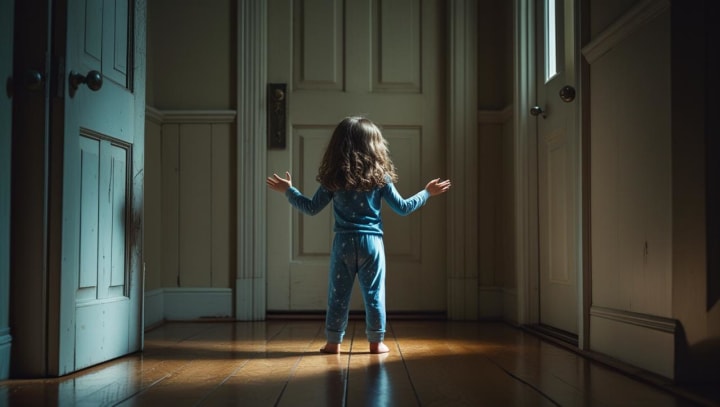
But there was one rule from the realtor, spoken in a low, almost embarrassed tone as she handed them the keys:
“Don’t go into the attic. It’s… unstable.”
The Wrens nodded, chalking it up to structural decay, and moved in.
The first week passed uneventfully. Boxes were unpacked, furniture was arranged, and Lila began school. The attic door — a narrow wooden hatch in the upstairs hallway ceiling — remained shut, its iron latch stiff with rust. At night, the house groaned and creaked as old homes do, but nothing alarming.
Until the whispering began.
It was Lila who heard it first.
Daddy?” she asked one night, standing in the doorway of her parents’ room in her pajamas. “Who’s talking upstairs?”
Mr. Wren furrowed his brow. “Nobody, sweetheart. You probably heard the wind.”
“No… it was whispering. It said my name.”
Rachel sat up straighter in bed. “Lila, it’s an old house. Sounds play tricks.”
Still, that night, Mr. Wren got up, flashlight in hand, and checked the attic door. The latch was still locked, though the wood around it looked slightly darker. Damp? Burned? He couldn’t tell in the dim light. He went back to bed uneasy.
Over the next few days, the whispering grew more distinct. Rachel heard it while folding laundry in the hallway — a gentle sibilance, like someone muttering just behind her. When she spun around, the corridor was empty.
“Did you say something?” she called to Lila downstairs.
“No,” came the distant reply.
The whispers became nightly.
They always came from above.
Lila began sleepwalking, always toward the attic, always murmuring as if in conversation. Rachel would find her standing beneath the hatch, eyes closed, mouthing silent words. When she tried to lead her away, Lila would resist, her expression blank and trance-like.
“Lila,” Rachel said one morning, gently, “what do you hear when you sleepwalk?”
Lila blinked. “It’s a girl. She’s lonely. She wants me to let her out.”
Rachel’s stomach dropped. “A girl? Who is she?”
“She says she used to live here. But they locked her in the attic for being bad.”
They called in a contractor to inspect the attic. When he arrived and climbed up to open the hatch, the moment his crowbar touched the wood, he recoiled as if burned. He looked pale.
“I don’t know what you’ve got up there,” he muttered, “but I’m not opening that. There’s something… wrong.”
That night, Rachel had a dream — or perhaps a memory not her own. A young girl, no older than Lila, was sobbing in a dusty attic. Her arms were bruised. Her dress torn. Voices shouted below, a woman screaming, “She’s not right! She talks to shadows!”
Then the attic door slammed shut. Locked from the outside.
Rachel awoke gasping.
The next morning, she drove to the town records office.

She discovered the house once belonged to the Ashcroft family in the early 1900s. A girl named Elise Ashcroft was listed as the daughter — but no death certificate existed. Just a faded news clipping about a fire that had gutted the upper floor in 1912. The cause? Unknown.
Rachel returned home trembling.
That night, Lila vanished.
They found her bedroom window open, but no sign of her in the yard. The police were called. Neighbors questioned. Search dogs brought in. Nothing.
Then, at dawn, Rachel heard it — Lila’s voice — calling faintly from above.
“Mommy… help me… it’s cold.”
Rachel screamed for her husband, and together they forced the attic hatch open. Dust fell in clouds as the wood splintered.
The attic was dry. Cold. Silent.
And empty.
Except for one thing — a child’s drawing, fresh and pinned to a rafter with a rusty nail. It showed two girls holding hands. One with pigtails.
One in black shadow.
Beneath the drawing, a single phrase was scrawled in a child’s shaky handwriting:
“Thank you for letting me out.”
They never found Lila.
The house was abandoned. Over time, stories spread. Children dared each other to knock on the old Wren house door. No one stayed past dark.
And still, above the ceiling, the whispering continues.
Calling. Waiting.
For the next child to listen.
About the Creator
Sultan Zeb
The Best story
Keep reading
More stories from Sultan Zeb and writers in Horror and other communities.
Beneath the Black Lake
They say the lake was once a village. Long before the waters rose, before the dam was built and the river redirected, a small hamlet lay nestled in a valley of pines. It had cobbled paths, stone cottages, a crooked church tower, and a single clock that struck every hour, even when the village went quiet.
By Sultan Zeb8 months ago in Horror
"Scream 7" (2026): Running out of Fresh Screams
This is the seventh time we’ve had a Ghostface crisis. Scream 7 is the latest edition of the Scream franchise. Sydney Prescott and her family are under attack by another anonymous killer dressed in a Ghostface costume. While having issues with her daughter, Tatum, they run from the bloody murders, trying to determine who is behind it all.
By Marielle Sabbag9 days ago in Horror
Architecture of the Scythe Pt. 3/5
The Architecture of a Lie The city has a remarkable, almost biological capacity for forgetting. My efforts and warning were all for not; sure enough: the digital scrolls of the *Daily Ledger*, you’ll see the narrative being woven in real-time, smoothed over like fresh concrete. "Maya Vane, 19, Perishes in Canyon Crash; Mechanical Failure Blamed." They’ve already run the op-eds about the "Vane Curse," the "Fragility of Fame," and the "Poetic Symmetry" of a daughter following her mother into the dark. To the three million souls living under the smog of this metropolis, Maya is just another beautiful ghost, a tragic face on a commemorative magazine cover.
By Nathan McAllister4 days ago in Horror




Comments
There are no comments for this story
Be the first to respond and start the conversation.