
The Weight of Unwritten Letters
Some words are too heavy to send.
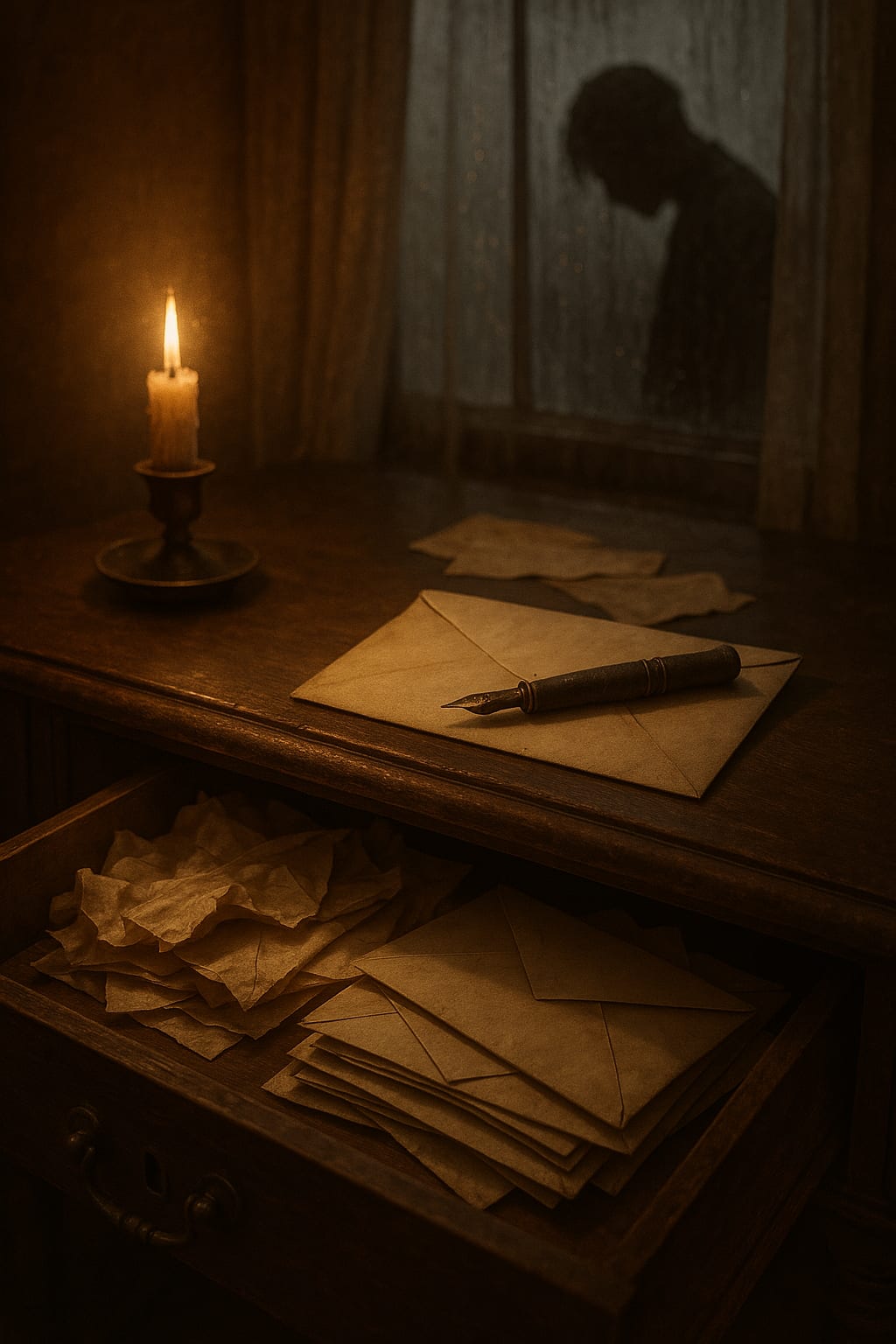
There’s a drawer in my study I haven’t opened in three years. It doesn’t creak when I tug on it. It doesn’t stick. But it resists. Not in the way wood resists rust or time—but in the way memories do.
It’s the third drawer from the top, in an old mahogany desk my mother once called “a burdened thing.” She didn’t mean it figuratively. The desk is massive, heavy, and impossibly difficult to move. Just like the things I’ve hidden inside it.
Today, for some reason I can’t name, I open it.
Inside are letters. Hundreds of them. All blank.
Creamy stationery, curled at the edges, aged by a silence I never broke.
Each one was meant for her.
Her name was Lena.
The kind of person who entered your life like a season—slowly at first, but inevitable. She brought sunlight to my cold spaces and somehow turned small talk into symphonies. I met her in a used bookstore six years ago, where we both reached for the same copy of The Bell Jar. Her hand brushed mine. She smiled. I apologized awkwardly and offered her the book. She refused. We ended up buying two different ones, but walking out together.
She stayed.
We weren’t lovers. At least not in the way the world defines love. There was no kiss under a moonlit sky. No exchanged keys. No promises that echoed in vows. But she knew my favorite type of tea and the way I tapped my fingers when I was lying. She understood the silence I retreated into when I was overwhelmed, and I, in turn, memorized the exact kind of laugh she gave when she didn’t find something funny—but loved that I did.
We were unfinished. Not because we lacked time—but because I lacked courage.
I started writing her letters the week she left.
Not because she asked for them.
Not because I thought she’d read them.
But because I didn’t know how else to bleed.
The letters in this drawer—all of them—start the same way.
“Lena, I meant to say this before…”
But none of them continue.
Not even a second line.
Just silence. Heavy. Infinite. Guilt-ridden.
I wanted to tell her that I missed her in ways that didn’t make sense—that I missed the shape of her in the kitchen doorway, humming without lyrics, and the way she left post-it notes with terrible poetry on the fridge. I wanted to say I should’ve asked her to stay when she said she was thinking of moving back to Oregon.
I wanted to say I was in love with her.
But every time I sat down, the words curdled inside me. I wrote nothing. Just her name and that one sentence. Then I'd put the page away and start another.
Unwritten letters piled up like regrets.
Three years ago, Lena was killed by a drunk driver.
Crossing a street in Portland.
A letter she never got was in my coat pocket when I got the call. Blank. Like always.
They asked if I wanted anything from her apartment.
I said no.
I lied.
What I wanted—what I still want—is a chance to tell her what I never could.
I never deleted her contact. Her name still pops up in my “frequently messaged” list, as if my phone, too, is waiting for me to finally write something worth sending. Sometimes I think about texting her, just to feel the pain of the undelivered message. Just to remember she was real.
Just to feel something sharper than regret.
Today, I pull one of the blank pages from the drawer and finally write more than that single line. My hand trembles, but not from fear. From release. The kind that only comes when you stop rehearsing your sorrow and just let it speak.
Lena, I meant to say this before…
But I didn’t know how to tell you you mattered more than anyone.
That every moment with you felt like a soft rebellion against everything I was taught love had to be.
I didn’t know how to say I loved you in quiet ways.
And that I still do.
Even now.
I don’t stop writing. I fill the page. Then another. And another.
It’s not elegant. It’s not poetic. But it’s honest.
When I’m done, the drawer feels lighter. So does my chest. Grief doesn’t leave, but it changes. It becomes something you can carry without sinking.
I take the letter, seal it, and write her name on the front.
Then I walk out of the house and down to the nearby river.
The sun is setting. The sky is that same soft orange she used to call “apricot gold.”
I let the letter go.
The wind doesn’t protest.
The water doesn’t resist.
And for the first time in years, I breathe without hurting.
Because even unwritten letters have weight.
And sometimes, the only way to be free of them…
…is to let them go.
About the Creator
Keep reading
More stories from junaid ali and writers in Horror and other communities.
The Clock That Ticked Backwards
The old grandfather clock had been in the attic for over a hundred years, wrapped in a moldy tarp and forgotten by every generation that lived in the Carrington house. It didn’t make a sound—not a tick, not a chime. It just stood there like a silent sentinel guarding something it never wanted to share.
By junaid ali6 months ago in Horror
One to See, One to Speak, One to Listen
Contains gore and horror some readers may find disturbing. Rated 14+ Author's Intro: This story is meant to revive the Gothic literature so famously crafted by one of my favourite writer's, Edgar Allen Poe, and as such, the language and style is deliberately antiquated. Thank you for reading my all time favourite work of horror - Les
By Call Me Les20 days ago in Horror
Ludacris and Nelly draw backlash over bookings at MAGA-coded music festival
Ludacris and Nelly headlining a mostly right-wing event is good for them. It’s also great for the genre of hip hop. The two rap veterans have showcased their talents on other stages. Why can’t they perform for mostly MAGA folks and grab that bag?
By Skyler Saunders5 days ago in Beat


Comments
There are no comments for this story
Be the first to respond and start the conversation.