
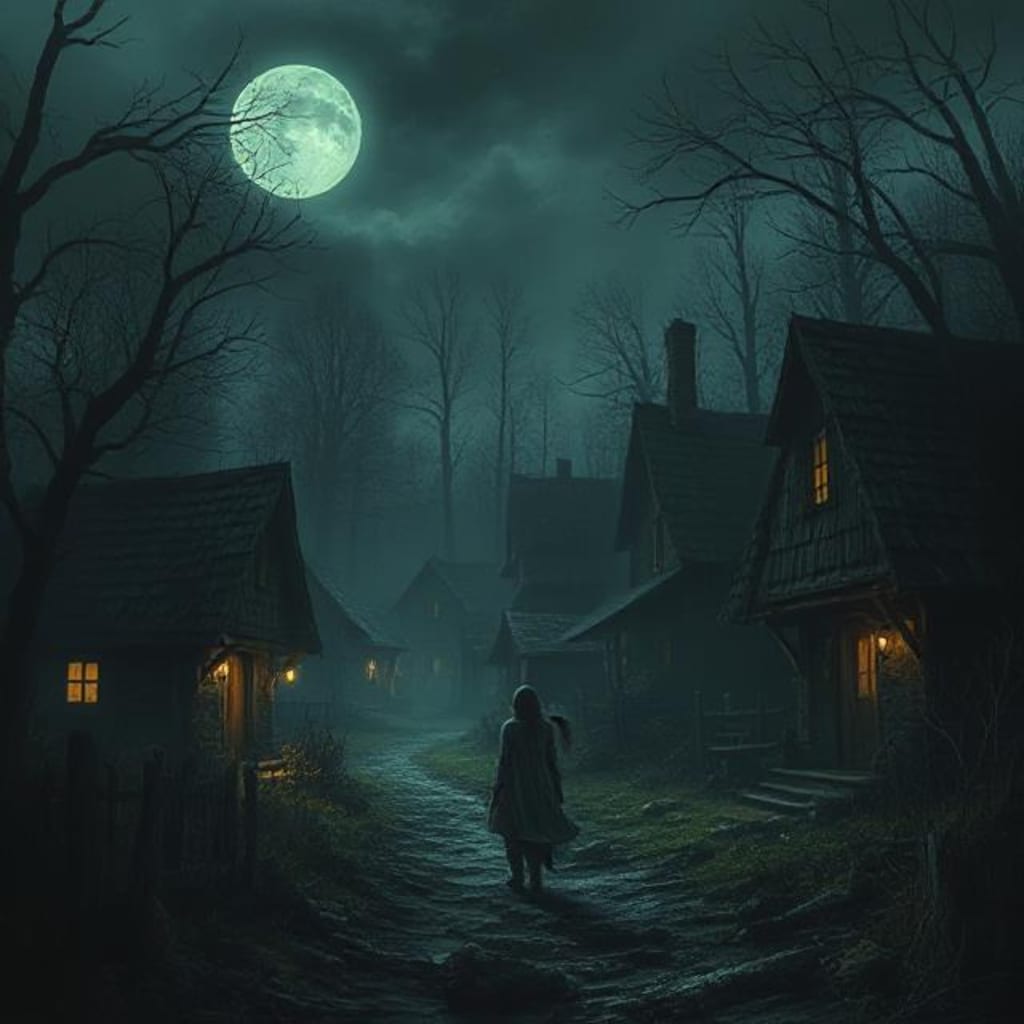
Where Nightmares Walk the Streets
The people of Black Hollow hadn’t slept in thirty nights.
At first, it was subtle. Tossing, turning. Children waking with night terrors. Pets acting strange, pacing in circles or staring at corners. The townsfolk thought it was just the cold season settling in—a long winter was common in the hills.
But then came the whispers.
They began just after midnight. Faint, like wind through cracks in the old stone homes. But the wind never called your name.
On the twelfth night, Father Hargrove rang the church bell without explanation and wandered into the woods, barefoot in the snow. They found his boots by the bell tower. They never found him.
By the twentieth night, the village was unraveling.
No one could rest. Even with eyes closed, sleep wouldn’t come. Faces grew pale and hollow. Tempers snapped like dry twigs. Crops wilted. Chickens stopped laying. The once-vibrant Black Hollow was now a ghost of itself, filled with wide-eyed people afraid of closing their own.
Mira Ellison, a schoolteacher, was the first to believe the cause wasn’t natural. She hadn’t dreamt in three weeks, and every time she blinked too long, she saw her—a girl in white, standing at the edge of the well in the center of town.
Mira didn’t tell anyone. Not yet.
That night, she lit a candle and waited by the window. Fog crept in early. Midnight came. The whispers followed.
But this time, they didn’t just float through the air.
They came from below.
From the well.
She stepped out into the mist, candle trembling in her hand. The village square was dead silent, not even the usual creak of old shutters or the rustle of trees. Just a stillness so thick, it pressed against her skin.
She approached the well.
The whisper was clearer now. Not a moan. A voice.
"Why did they forget me?"
Mira’s breath hitched. She leaned closer.
A face formed in the darkness—pale, with eyes like voids and hair like soaked ash. The girl.
Mira stumbled back, dropping the candle. It hissed out in the snow.
The next morning, Mira gathered what strength she had and searched the town archives. Hidden beneath records of harvests and births was a name: Annabeth Wren. Died in 1872. Cause: house fire. Age: fifteen. No funeral record. No burial.
Mira showed the town council. Most scoffed. A few crossed themselves. Only old Edith Moore, the former midwife, believed her.
“I was a child,” Edith said. “But I remember. She was accused of witchcraft. They never buried her. Tossed her body in the well to keep her spirit from escaping.”
That night, Mira led a group of villagers to the well. They lowered a lantern and a rope.
It didn’t take long.
The remains were still there—small, hunched, wrapped in a scorched shawl. Her bones were tangled in roots and rusted chains.
They buried Annabeth on the hill, beneath the lone willow tree. Mira placed a handmade doll at the grave, just like the ones Annabeth had sewn for the village children before the fire.
They waited.
And for the first time in thirty nights, the whispers did not come.
The fog lifted with the morning sun. People yawned, laughed, wept. Black Hollow breathed again.
But the well remains sealed with iron nails and salt. The church bell lies cracked in two, never replaced.
And every winter, when the snow returns and the air goes still, the villagers light candles around Annabeth’s grave and whisper apologies to the dark.
Because the village knows better now.
To forget the dead… is to invite them back
About the Creator
THE BEAUTY OF NATURE
Where Peace Begins and Wonder Never Ends Nature is not just the background of our lives — it is the heartbeat of the world. Every rustling leaf, flowing river, and quiet sunrise speaks a silent language, reminding us that beauty exists not just in art or architecture, but all around us, in the trees we pass by, the air we breathe, and the stars that blink quietly above.
By A KHAN9 months ago in Motivation



Comments
There are no comments for this story
Be the first to respond and start the conversation.