
The Tragic Tale Oiwa
Bloodstained Kimono:Oiwa's Revenge Echoes Through Time.
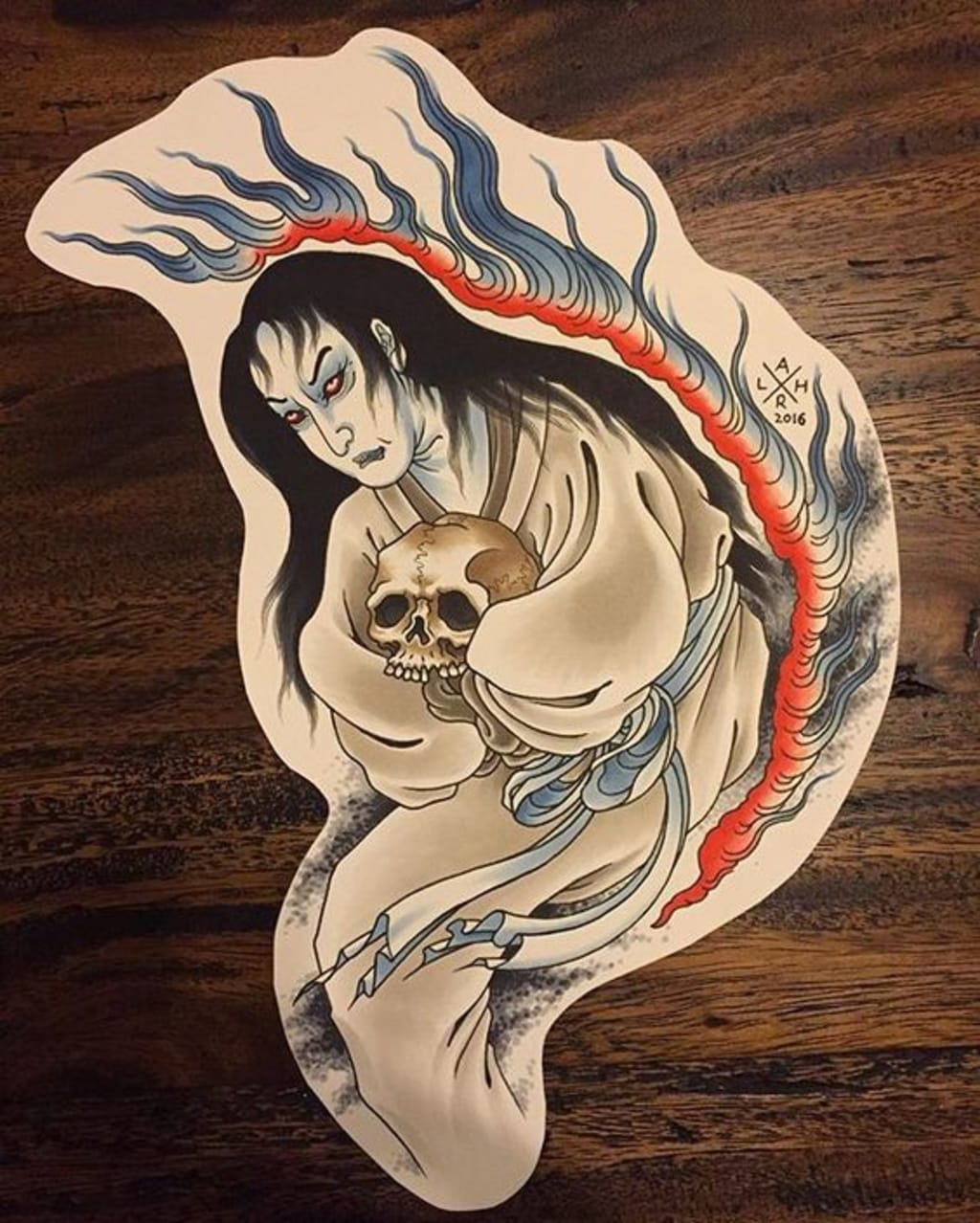
The Tragic Tale of Oiwa: A Vengeful Ghost Seeking Justice
In the world of Japanese folklore and ghost stories, there exists a haunting and heartbreaking tale that has captivated the hearts and minds of countless generations. The story of Oiwa, a young woman whose life was tragically cut short by the treacherous actions of her husband, has become a symbol of enduring love, revenge, and the supernatural. This chilling narrative has been retold and reimagined in various forms of art and literature, cementing Oiwa's place in the annals of Japanese ghost legends.
The story of Oiwa begins in the Edo period of Japan, during the 17th century. Oiwa, a beautiful and virtuous woman, married a man named Iemon, a ronin without a master who struggled to make ends meet. Their love was genuine, and their lives seemed perfect, until tragedy struck. Iemon became consumed by ambition and greed, desiring a wealthier and more advantageous life. To achieve his goals, he hatched a sinister plan to eliminate Oiwa, his innocent wife.
Iemon poisoned Oiwa, leading to her slow and agonizing death. To make matters worse, he conspired with a conniving associate named Takuetsu to murder Oiwa's father, further securing his position and wealth. The brutal betrayal of her husband and the murder of her beloved father were the last things Oiwa experienced in her earthly life. As she lay dying, her once-beautiful face became grotesquely disfigured by the poison, leaving her with a twisted and ghastly appearance. Oiwa's suffering and the injustice of her death created a powerful and vengeful spirit that could not rest in peace.
The tale of Oiwa's relentless quest for revenge is deeply embedded in Japanese culture. She is often depicted as an onryō, a vengeful spirit that returns from the afterlife to seek justice or retribution. Her disfigured face, concealed by a white kimono, became an iconic symbol of Japanese horror. This image is known as the "Oiwa face" and is frequently featured in kabuki plays, ukiyo-e woodblock prints, and various forms of literature.
One of the most famous adaptations of Oiwa's story is the kabuki play "Yotsuya Kaidan," written by Tsuruya Nanboku IV in 1825. In this play, Oiwa's vengeful spirit relentlessly pursues Iemon, causing him to descend into madness and despair. The play has been adapted and retold countless times over the years and remains a staple in the Japanese theatrical tradition.
The enduring popularity of Oiwa's story also extends to literature, film, and television. Her tale has inspired numerous adaptations and retellings, with modern interpretations still captivating audiences. Her character and story continue to resonate because they explore timeless themes of betrayal, love, and revenge.
Furthermore, Oiwa's story has influenced the broader genre of Japanese horror, inspiring countless other ghost stories, films, and novels. Her legacy is intertwined with the enduring fascination of the supernatural and the macabre in Japanese culture.
The tragic tale of Oiwa is a haunting reminder of the enduring power of love, betrayal, and vengeance. Her story has transcended generations and mediums, making her one of the most iconic figures in Japanese folklore. Oiwa's relentless pursuit of justice from beyond the grave serves as a cautionary tale, reminding us of the consequences of treachery and the persistence of the human spirit, even in the face of death. The legend of Oiwa continues to captivate and terrify, a testament to the enduring power of a woman wronged and her unquenchable thirst for revenge.
Oiwa's story has also been interpreted through a feminist lens in more recent times. In the modern era, her tale has been seen as a symbol of women's resilience and the fight against domestic violence. Oiwa's transformation into a vengeful spirit can be seen as a metaphor for women who have suffered at the hands of abusive partners and society's injustices, rising up to demand justice and retribution.
The character of Oiwa has not only inspired artistic expressions but also found its way into popular culture, both in Japan and abroad. References to Oiwa and her vengeful spirit can be found in various manga, anime, and even horror video games. Her story continues to captivate a new generation of audiences, ensuring that the tragic tale of Oiwa remains an enduring part of the cultural landscape.
In conclusion, the story of Oiwa is a timeless and haunting narrative that has left an indelible mark on Japanese culture. Her tale of love, betrayal, and relentless revenge transcends generations and continues to inspire countless adaptations and reinterpretations in various forms of art and media. Oiwa's enduring presence serves as a testament to the enduring power of storytelling and the universal themes of love and vengeance that resonate with people from all walks of life.
About the Creator
Killing him slowly
There’s an intruder in my house again. He stumbles through the door, wet carrier bags in hand. He’s bought me offerings. I show my appreciation, letting him caress my beautiful body. He wants to touch me. I rub myself against his legs. He sighs, dropping the bags. He can’t resist touching me. Running his hand slowly down my spine, I arch my back towards his caress, let out a low purr. It’s what we both need.
By N J Delmasa day ago in Horror
The Revenge of the Dead
This story takes us back fifteen years, when Asif and Rizwan were medical students. One day, while studying human anatomy in class, their teacher announced, “Dear students, after the upcoming two holidays for the Islamic festival, I will take a full test on the human skeleton.”
By Sudais Zakwana day ago in Horror




Comments
There are no comments for this story
Be the first to respond and start the conversation.