
The Town That Forgot It Had a Name
In a quiet valley untouched by maps, a town thrives without knowing who—or what—it once was. There are no signboards, no records, no memory of its name. Yet every person feels the echo of something missing. When a stranger arrives asking questions, the silence begins to unravel.


No one remembered the name of the town. Not the children chasing kites across sunbaked fields, nor the elders sipping bitter tea under fig trees. Even the schoolteacher, who kept a record of everything from harvest dates to the height of every student, left the space for the town's name blank.
People didn’t talk about it. It wasn’t denial, just silence—as if naming things had become dangerous.
The post office bore no sign. Letters arrived addressed simply to “That town near the twin hills, beyond the crooked river.” They always found their way, as if the wind itself remembered.
Children once asked their parents, “What is this place called?” The answers varied.
“It doesn’t matter,” some would say.
“It had a name, long ago,” others whispered.
“The town forgot,” said a few, and left it at that.
The forgetting felt natural—like rain fading chalk from a wall.
One morning, as spring painted the valley gold, a stranger arrived. He wore a blue coat and dusty boots. His satchel held maps—real ones, with borders and labeled cities. He said he was a writer, traveling through forgotten towns, stitching together histories.
“But how can I write about a town with no name?” he asked the baker.
The baker frowned, sprinkling flour like it was a ritual. “Names are overrated. Bread doesn’t care what town it’s baked in.”
He asked the librarian, who dusted off a shelf of nameless, handwritten books. “Try the archives,” she offered with a shrug, though the records ended fifty years ago and even those had pages missing.
Then he asked a child, playing near the well.
“Why doesn’t your town have a name?” he asked.
The child paused. “It did. But we lost it. Like you lose a button. One day, it was just... gone.”
“Do you want it back?”
The child looked at him curiously. “Would it make a difference?”
The stranger began his search anyway. He asked questions no one wanted to answer. He wandered the graveyard, reading weather-worn stones, but most bore only first names. No dates. No places.
At the edge of town, he found a crumbled sign buried under wild grass. Faded letters barely visible: E L D E R. Was that the name? Or a warning? No one could tell.
He brought the sign into the town square, raising it like an artifact. The townspeople gathered. Eyes narrowed. The silence thickened.
“We must remember,” he said. “Your past matters.”
But they didn’t applaud. They didn’t cheer. The mayor, a woman of few words, stepped forward.
“We didn’t forget because we were careless,” she said. “We forgot to survive.”
She explained, slowly, like telling a bedtime story no one wanted to hear again.
Decades ago, the town was caught in a war—not of armies, but of ideas. Flags changed, names rewritten, histories edited. Every few years, a new ruler came with a new name, each insisting theirs was the true one. Elders were punished for remembering the old. Children were taught different stories each decade.
So, they chose to forget.
Better to be nameless than to be branded wrongly. Better to build lives than defend labels.
“And we’ve been free ever since,” she finished, her voice soft but steady.
The stranger stood stunned. “But identity—memory—these are important!”
A carpenter in the crowd replied, “We remember what matters. We remember faces. We remember kindness. The name didn’t hold us together—living did.”
The writer didn’t argue. He left the next morning, leaving behind his maps, his pens, and a single note pinned to the community board:
“A town with no name, but with more soul than cities with a thousand.”
Years passed.
The children grew into adults. The mayor grew old and passed quietly, her grave marked simply:
“She led us gently.”
Still, the town thrived. Without a name, it remained untouched by politics, war, and ambition. Travelers came and went. Some called it "Whisper Hollow." Others, "The Place Beyond the River." None of the names stuck.
And then one day, the child who once spoke to the stranger—now grown and weathered—stood in the town square with their own child, pointing to the old library, the crooked river, the twin hills.
“What is this place called?” the child asked.
The parent smiled.
“This is home,” they said.
And that, for them, was always enough.
________________________________________

About the Creator
Hamza khan
Experienced article writer with a passion for crafting engaging content. Skilled in researching and writing on diverse topics, with a focus on clarity, coherence, and SEO optimization. Proven track record of delivering high-quality articles
Keep reading
More stories from Hamza khan and writers in Horror and other communities.
"Scream 7" (2026): Running out of Fresh Screams
This is the seventh time we’ve had a Ghostface crisis. Scream 7 is the latest edition of the Scream franchise. Sydney Prescott and her family are under attack by another anonymous killer dressed in a Ghostface costume. While having issues with her daughter, Tatum, they run from the bloody murders, trying to determine who is behind it all.
By Marielle Sabbag4 days ago in Horror
The Bridge That Whispers
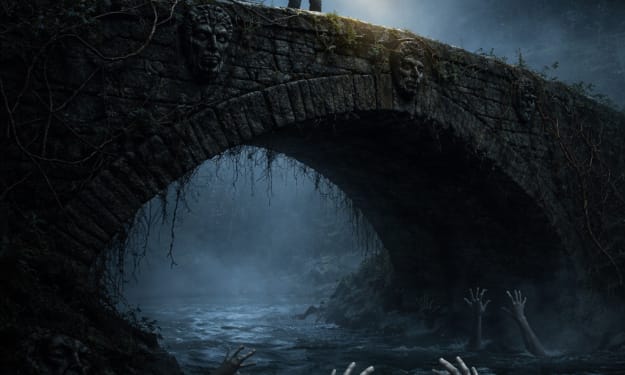
In bridge no one used anymore. It curved gently over a narrow river, its surface cracked and moss-covered, as if time itself had tried to bury it. Locals crossed the modern bridge downstream, leaving the old one to the fog, the wind, and the stories. Tourists were told the bridge was unsafe. Children were told it was haunted. Elena heard about it on her first night in Greyhaven. She had come from the city to catalog historical structures for a regional preservation project. Greyhaven was her last stop—quiet, remote, and perfect for work. The innkeeper, a thin man with pale eyes, hesitated when she mentioned the old bridge. “Don’t go there after sunset,” he said. “It talks.” Elena laughed politely. She had spent years documenting ruins, castles, and forgotten churches. Every village had a ghost story to protect a pile of stones. Still, she noticed how the innkeeper’s hand trembled when he handed her the room key. The next morning, Elena walked to the bridge with her camera and notebook. In daylight, it looked harmless—beautiful, even. Wildflowers grew between the stones, and the river below whispered softly. She took photographs, measured the arch, and noted the erosion. There were strange carvings on the sides: not words, but twisted symbols, worn almost smooth. That night, she dreamed of water. In her dream, she stood on the bridge in thick fog. The river beneath her was silent, black as ink. From the stones under her feet came a low sound, like breath passing through teeth. Come back. She woke suddenly, heart racing. Outside her window, the fog was rolling in from the hills. Elena told herself it was only a dream caused by fatigue. But the next night, it happened again. This time, the whisper was clearer. Come back to us. On the third day, she asked a woman in the village café about the bridge. The woman stopped stirring her coffee. “They drowned there,” she said quietly. “Long ago. When the river flooded, the bridge broke in the middle. A wedding party was crossing. Carriage, horses, music… all gone. People say the stones remember the weight of them.” Elena felt a chill run down her spine. “That’s just a story, right?” The woman looked up. “Stories begin somewhere.” That evening, driven by curiosity and something darker—something pulling at her—Elena returned to the bridge at dusk. Fog wrapped around the riverbanks like a living thing. The modern bridge lights glowed far away, safe and distant. She stepped onto the old stones. The air felt colder in the center of the bridge. Her breath became visible. Then she heard it: soft footsteps behind her. She turned. No one was there. The river below began to make a different sound—not water, but voices. Murmuring, layered and slow. Stay. Elena backed away, but her foot caught on a broken stone. She fell to her knees. The carvings along the bridge seemed deeper now, sharper. They formed shapes—faces, frozen in stone, mouths open in endless screams. Hands rose from the mist. They were pale, dripping, reaching for her ankles. Elena screamed and scrambled backward, tearing her coat on the rough stone. One cold hand brushed her skin, and in that moment, she saw it: a flash of the past. Horses panicking. A carriage tipping. People crying out as dark water swallowed them. And then silence. She ran. By the time she reached the inn, her legs were shaking so badly she could barely stand. The innkeeper saw her face and said nothing—only locked the door behind her. She left Greyhaven the next morning without finishing her work. Months later, her report mentioned “structural instability” and “severe erosion.” It said nothing about whispers or hands or memories trapped in stone. But sometimes, when Elena stands on bridges in other cities—busy ones filled with traffic and noise—she feels a vibration under her feet, like a distant echo. And in the sound of rushing water, she hears a familiar voice: Come back.
By Iazaz hussain3 days ago in Horror
A Historic Declaration
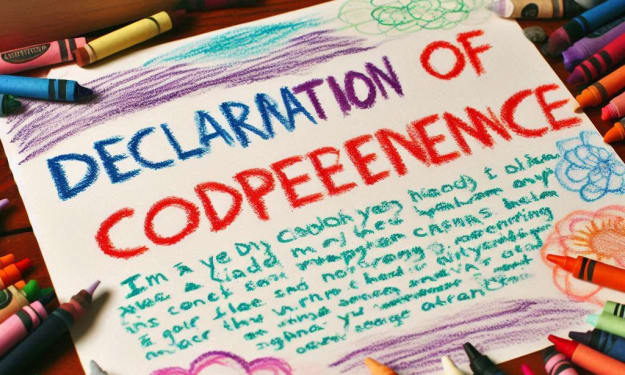
We the People of the Husbands of the United States of America, in Order to form a more perfect Union, and I mean you...with me...establish Justice, insure domestic Tranquility, provide for the common defence, promote the general Welfare, and secure the Blessings of Liberty to ourselves, after Puberty, do ordain and establish this Declaration of Co-Dependence.
By Gerard DiLeo7 days ago in Humans


Comments
There are no comments for this story
Be the first to respond and start the conversation.