
The secret of the painting "The Scream" - the inspiration for the horror movie "Ghostface"
The secret of the painting "The Scream" - the inspiration for the horror movie "Ghostface"

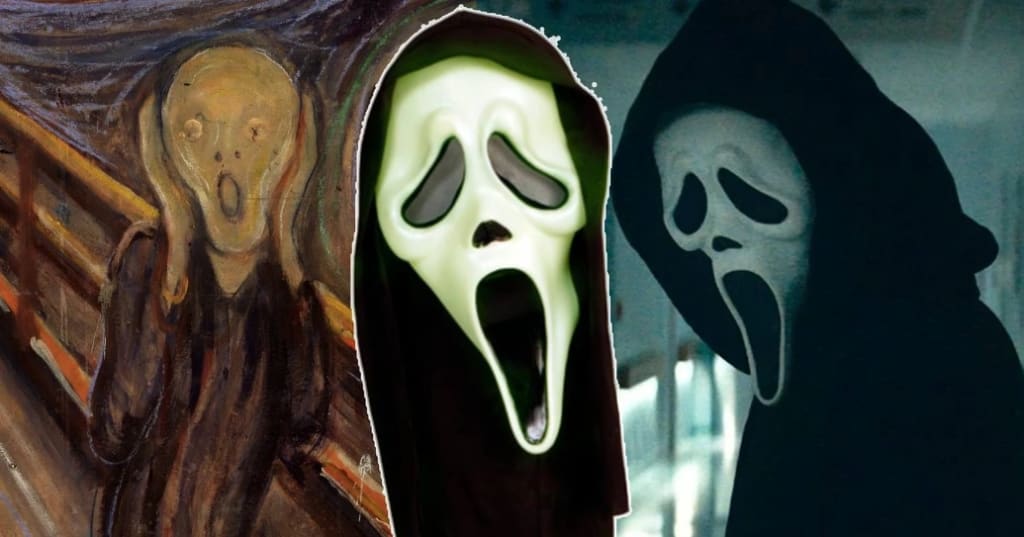
"Ghostface": Horror character inspired by the blockbuster "Scream"
Ghostface, the killer in the horror film series "Scream", is characterized by his white mask. This mask was originally made by a costume company for Halloween.
The mask was inspired by the painting series "The Scream" by famous artist Edvard Munch. Since the first episode was released in 1996 until the following films, the killers appearing in the horror film series "Scream" have always worn black cloaks and white masks, which is an unchanging "fashion formula" of the character Ghostface.
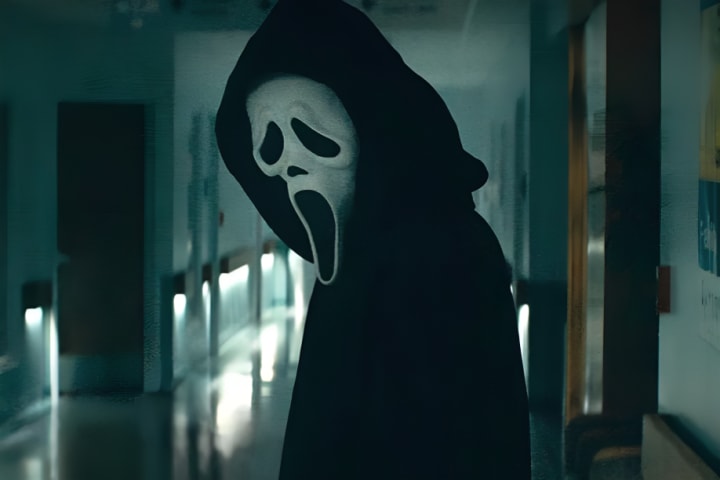
Currently, "Scream" - the 5th film in the series has been released in theaters and received many positive reviews from critics. The film's revenue is also very positive when in just the first week of release, the film earned nearly 52 million USD from a production budget of 24 million USD.
Besides the "Scream" series, there are many other famous cultural products inspired by the "Scream" series of paintings by the famous artist Edvard Munch. For example, the expression of the boy Kevin on the poster of the movie "Home Alone" (1990) was inspired by the painting "Scream".
The emoticon depicting a face screaming in fear was also inspired by the painting "The Scream". And many other applications in popular culture also originated from this famous painting.
In fact, Norwegian artist Edvard Munch made four "The Scream" paintings, the first two of which he did in 1893, the other two in 1895 and 1910.
The "Scream" series is known as "portrait of the soul", "face that challenges psychologists", in which the artist depicts a distorted human face with two hands covering the face, eyes and mouth wide open. The background is a chaotic world like in a nightmare. The "Scream" series is considered one of the icons in popular culture.
Behind the "bony", distorted figure, mouth open, face expressing terror against the backdrop of a threatening red sky, there are deep secrets...
The painting "The Scream" does not actually depict anyone screaming.
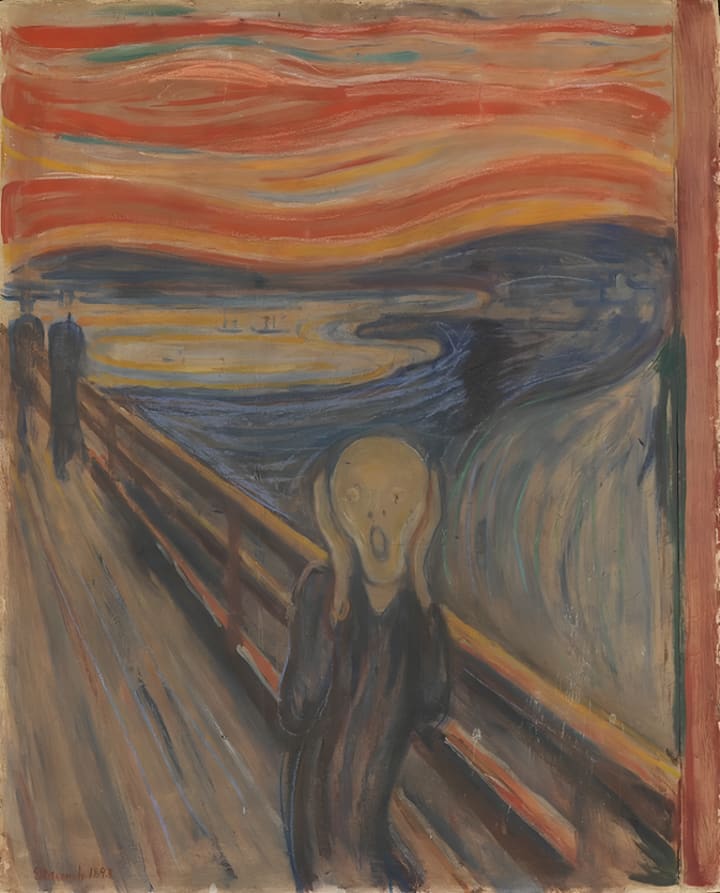
"The Scream" is one of the most enduring and remembered paintings in the history of modern painting.
The famous painter Munch was inspired to create this painting while walking in Oslo (Norway) in 1892. At that time, he was feeling unwell. When he passed a bridge, the sun was setting, the sky suddenly turned bright red, Munch felt as if a scream was spreading through the space.
He once wrote on a black-and-white lithograph of "The Scream": "I felt a great scream through nature." Munch wrote in his diary: "I heard the scream and painted this picture, painted the clouds as if they were the color of blood." Thus, the character in the painting is hearing the scream, not creating the scream as is often thought.
In another note, the famous painter Edvard Munch wrote more clearly about the circumstances in which he created "The Scream": "I was walking on the bridge with two friends. The sun was setting. The sky suddenly turned red. I stopped, exhausted, leaning against the bridge railing. My friends continued walking. I stood there trembling with fear. I felt the endless scream spreading through the space."
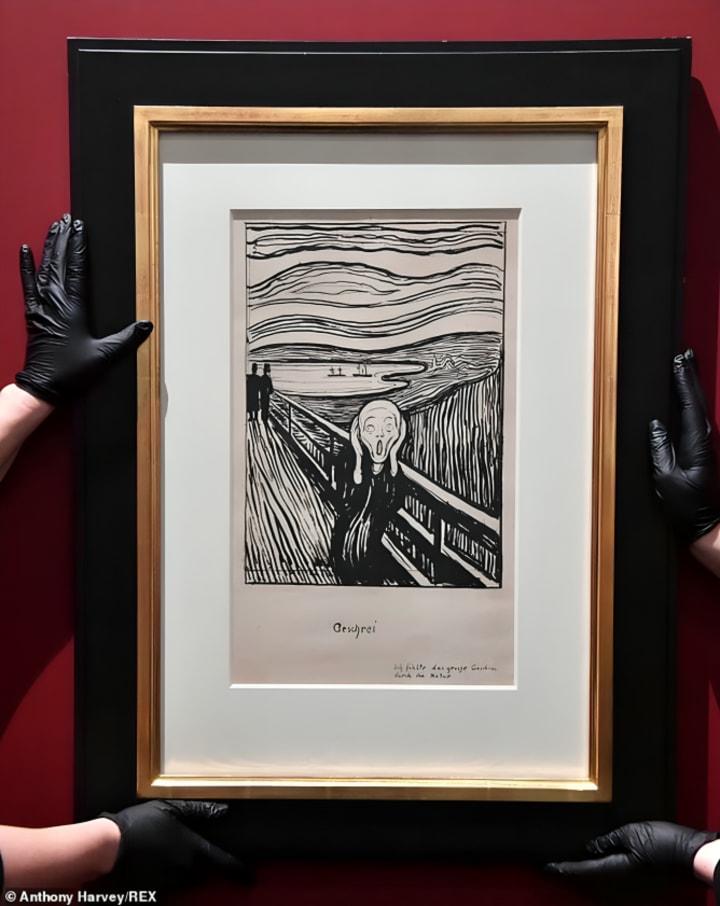
The character's head in "The Scream" looks like... a light bulb
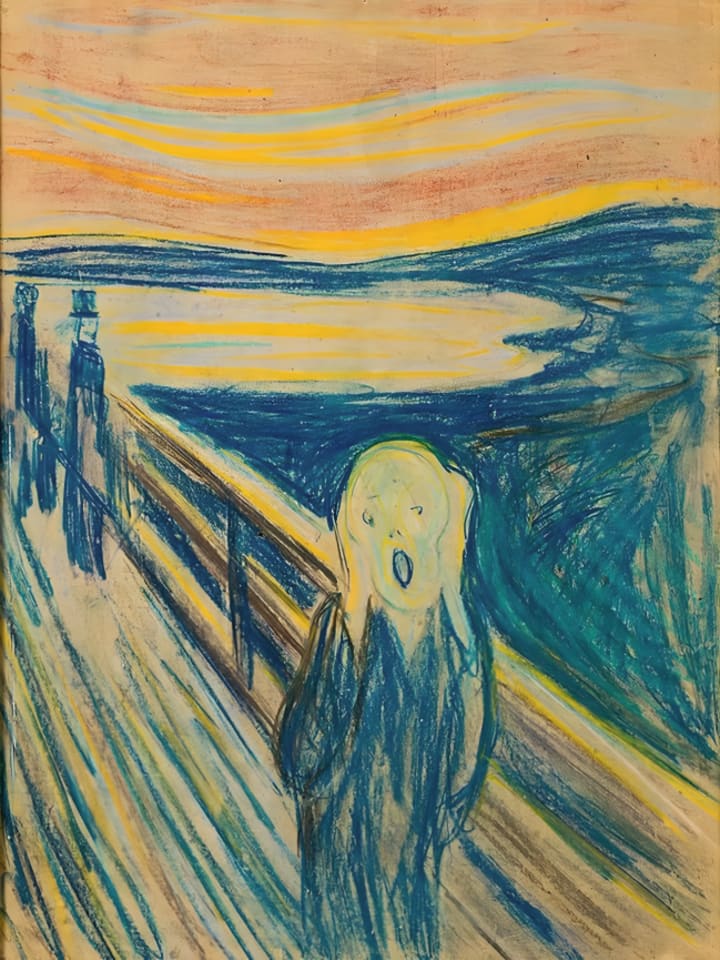
The painting depicts a screaming figure, which has always been an iconic archetype of existential panic, and has always fascinated art critics. The figure’s face looks like a… burning light bulb.
Munch was very interested in the scientific inventions of the time, which were inventions and technological improvements that brought electricity into life. At that time, the image of a burning light bulb was a symbol. Munch once shared in his diary that he was obsessed with the technological inventions of the time he lived in.
The image of burning light bulbs appearing more and more in Europe at that time must have been deeply imprinted in Munch's mind and helped him create the masterpiece "The Scream".
The miserable life of Edvard Munch
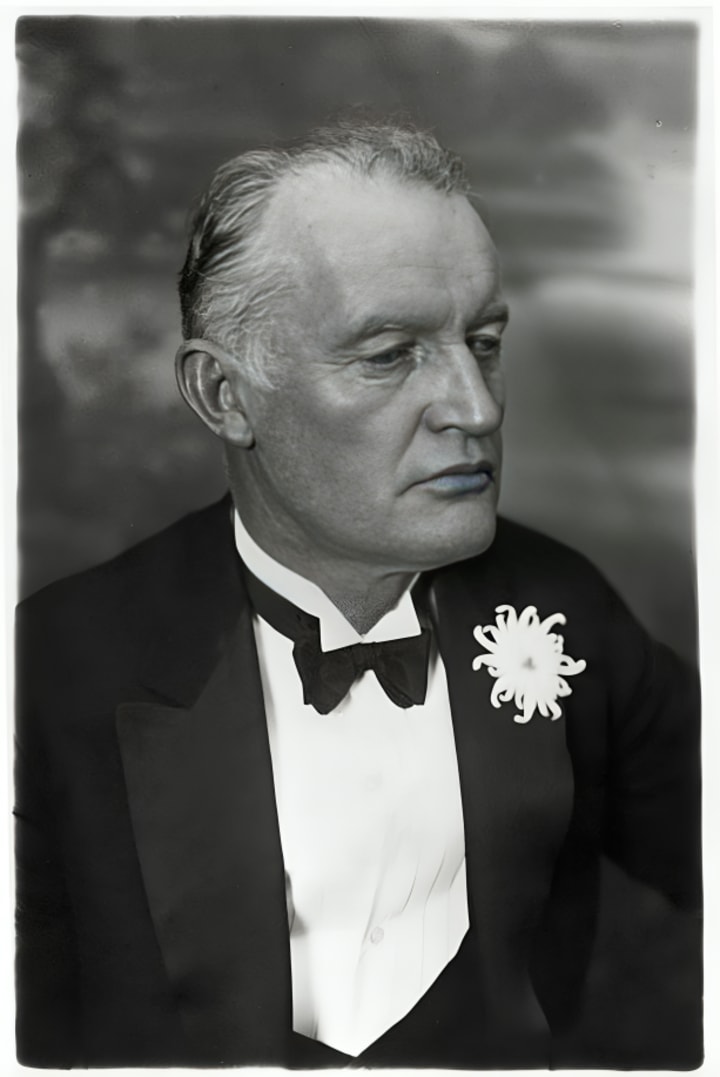
Norwegian painter Edvard Munch (1863-1944) was tormented by a mental illness. He was always haunted by the thought that death was knocking on his door, his sleep was often interrupted by terrifying nightmares, and he often saw terrifying images of ghosts... These things influenced Munch's creative style.
As his anxiety and hallucinations became more severe, Munch suffered a severe breakdown. Fortunately, however, psychotherapy worked for him.
The text written on the blockbuster "The Scream" reveals a secret
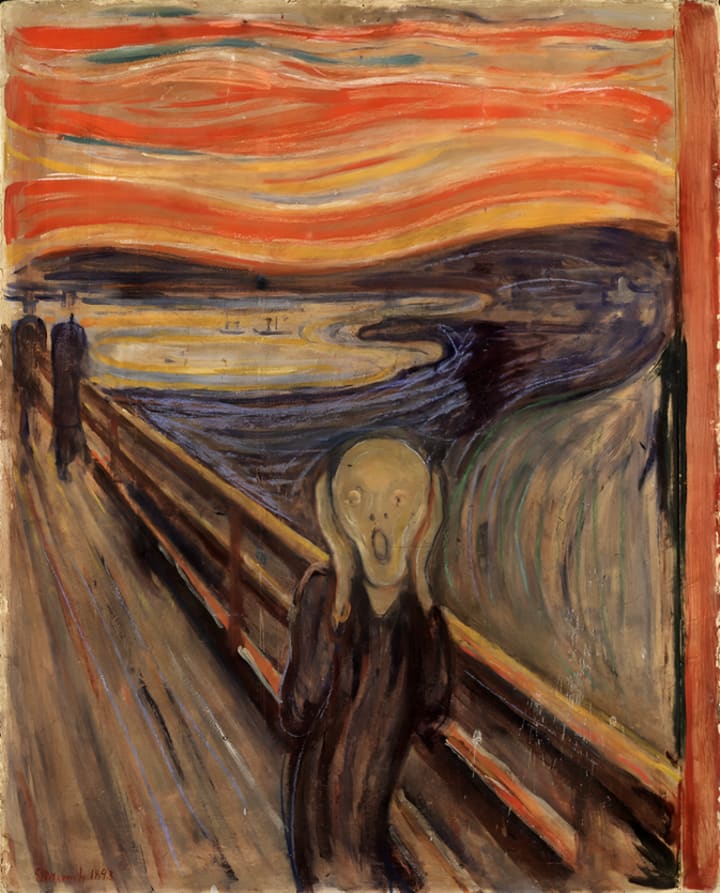
A tiny line of pencil text in the upper left corner of one of the four versions of “The Scream” reads: “Could only have been painted by a madman.” The line has long been the subject of debate among experts as to who wrote it.
Initially, it was thought that the inscription was written by the artist himself, but later it was thought that it was written by someone else. However, after a long period of research, in 2021, experts at the National Museum of Norway believed that the inscription was actually written by the artist Edvard Munch himself.
Mai Britt Guleng, an expert on the artist Edvard Munch who works at the National Museum of Norway, believes that this line can reveal a lot about the artist's mental state.
Experts believe that this line was written by Mr. Munch on the painting in 1895 after Mr. Munch attended a meeting, at which a medical student said that the work "The Scream" could only have been painted by... a madman.
Ms Guleng commented: "The act of writing on the painting shows many things, it is both humorous, witty, and honest about Mr Munch's unstable mental health.
Mr. Munch was actually very serious about his mental health, he was very distressed because there were members in his family with mental problems, he was very worried about it and often showed that he was very concerned about it himself.
Ms. Guleng believes that Mr. Munch wrote the words "Can only be painted by a madman" in pencil on the painting with a humorous attitude, to face the criticism surrounding his work, as well as a way for him to face his inner misery, the psychological problems that had appeared in him since that time.
In general, art experts who have studied the career of Edvard Munch (1863 - 1944) understand that he was well aware of his mental health problems, and Munch was under even more pressure from his contemporaries' perception of this issue, as there were still many harsh stigmas at that time.
About the Creator
hung do
Hello I love you all
He wasn't Santa
He wore black instead of red and he had a gaunt face. His teeth were yellow and jagged. He spoke in a dialect not of this world. There was a lot of clicking of his forked tongue when he spoke. He handed little Judy Miller a shiny red box. She took it and watched as the creature walked out the front door. She stood there a moment or two looking at the package. She wanted to open it. The present was from Santa, or so she thought. She placed it under the tree and headed up to her bedroom. She curled up all nice and comfy in her bed. She fell asleep and entered a nightmare. She went downstairs to find her parents, Stacy and Jeff butchered beyond recognition. She also found her little brother Donny; he was dead as well. She woke up crying.
By DJ Robbins4 days ago in Horror



Comments
There are no comments for this story
Be the first to respond and start the conversation.