
The Roommate Who Never Left
A college student discovers their new roommate has been dead for weeks… yet keeps leaving notes on the fridge.
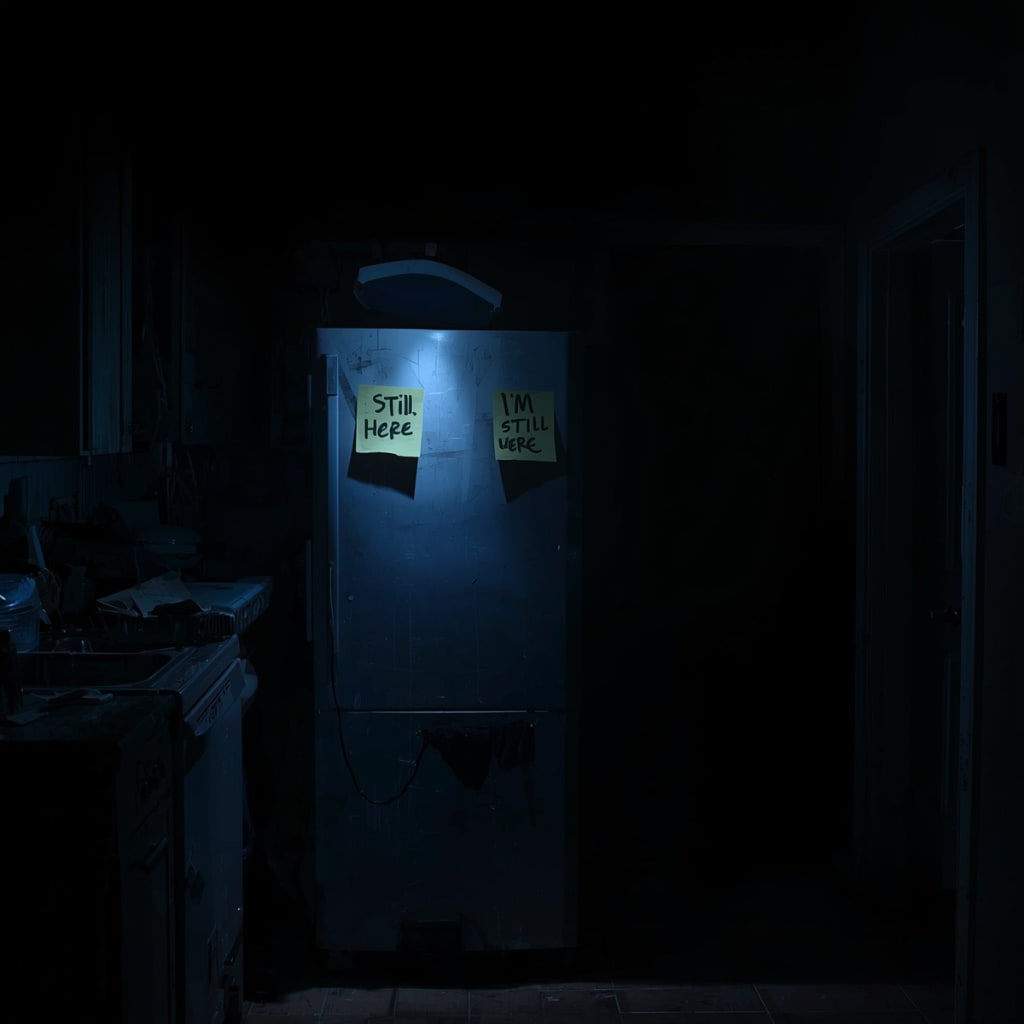
The Roommate Who Never Left
I didn’t notice at first.
College life has a way of blurring the days together—classes, late-night ramen, group projects that drag on, and the constant background hum of exhaustion. When I moved into my off-campus apartment, I was just grateful I wasn’t stuck in a dorm anymore.
The lease said “two-bedroom shared unit,” and sure enough, someone else’s stuff was already there when I moved in. His name, according to the little sticky note on the door, was Evan.
Our schedules didn’t line up. I’d hear the shower running at 3 a.m. when I was finally collapsing into bed, and sometimes I’d catch the faint clatter of him cooking when I rushed out the door at 7 a.m. for class. We hardly crossed paths. The only proof I had that he existed was the trail he left behind.
And the notes.
Always on the fridge.
They weren’t anything dramatic:
“Don’t forget rent’s due Friday.”
“Picked up milk.”
“Can you grab trash bags?”
Just the ordinary language of cohabitation. I wrote back too—little messages about who owed what, or when I’d restock the coffee.
It was a comfortable rhythm. Familiar. Like having a roommate who respected boundaries but still acknowledged me.
But three weeks in, I realized something strange.
I was standing in the kitchen, peeling a granola bar wrapper, when I noticed the trash can was nearly empty. I hadn’t taken it out. The recycling bin was neatly sorted. The counters wiped spotless.
I hadn’t seen Evan once. Not face-to-face.
That night, I left my first deliberate note:
“Hey, man—when are you usually around? We should hang out sometime.”
The next morning, another sticky note waited for me:
“Busy week. Soon.”
Something about the handwriting felt rushed. Uneven. Almost shaky.
By the fourth week, the smell started.
It wasn’t overpowering at first, just a faint mustiness in the hall outside Evan’s door. I assumed it was old laundry. But each day, it grew stronger, sour and sickly-sweet, seeping beneath the crack of his door, curling down the hall until it lingered even in the kitchen.
I slipped another note onto the fridge:
“Hey, think something’s off in your room—smells bad. Maybe trash? Check it?”
The reply came the next day:
“All good. Don’t worry about it.”
That was the moment my stomach twisted. The handwriting didn’t just look shaky—it looked wrong. Like someone struggling to remember how letters were supposed to form.
One night, after a particularly brutal exam, I came home at 2 a.m. The apartment was silent, except for the faint hum of the fridge. But as I passed by Evan’s door, I heard it.
A dragging sound. Slow. Wet. Like fabric pulling across the floor.
I froze, heart pounding, ear pressed to the wood. The dragging stopped. Then: a faint thud.
I backed away, grabbed my keys, and locked myself in my room until morning.
The smell was unbearable by the next week. I couldn’t ignore it anymore. My chest felt heavy when I breathed inside the apartment, and even my clothes carried the stench when I left.
I knocked on Evan’s door. No answer.
I tried again, louder. “Evan? You okay?”
Silence.
I don’t know what compelled me—some mixture of anger, fear, and sheer exhaustion—but I twisted the knob. It was unlocked.
The door creaked open.
The room was dark, curtains drawn. Clothes were strewn across the floor, textbooks stacked in uneven piles. And on the bed…
My stomach lurched.
Evan was there. Or what was left of him.
His body was sunken into the mattress, skin gray and shriveled, eyes clouded and lifeless. He’d been dead for weeks.
I stumbled backward, gagging, heart slamming against my ribs. That’s when I saw it—the sticky notes. Lined up on the desk. Dozens of them. My handwriting. His handwriting. Conversations. Back and forth.
The last one, sitting squarely in the middle, read:
“I’m still here.”
I called the police. They arrived with paramedics, and soon the apartment buzzed with radios, heavy boots, the flash of cameras. One officer pulled me aside, face pale.
“Son, you said you’ve been getting notes from him? On the fridge?”
“Yeah,” I said, voice trembling. “Every day. Look, I can show you—”
I turned toward the kitchen. The fridge was bare. Every sticky note I’d left, every reply I’d received—gone.
“Nothing there,” the officer said quietly.
I swear I felt something cold brush past me then, drifting down the hall. A faint rustle, like paper against tile.
When I checked the fridge again later that night—after they’d zipped Evan’s body into a black bag and carried him away—there was one note waiting.
Just one.
“You shouldn’t have opened the door.”
© 2025 by [Talha Maroof]
About the Creator
Keep reading
More stories from Talha Maroof and writers in Horror and other communities.
Whispers from Apartment 413
Apartment 413 had turned into something of a neighborhood rumor. Three people had lived there in the past year. None stayed more than a month. Two just... vanished. Their stuff was still there, phones dead, rent unpaid. The third tenant? He left in the middle of the night without telling anyone. All he said to the landlord before speeding off was:
By Talha Maroof6 months ago in Horror


Comments
There are no comments for this story
Be the first to respond and start the conversation.