
The Room Upstairs
The Boy I Was Never Meant to Remember
The first time I saw the photograph, I didn't recognize the face.
It was tucked behind the loose panel in the hallway upstairs, the one that always clicked when you walked past after dark. We'd lived in the house six months before I found it—a black-and-white photo folded neatly and wedged between the laths, as though it had been waiting.
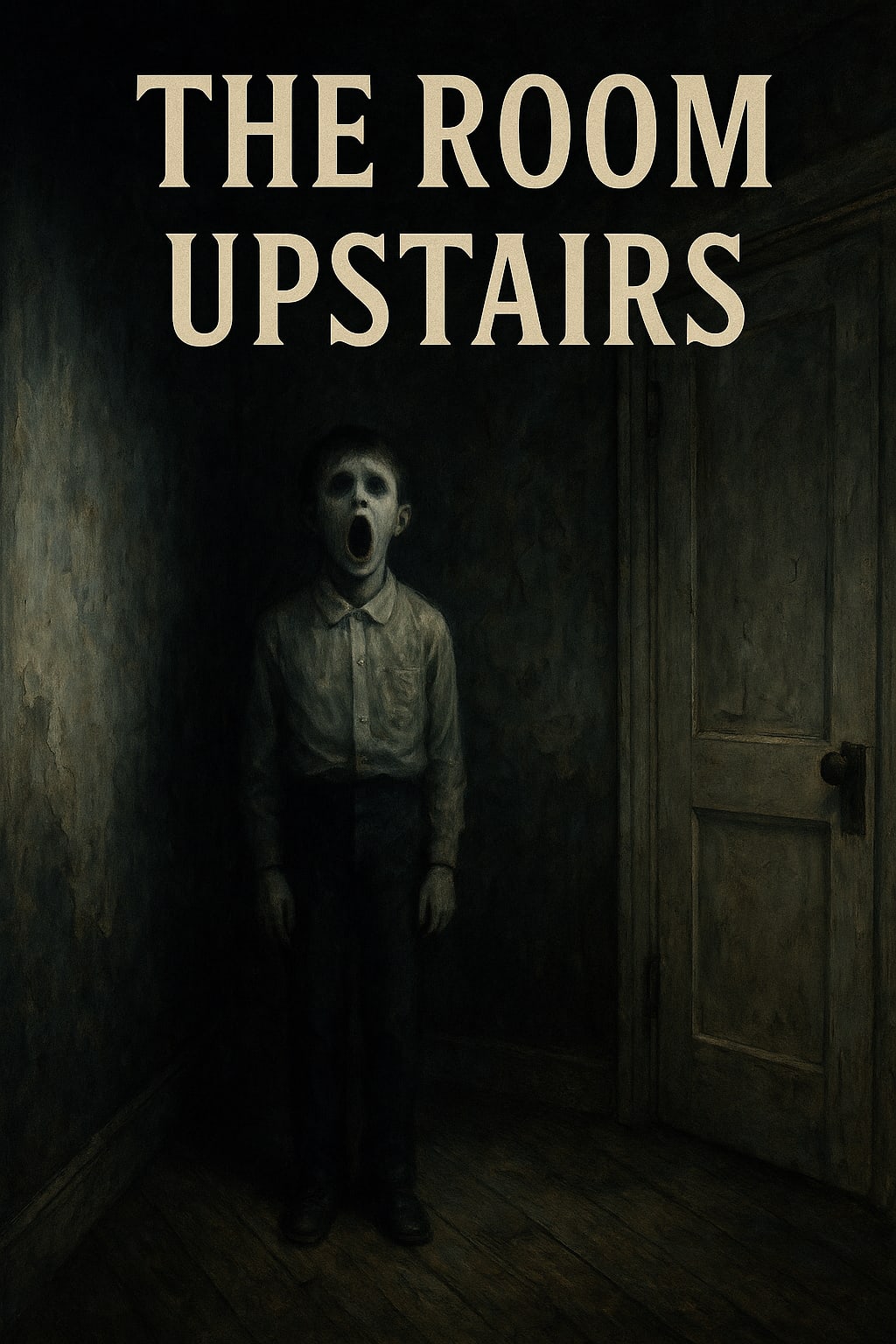
The boy—perhaps thirteen, though something in his stillness made him seem older—stood rigid in the far corner of a plain, shadow-washed room. He wore Sunday clothes: a stiff white shirt buttoned to the throat, slacks with creases too sharp to have ever known play, and shoes polished to a shine that seemed more funereal than formal. The outfit didn't fit quite right, as if chosen by someone who'd never met him—cuffs too long, collar tight enough to bruise.
His face was a study in lifeless symmetry: pale skin stretched too thin, lips pressed into a line too straight to be calm. And then there were the eyes. Those awful, heavy-lidded eyes, staring directly into the lens like he was trying to see not just through the camera, but through time itself. They held no curiosity, no spark, only the distant weight of a memory that had either never happened… or happened too often. It was the gaze of someone who had seen too much—or worse, someone who had seen nothing at all, and had been left there to rot in the silence.
On the back, in faded pencil, were two words: For Andrew.
I showed my wife.
"Do you know him?"
Sarah frowned. "No. Creepy, though. Like one of those photos they take after someone dies."
I placed it in my desk drawer and tried—really tried—to forget about it. But even that act felt unnatural, like I was shoving something unclean beneath the floorboards. My hand trembled as I slid the drawer shut, the old wood groaning in protest. Sarah had already left the room by then, muttering something about how the boy's eyes "felt like they followed her." She hadn't looked at the photo for more than a second, but it had unsettled her deeply—she'd actually wrapped her cardigan tighter around herself like a shield and wouldn't make eye contact afterward.
I forced the drawer closed with more strength than necessary, as if burying the picture could somehow suffocate the strange tension it had stirred up. But even with it out of sight, I couldn't shake the sensation that it hadn't really gone anywhere. That its presence was just beneath the surface now, quieter but watching.
That night, just as I was drifting off, I heard it—footsteps in the hallway upstairs. Slow. Deliberate. Crossing the creaky plank by the panel.
Sarah was asleep beside me, her breathing soft and even, unaware of the cold crawl of unease tightening in my chest. Our daughter, Madelyn—five years old and wild-eyed—was tucked in down the hall, her bedroom door cracked the way she liked, just enough to let the hallway light spill across her carpet like a nightlight she wouldn't admit she needed. On stormy nights, she always curled into the crook of her mother's arm, Sarah whispering stories to chase away the thunder. But tonight, the skies were clear. No rain. No lightning. Just a silence so complete it rang in my ears, as if the house were holding its breath. I checked. I could almost sense the pulse of the house, slow and methodical, rhythmic.
The hallway was still and cold—colder than it had ever been, like the air had been sucked out and replaced with something ancient and wrong. Every step I took made the old wood beneath my feet groan like it was protesting my presence. I paused just past the linen closet, heart thudding in my ears.
That's when I saw it.
The panel.
A narrow, vertical board halfway up the wall, never quite flush with the rest of the molding. I'd noticed it when we first moved in, just a strange architectural quirk above the floorboards, barely wide enough to fit a hand behind.
But now it was ajar.
Only an inch, maybe less—but unmistakably shifted. Tilted outward like something behind it had pushed, or someone had forgotten to seal it shut.
It had always clicked softly when you walked past it at night, but I'd chalked that up to old nails and settling wood.
Now I wasn't so sure.
The gap revealed nothing but darkness. No hinge. No draft. Just a sliver of space that hadn't been there before.
And for the first time, I felt certain that I hadn't found the photograph.
It had shown itself.
****
It started then.
Not with a bang or scream—but with a subtle, creeping wrongness. The kind that settles in unnoticed until it's everywhere.
First, small things began to disappear—my keys, a screwdriver, Madelyn's favorite red crayon—only to turn up later in places I never would've put them. The photo, too, moved without explanation. I'd find it lying on the kitchen counter, or tucked inside my coat pocket, or once—terrifyingly—balanced perfectly on my pillow when I came home late from work – like some sort of ghostly elf on a shelf following me around the home.
Sarah brushed it off, said I was distracted, maybe sleepwalking. She shrugged off the photograph, but I could tell she just didn't want to acknowledge it. No matter what she said, the chill I felt wasn't from forgetfulness. It was something else. Like a film of cold sweat that never left.
It was as though the house had blinked—and when its eyes opened again, nothing was quite where it had been.
That's when I began to feel watched. Not constantly, not overtly—but in those quiet stretches of early morning when the air hung too still and the shadows seemed a little too aware.
And all the while, the panel in the hallway waited. It teased me daily with small movements, never in the same place twice. But when I would show Sarah, it all appeared normal, as if nothing had moved, as if it was fixed and rigid.
That was until Madelyn asked, "Daddy, when can I play with the boy in the upstairs room again?"
I froze.
"What boy?"
She looked confused, as if I'd forgotten something obvious. "Andrew," she said matter-of-factly. "He says he used to live here. He said his daddy locked the door, but he got out."
My gut dropped. Not metaphorically—physically, like something inside me had slipped loose and wouldn't settle. It was the kind of feeling you get right before a car crash or a phone call that changes everything.
"What did you say?" I asked, trying—and failing—to keep my voice steady.
Sarah looked up from her coffee, a half-smirk tugging at her mouth. "She's got quite the imagination, huh?"
But she wasn't smiling with her eyes. Not really.
"She said it so casually," I said. "Like it's someone she knows."
"Kids make stuff up all the time. Imaginary friends. Ghost stories. You were the same way."
I nodded, but inside, something writhed. Imaginary friends didn't say things like he got out.
And when I glanced over at Madelyn, sitting on the floor tracing circles into the carpet with her fingers, she smiled, though not at me. It was as if she were looking past me. I could sense Andrew standing just beyond my back. Those cold, dead eyes pierced through me to look at my daughter. I whisked around to confirm my suspicion that he was standing there, ready to take on the ghost. He would not have Madelyn.
When I turned, there was nothing there. I could hear Sarah softly smirk at my action.
****
That night, I dreamed of him.
He stood in that same corner from the photo, cloaked in shadow, but now there was something different—something horribly, fundamentally wrong. His mouth was open. Not slightly—not the parted lips of surprise or speech—but wide, unnaturally wide, like his jaw had come unhinged.
It was a dark, gaping void that seemed to stretch too far down, as though there was no throat, no end—only a tunnel of blackness carved into a pale, childlike face. His lips were cracked. Torn at the edges. His cheeks sunken, twitching slightly, as if the muscles remembered how to scream but had long since forgotten what for.
There was no sound. Not even a whisper. Just the horrible silence of something that had once known language but had been silenced for so long it had lost the meaning of noise altogether.
And though he didn't move, didn't breathe, I could feel it—something pressing outward from that open mouth. A pressure. A hunger.
It wasn't a boy. Not anymore.
It was a memory that had found a body.
And now, it was trying to speak through mine.
****
I woke up gasping.
And not alone.
There were wet footprints across the floor—small, barefoot. Leading from the window to the foot of our bed.
Sarah saw them too.
She froze when she spotted them, her coffee mug trembling in her hand, eyes locked on the pale impressions staining the hardwood. Slowly, like someone moving underwater, she walked over and crouched, reaching toward one as if to prove to herself it wasn't real. But before her fingers touched it, she pulled back, her breath catching in her throat.
"He was here," she whispered. Not a question. Not a theory. A fact.
I turned to her, but she wouldn't meet my eyes.
"I saw him last night," she said, barely audible. "In the hallway."
"What?"
"I got up to check on Madelyn and… he was just standing there." Her voice was flat, like she hadn't yet processed what she'd seen. "At the end of the hall. A boy. Thirteen, maybe. But something was… off."
She rubbed her arms, as if trying to wipe off a cold that had sunk too deep. "He didn't move. Didn't blink. Just stared. His head was tilted slightly, as if he were trying to listen to me breathe. Like he'd been standing there for hours, just waiting for someone to notice. And Ben—his eyes…"
She trailed off, then met my gaze for the first time, and there was something new behind her expression. Not fear—recognition.
"They weren't right. Too dark. Like… hollow, but not empty. Like something was looking out through them that didn't belong to a child. Something that wanted me to see it."
She swallowed hard.
"I didn't move. I couldn't. It felt like the air around him was thick. Heavy. Like the moment before something awful happens, but stretched into minutes. I thought if I blinked, he'd be closer."
Then, more quietly: "And for a second… I swear to God… I thought he looked like you."
A silence stretched between us, thick as smoke.
She didn't scream. She didn't cry. She averted her gaze from as if it pained her to even look at me anymore.
She walked into our daughter's bedroom, pulled out the overnight bag from the closet, and began folding Madelyn's clothes into it with methodical precision.
"I'm taking her to my sister's," she said without looking up. "There's something here, Ben. And I don't care what it is—I'm not staying another night." Her tone was definitive and succinct. No room for debate.
She zipped the bag, her hands shaking now.
"Whatever you found in this house... it found us too."
Then she scooped Madelyn into her arms, wrapped in a blanket, and walked out without another word.
I didn't stop her.
****
I searched for answers. I dug into the property history. No record of any child named Andrew. No deaths. No crimes. However, when I retrieved the original blueprints from 1931, I found it.
A child's bedroom once existed where the crawl space now sat. A full, livable room—nine by nine feet. Walled off sometime in the 1950s.
Erased. But why?
I took a crowbar to the wall while Sarah was gone. She called me three times. I didn't answer.
I tore through the panel, drywall, insulation, wood, and dust—until I broke into something else.
Wallpaper.
Faded. Patterned with moons and stars. It was old, definitely from a period long forgotten.
There was a rusted bedframe in one corner, small enough for a child. A stuffed rabbit, half-eaten by moths. And a wooden chair, almost identical to the one in the photo.
On the wall, at child-height, were scratches. Hundreds. Some were lines, others crude letters.
One name was carved over and over: ANDREW.
And then, a second.
BEN.
My name.
I stumbled back. My hands were shaking. Sarah's words haunted me. He looked just like you.
I didn't remember carving it.
I didn't remember ever going in there.
And yet... the carving angles were mine. The handwriting was eerily familiar.
I slept in the guest room that night. I locked the door. I wrestled with the idea of joining Sarah, but something bade me to stay in the house.
At 3:13 a.m., I woke up to the sound of knocking coming from inside the wall.
****
Sarah called the next morning. Said Madelyn wasn't eating. Wasn't talking. Just drawing.
She texted a photo. My jaw dropped when I loaded it.
Madelyn had drawn me in the upstairs hallway. Standing by the panel. Holding hands with another figure—taller than her, smaller than me. A boy in black-and-white.
In the window, she'd drawn a third face. Pale, hollow. Watching.
I zoomed in.
It looked just like me.
But not now. Not how I looked now.
How I looked then.
As a boy.
My heart and gut wrenched, and I could swear my pulse stopped for a good few beats.
****
That night, I stayed up. I sat in the crawlspace. I whispered to the dark. I wanted answers, answers only a ghost boy could give.
"Who are you?"
Nothing.
Then a shift in the air.
It wasn't colder. Just… wrong. Like something sliding sideways in the room, but not physically moving.
And then I heard the voice.
Heard it not with my ears, but from inside my teeth. My jaw. My bones. It emanated from within me, like it was a part of my brain.
"He made me."
A rush of sound attacked me. A scream. Then silence.
I woke on the hallway floor. Blood and wallpaper bits under my nails.
The wall in front of me had finger etchings with the words For Andrew mocking me.
****
I checked into a motel after that and spent the next three days trying to find myself. Andrew was ever present in my mind and vision.
I did some personal historical digging. I requested my birth certificate. My school records. I called my mother.
"Ben, are you okay?" she asked. "You sound strange."
"Did I have an imaginary friend when I was little?"
Pause.
"Why are you asking that?"
"I found an old photo in the house. A boy. His name is Andrew."
Silence.
Then she said, "You're scaring me."
"Mom, please."
"Ben… listen to me, you don't have a brother!!"
"I didn't say I did," I responded in disbelief.
Another silence.
Then: "You used to."
It came across as a ghostly whisper. Then a Click.
The phone line went dead and silence engulfed me. I could feel Andrew's fingers caress my neck.
****
I drove back to the house that night. I knew I shouldn't. I knew it wasn't just a haunting. Not something I could bless away.
This house didn't hold a ghost. It held a memory. One that had been waiting. Biding. Growing teeth in the dark.
When I opened the door, the air hit me like a basement full of rot. The lights wouldn't work. The panel had shifted, and the crawlspace door was open. Against better judgment, I climbed inside.
Everything was as I'd left it—bedframe, rabbit, chair. But the wall had changed. New names were scratched into it.
Sarah. Madelyn.
And another: BENJAMIN, AGE 6.
Something or someone moved behind me. When I turned, there was a boy. He looked like me. Not now, but then – like 1930s then. A pale, thin child with a crooked smile and tired eyes. He edged his way closer to me, though his feet never hit the floorboards.
"Hi," he said. "I was lonely."
"What are you?" I whispered.
"I'm the part they made you forget."
I backed away, heart pounding.
"Your mom thought if she hid me, I'd go away. But you kept calling. You kept coming back. So, they built a wall. And now I live here."
He took another step forward.
"You are me," I whispered—same soul, split across two broken bodies.
He nodded. "And I want out."
Everything went dark after that.
****
I woke up in the hospital. They had found me unconscious at the bottom of the stairs. Said I must've fallen. My wife, Sarah, sat beside me; her eyes gave me a cautious look of love.
"You said a name," she whispered. "Over and over."
I didn't have to ask.
"Madelyn hasn't spoken since we left," she said. "But this morning… she said something."
"What?"
"She said, 'Daddy let Andrew out.'"
Sarah left me that day. She took Madelyn and moved three states away. A piece of my soul died that day. The house was sold in pieces, first through foreclosure, then at auction. Last I checked, no one's lived there longer than a month.
They all leave eventually.
But not me.
Because I still hear him.
In every reflection. Every footstep I didn't take. Every time I forget what I was doing.
He's not gone. He was never real. And he was never imaginary.
Andrew is what's left.
And so I am. I belong to him. We do not exist without each other. Never have. Never will.
If you ever find the photo, burn it. If you hear him, run.
But if he says your name, It's already too late.
About the Creator
Lucien v. Crow
Lucien V. Crow writes haunted fiction where the dead don’t rest and secrets linger like fog. Raised on whispers and shadows, his tales chill the spine and stir the soul. Read with care—you may not sleep alone again.
https://a.co/d/dRn75g6
Keep reading
More stories from Lucien v. Crow and writers in Horror and other communities.
Meet Me - Lucien V. Crow
Welcome, dear wanderer, to the dim-lit corridor that is my mind. My name is Lucien V. Crow, and if you’ve stumbled here, chances are something inside you itches for the eerie—the flicker of candlelight down a long-forgotten hall, the creak of a rocking chair no one remembers owning, the soft thud of footsteps in an attic long sealed. You’re among kin now.
By Lucien v. Crow6 months ago in Horror
Lideco Ghost Town Vietnam: Inside Hanoi’s Most Mysterious Abandoned City
Approximately 15 km to the west of Hà Nội city center, in Hoài Đức District, is one of the most fascinating ruin sights in Vietnam, which is the remnants of a large housing estate called Lideco Bắc 32. This location does not appear to be a typical residential area to tourists who visit there or those who hear of its existence; it is more of a ghost town.
By Kyrol Mojikalabout 19 hours ago in Horror



Comments
There are no comments for this story
Be the first to respond and start the conversation.