
The Room That Watches
Some rooms hold memories. This one holds you

Eva didn’t believe in haunted houses—only haunted minds.
That’s what she told herself as she stepped into the remote Victorian rental, dragging two overstuffed suitcases and a half-finished manuscript behind her. The house stood alone on a hilltop, surrounded by fog-drenched trees that swayed without wind, their gnarled branches brushing the windows like bony fingers. It was the perfect place to finish her psychological thriller. Isolated, quiet, inspiring. Or so she believed.
The landlord, a pale man with watery eyes and a stitched-up coat, had handed her the keys silently, his fingers cold and trembling. “The desk is old,” he muttered, “but it remembers stories well.” She laughed politely, dismissing his odd warning as just another attempt at being mysterious.
Inside, the house reeked of rosewater, mildew, and dust. Every floorboard groaned in protest with each step she took. A grand mirror hung in the hallway, its silvering eaten away by time. As Eva walked past it, she noticed her reflection hesitate before following her movements. She blinked hard and blamed it on exhaustion.
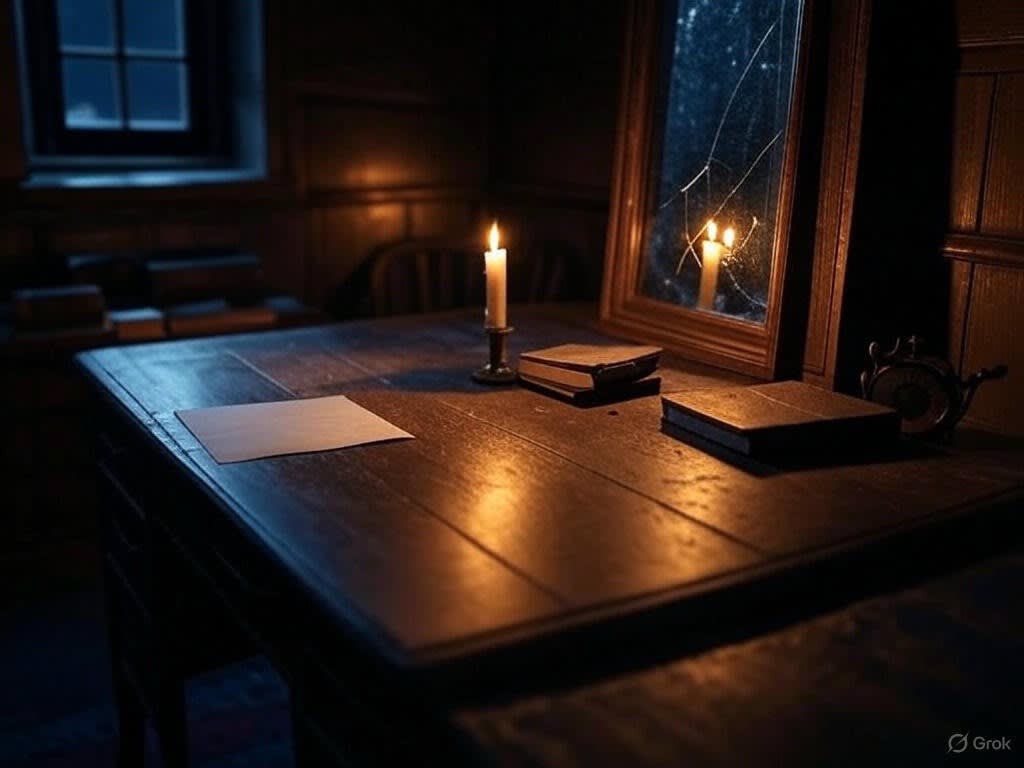
The room she chose to write in was small but cozy. It had faded floral wallpaper, a rusted chandelier, and an antique writing desk carved with symbols she didn’t recognize. A cracked leather chair faced the desk. There was a lamp with a red glass shade that gave off a strange humming sound, even when it wasn’t plugged in. She chalked it all up to “old house charm.”
That night, she lit a candle beside the desk, placed her notebook down, and stared at the empty page. The words wouldn’t come. Frustrated, she went to bed.
By morning, something had written on the page:
“I see you.”
Her stomach twisted. Had she scribbled that herself in a sleepy daze? Maybe. She tore out the page and threw it away.
But each night after, the desk wrote back.
“You don’t belong here.”
“We’re still hungry.”
“Don’t turn around.”
The ink wasn’t hers. It was faded brown, smeared like dried blood. She stopped sleeping. Her days blurred into one another, filled with whispers behind the walls and cold drafts that followed her through the house. She told herself it was just her imagination.
But then the mirror began to change.
One afternoon, as she passed it, her reflection remained perfectly still while she moved. Then it smiled. A long, toothy grin that didn’t belong to her face. She dropped the mirror to the floor and covered it with a sheet. But the smile lingered in her mind.
On the fourth night, she awoke to scratching—under the bed, behind the walls, inside the desk. She threw open the drawers. Empty. But the manuscript now had ten new pages, written in the same ghostly hand. They described events she hadn’t yet experienced: her fear, her screams, her decision to flee.
It was writing her fate.
She called the landlord the next morning. No answer. She tried to leave—but the front door led back into the hallway. Every exit looped. The windows showed fog and nothing else. She was trapped.
That night, the house came alive.
The chandelier flickered violently, the wallpaper pulsed as if it were breathing. Footsteps echoed from the attic above, even though the landlord had said there was no attic. The desk glowed dimly, a red light bleeding from under its surface.
She ran to her room and found the mirror uncovered. Her reflection stood still again—but now, it was crying. Blood streamed from its eyes. Then it whispered:
“Let me in.”
Eva screamed and slammed the door. But when she turned, her reflection was standing inside the room.
The final night came without sleep. She returned to the desk to find a new message waiting for her:
“We write. You stay.”
She ran to the mirror, hoping to smash it, hoping to break the curse. But her reflection grabbed her arm—from the other side.
No one heard her scream.
Today, the house is listed online as a short-term rental for artists and writers. It boasts “classic Victorian charm” and “an antique writing desk for inspiration.” Renters rarely stay long.
But the desk always remembers.
And if you sit too long in the chair, your story will write itself—whether you want it to or not.
About the Creator
Muhammad Hakimi
Writing stories of growth, challenge, and resilience.
Exploring personal journeys and universal truths to inspire, connect, and share the power of every voice.
Join me on a journey of stories that inspire, heal, and connect.
Reader insights
Outstanding
Excellent work. Looking forward to reading more!
Top insights
Compelling and original writing
Creative use of language & vocab
Easy to read and follow
Well-structured & engaging content
Excellent storytelling
Original narrative & well developed characters
Expert insights and opinions
Arguments were carefully researched and presented
On-point and relevant
Writing reflected the title & theme
Heartfelt and relatable
The story invoked strong personal emotions
Masterful proofreading
Zero grammar & spelling mistakes
Eye opening
Niche topic & fresh perspectives
Keep reading
More stories from Muhammad Hakimi and writers in Horror and other communities.



Comments (3)
The thumbnail was like 1920’s
Im reading it at 2am and i have to sleep now 😅😬
This story is such a horrible