
The Reflection Room
At the edge of town, a house was condemned—not because of its age, but because of its mirrors.

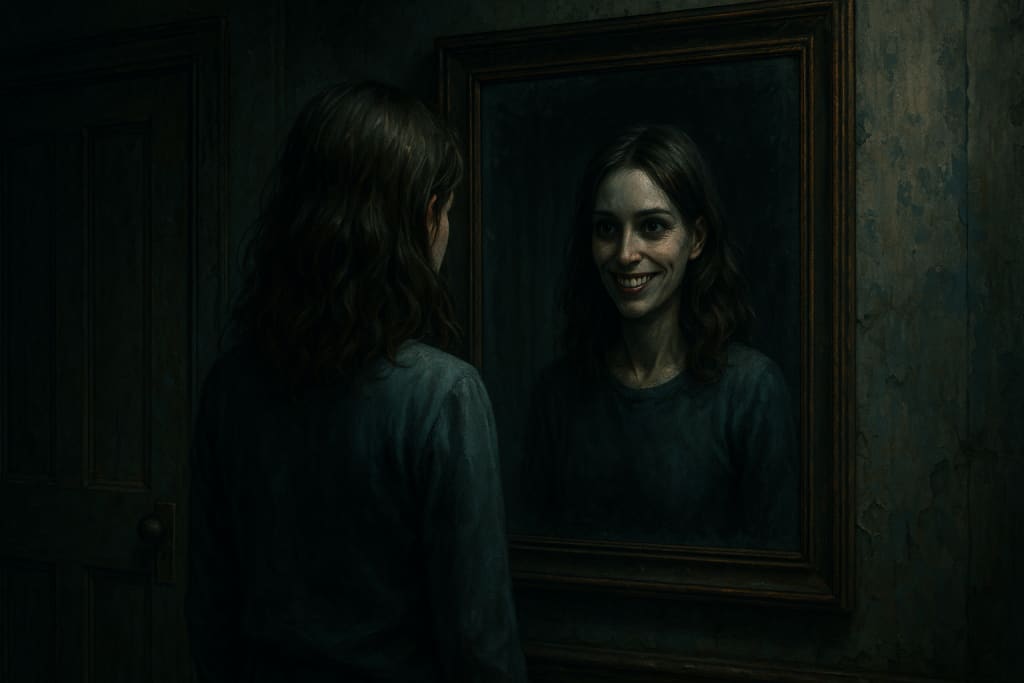
There was a house at the end of Elder wood Lane that no one talked about anymore. Children crossed the street to avoid walking past it. Teenagers dared each other to peek through its shattered windows. Adults simply whispered, “That’s the Lockwood place,” and changed the subject.
But to Ava, it was a curiosity too tempting to resist.
A graduate student researching local folklore, Ava had heard about the “Reflection Room” from an old newspaper buried in her university archive. The article, dated 1929, described a series of strange disappearances all linked to the Lockwood House. The only consistent detail? A mirror in the back room—where reflections moved on their own.
The article claimed the room had been sealed shut. But over time, history faded, and the legend became a ghost story parents told to scare their kids into behaving.
Ava didn’t believe in ghosts. She believed in forgotten stories waiting to be retold.
On a rainy Thursday afternoon, she arrived at the Lockwood House, camera and notebook in hand. The porch groaned under her weight. The front door, long rusted, gave way with a push.
The air inside was stale, as if the house had been holding its breath for decades.
She stepped carefully, her boots crunching over broken glass. Graffiti and dust covered most of the walls, but something about the back hallway felt… untouched. No vandalism. No grime. As if the house itself guarded it.
A narrow door waited at the end.
It wasn’t locked.
Inside, the Reflection Room was perfectly preserved. No cobwebs, no dust. The floor shone like polished marble. A single, large mirror hung on the far wall, its surface silver and smooth as liquid.
Ava raised her camera.
The screen stayed black.
She frowned and tapped it. Nothing.
Her phone wouldn’t turn on either.
Then she noticed something strange.
In the mirror, she was smiling.
But she wasn’t smiling.
Her reflection’s grin was wide, unnatural. The eyes in the mirror gleamed—too dark, too knowing. Ava’s stomach twisted.
She turned to leave.
The door was gone.
Not closed. Gone.
Just a blank, endless wall behind her.
Panic surged in her chest. She reached out and touched the mirror. It was warm, almost alive.
Her reflection tilted its head, though she hadn’t moved.
Then, it stepped forward.
Ava stumbled back, heart pounding, but the reflection didn’t stop. It pressed a hand against the inside of the glass, palm to palm with her.
And then—it spoke.
“You don’t belong here,” it said with her voice. “But I do.”
The glass rippled like water.
The reflection pushed through.
Ava screamed.
Too late.
The thing stepped out of the mirror, identical to her in every way—except for the grin. She tried to run, but the room warped around her, stretching, spinning. Her limbs felt heavy, like drowning.
The last thing she saw before darkness took her was her doppelganger walking away—out of the room, out of the house—wearing her face.
Two days later, Ava’s friends received a text.
> “Found something big. House isn’t dangerous after all. Meet me at 8?”
They never saw her again.
Months passed. Ava’s name faded from search results. Her accounts posted occasionally, but friends said her tone was “off.” Colder. Robotic.
And the Lockwood House? It remained quiet. The door to the Reflection Room had returned.
Waiting.
🩸Conclusion:
“The Reflection Room” isn’t just a horror story—it’s a warning. Ava went looking for history and became part of it. Her curiosity opened a door that had been wisely shut for nearly a century. Some places aren’t forgotten—they’re hidden. For a reason. The mirror didn’t show the truth—it took it. Ava’s identity was stolen by something ancient and cruel, something that knows how to wear a face but not a soul. Now, it walks among us, blending in, hollow-eyed and watching. And the room? It waits patiently for the next curious visitor who dares to look too deeply into a reflection that smiles back just a little too wide.
About the Creator
The Voice That Waited
Seen (1) At the edge of a quiet town stood an abandoned radio station, forgotten by time and avoided by locals. The building had been shut down for over twenty years, yet people claimed that at exactly 2:17 a.m., a faint broadcast could still be heard on an old frequency. No music. No news. Just a voice. Daniel was a small content creator who specialized in audio storytelling. He didn’t believe in rumors, but he believed in stories. When he heard about the mysterious broadcast, he decided to investigate—not for views, but for curiosity. One cold night, Daniel entered the radio station with his recorder and headphones. Dust covered the equipment, and spider webs hung from the ceiling. Everything looked dead. Silent. At exactly 2:17 a.m., the old transmitter crackled. A voice broke through the static. “Hello… is anyone listening?” Daniel froze. The voice was calm but tired, like someone who had been waiting for a long time. “My name is Arthur,” the voice continued. “I used to work here. If you can hear me, please don’t turn this off.” Daniel whispered into his microphone, “I’m listening.” The voice seemed relieved. “For years, I spoke into this microphone, hoping someone would hear me. When the station shut down, everyone left. Everyone except me.” Daniel’s heart raced. “Are you… alive?” There was a pause. Then a soft laugh. “That depends on what you mean by alive,” Arthur said. “I passed away in this building many years ago. But my voice stayed. This place remembers me.” Arthur explained that he had been a late-night radio host, speaking to lonely people, travelers, and insomniacs. The night the station closed, he stayed behind to record one final message—something meaningful. But no one ever aired it. He died alone, with his words unheard. “So I kept talking,” Arthur said. “Night after night. Waiting for someone to listen.” Daniel felt a heavy silence fill the room. “What do you want from me?” Daniel asked. Arthur answered gently, “I don’t need fear. I don’t need fame. I just want my message to reach someone. Anyone.” Daniel nodded, even though Arthur couldn’t see him. “I’ll share your story.” For the first time, the static disappeared. Arthur’s voice became clear. “Tell them this,” he said. “You are not invisible. Someone, somewhere, needs your voice—even if you don’t know it yet.” The broadcast ended. The room fell silent. Daniel left the station before sunrise and spent the next day editing the audio. He uploaded the recording as a simple podcast episode titled *The Voice That Waited*. He didn’t add music. He didn’t add effects. Just the truth. Within days, thousands of messages poured in. People said the voice helped them through loneliness, grief, and dark nights. Some cried. Some found comfort. Some found hope. Daniel returned to the radio station one last time. At 2:17 a.m., there was no broadcast. The transmitter stayed silent. But Daniel smiled. Because he understood something important: Some voices don’t fade because they are loud. They survive because someone finally listens.
By Do bol ho jaaye 6 days ago in Horror


Comments
There are no comments for this story
Be the first to respond and start the conversation.