
The Real Story Of Operation Arctic Fox
WW2 Real Story

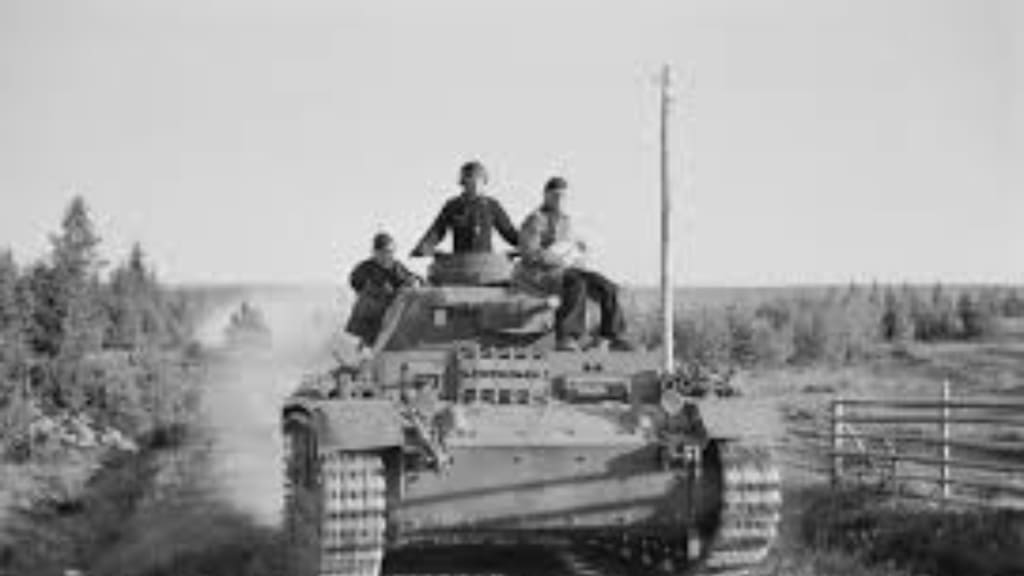
German and Finnish troops launched a World War II attack against Soviet Northern Front positions in Salla, Murmansk Oblast, in July 1941 under the secret name Operation Arctic Fox. The operation was a component of the broader plan known as Operation Silver Fox (Silberfuchs; Hopeakettu), which sought to seize the strategically important port of Murmansk. In the extreme north of Lappland, Arctic Fox was carried out concurrently with Operation Platinum Fox (Platinfuchs; Platinakettu). Operation Arctic Fox's main objective was to seize Salla and then move onto Kandalaksha (Finnish: Kantalahti) in order to cut off the railroad that led to Murmansk.
It was a joint German-Finnish operation that brought together somewhat unfit German soldiers from Norway with seasoned Finnish arctic troops. After intense combat, they were able to take Salla, but farther east, the German forces were unable to breach the ancient, pre-war Soviet frontier defenses. Better progress was made by the Finnish battalions, who eventually approached the Murmansk railway within 30 kilometers. Any more progress was halted by powerful Soviet troops. The Germans decided to halt their advance because they were hesitant to commit further forces to this theater due to the worsening situation in Central Russia farther south. When both sides dug in at their existing positions in November 1941, Arctic Fox came to an end because the Finns were hesitant to carry out the offensive on their own.
Finland was part of the German High Command's strategy for Operation Barbarossa, their massive invasion against the Soviet Union. Operation Silver Fox, a combined Finnish-German attack, was intended to aid Germany's primary offensive in central Russia. Silver Fox's objective was to launch a pincer assault on the port of Murmansk in order to seize or destroy it. This port was to be a key location for Western Allied shipping help to the Soviet Union. Operation Arctic Fox, the attack's southern pincer, was initiated against the fortifications at Salla from the Kemijärvi area of Central Finland.
When the Soviets invaded Finland in 1939, they took over Salla. The primary German force in the operation was the German XXXVI Corps, which included both German and Finnish soldiers. General Hans Feige oversaw the corps, which was under the leadership of Nikolaus von Falkenhorst, who oversaw the Army of Norway. Hjalmar Siilasvuo's Finnish III Corps provided assistance to XXXVI Corps.
In December 1940, preparations for the operation began. During his tour to Finland, Army of Norway Chief of Staff Erich Buschenhagen drafted the first draft of German-Finnish combined operations against the Soviet Union and formulated a strategy that would decide Finland's position in the war. Hitler published Directive No. 21 on December 8, 1940, outlining his overall strategy for Operation Barbarossa and naming the goals of the envisaged German-Finnish collaboration. In January 1941, Nikolaus von Falkenhorst and Army of Norway personnel drafted the comprehensive operating plan.
In operations Blue Fox 1 and 2, German forces assigned to the operation were sent to the Arctic. Feige's headquarters and the 169th Division were shipped and railroaded to Rovaniemi. Under the pretense of border drills, they then joined Finnish soldiers and positioned themselves for the attack. The 6th and 7th Motorized SS Infantry Regiments, two artillery battalions, and one reconnaissance battalion formed the SS-Infantry Kampfgruppe Nord. This squad was not equipped for cold combat and was essentially an inexperienced police force. 110 troops perished when a cargo ship caught fire while traveling from Norway to Finland.
Under General Demelhuber's command, the unit was redesignated the 6th SS Mountain Division Nord. The force included two minor Panzer units: Panzer-Abteilung 40, which was mostly composed of Panzer I and II tanks (with a tiny addition of Panzer III tanks), and Panzer-Abteilung 211, which included seized French tanks (Hotchkiss H39).
Taking Salla, then moving east along the railway to seize Kandalaksha, and cutting the Murmansk Railway line that linked Murmansk with Russia were the objectives of the operation. In order to do this, the German-Finnish troops moved forward in two major groups: the Finnish III Corps in the south and the XXXVI Corps in the north. The 169th Division launched a three-pronged, frontal assault on the Tenniö River defensive line on behalf of the XXXVI Corps. The Finnish 6th Division made an effort to flank the Soviet rear from Kuusamo farther south. In order to take the towns of Alakurtti and Kayraly (Kairala), they had to go northeastward across challenging terrain. For the operation, Army High lead Norway was assigned to lead the Finnish III Corps. The German divisions would meet them there. The 6th SS Mountain Division, which led a frontal attack on the defensive line in the center along the Salla-Kandalaksha route, provided assistance to both divisions.
The Finnish 3rd Division attacked farther south with the intention of cutting off the supply routes to Murmansk at Loukhi and Kem. The 3rd Division was divided into two battlegroups for this purpose. Group F launched an offensive from Suomussalmi to seize Ukhta, while Group J moved south of Kuusamo to conquer Kestenga (Kiestinki).
The Finnish Air Force and Luftflotte 5 supported the attack from the air. The Luftwaffe relocated the mission to Finland and established a new headquarters. There were over 230 different kinds of aircraft in the Finnish air force. Silver Fox was given 60 aircraft by Luftflotte 5, and Heinkel He 111, Junkers Ju 87, and Junkers Ju 88 aircraft were used for ground support.
Less preparation was shown by the Soviets. Stalin did not anticipate an assault along the whole border so early, but they did expect a German invasion with potential Finnish backing. Despite the border's strong defenses, Soviet leadership was caught off guard by the German assault. The Northern Front, which included the 7th and 14th Armies, was the group that opposed Silver Fox. Lieutenant-General Markian Popov led them. Under the leadership of Valerian Frolov and Popov, the Northern Front was divided into the Karelian Front and the Leningrad Front on August 23, 1941. Up until September 1st, when he was promoted and Roman Panin took over, Frolov continued to lead the Karelian Front. Since the Soviets only had 150,000 soldiers north of Lake Ladoga along the border, the Axis would have a numerical advantage during the first several weeks.
With 273 aircraft, many of which were outclassed by their adversary, the 1st and 55th Mixed Air Divisions provided protection for Soviet Karelia, giving the Axis air supremacy. On September 7, 1941, No. 151 Wing RAF was reinforced at Vaenga airport, which helped to mitigate this crisis. In addition to supplying the Russians with Hawker Hurricane aircraft and training, the Wing conducted 365 sorties over the Murmansk region, killing 14 German aircraft.
About the Creator
Becca
"Everything is so... flat." Denille said stupidly as she looked around her new neighborhood. She looked around at the muted desert where even the smallest sign of life seemed to have given up. The plant life was shrubs that were half cooked by the heat and where there should have been a lawn, a mess of white rocks laid glistening in the sun. Even the sky looked stretched thin, like the sun had ironed it smooth. She’d moved from Riverside, where at least there were hills, but here in Barstow, everything felt baked and brittle.
By Sara Wilson7 days ago in Fiction




Comments
There are no comments for this story
Be the first to respond and start the conversation.