
The Overlook Never Existed
Jack Torrance and the Horror of Consciousness Without Agency


The Overlook Never Existed: Jack Torrance and the Horror of Consciousness Without Agency
Introduction
Stanley Kubrick’s The Shining is widely discussed as a masterpiece of psychological horror, yet its true terror lies not in ghosts or haunted halls, but in the very nature of Jack Torrance’s existence. Traditional readings suggest the Overlook Hotel is a supernatural trap that corrupts Jack, Wendy, and Danny. However, a closer examination reveals a far darker possibility: the hotel does not exist. Jack is brain-dead or otherwise unalive, and everything the film presents is a narrative generated by his own mind, compelling him to live and write a story that he can never escape.
Jack’s Subjective Reality
From the opening scene, the film frames Jack’s world through his perspective. His interview with Ullman is not just a plot point; it is the moment he consents to the story he will inhabit. This is where horror begins: nothing exists externally until Jack allows it. Wendy, Danny, the ghosts, the Overlook itself—they are all artifacts of his mind. They come into being only as he participates, believing them real. Here, Kubrick establishes a horror rooted not in threat but in consent: Jack is trapped in a story that he authorizes with every action and perception.
The Overlook as a Construct of Mind
All supernatural elements—the twins, the woman in Room 237, the blood-filled elevators, Lloyd the bartender—function less as independent horrors and more as prompts from Jack’s own consciousness. The hotel is not an external entity; it is a co-author, but one that exists entirely within the boundaries of Jack’s mind. Each terrifying encounter pushes him further into madness, compelling him to continue a narrative he cannot pause or end. The horror is not Jack’s death, but his role as both protagonist and prisoner of his own story.
The Illusion of Other Characters
Wendy and Danny are not independent agents; they exist to maintain the structure of Jack’s narrative. Wendy embodies hope and moral restraint, while Danny embodies innocence and foresight. Their “escape” is not evidence of survival but of the story’s need to maintain tension and rhythm. They are props in a narrative perpetually authored by a consciousness unable to verify reality or alter its trajectory.
Death, Reset, and Perpetual Horror
The film’s conclusion, particularly the final photograph, reveals the core of this reading. Jack has “always been” in the Overlook—not through supernatural immortality, but because his story loops endlessly. He dies never knowing, and the narrative resets, confirming that his consciousness is trapped in a system where learning, growth, and closure are impossible. Jack is brain-dead; he is unalive. Yet the story continues to generate experiences, feeding his mind with perpetual horror.
The Audience as Co-Conspirator
Rewatching the film compounds the horror. Each viewing sustains Jack’s loop. The audience becomes a hitchhiker, providing the necessary consciousness for the story to function. Unlike Jack, viewers may leave at any time; his consciousness cannot. The Overlook is not a location—it is an event system, requiring participation. Horror arises from realization: we are complicit in Jack’s endless loop simply by observing it.
Conclusion
Kubrick’s The Shining transcends traditional horror. It is not about a haunted hotel or a man’s descent into madness. It is about consciousness trapped in narrative, forced to author and experience horror simultaneously. Jack Torrance does not live; he is unalive. He does not suffer; he is simulated. And every viewer who engages with the film becomes part of the system sustaining his perpetual imprisonment. In this reading, the true terror of The Shining lies not in ghosts or blood but in the philosophical horror of existence without agency, awareness without control, and the infinite, unalterable loop of consciousness that masquerades as life.
About the Creator
K-jay
I weave stories from social media,and life, blending critique, fiction, and horror. Inspired by Hamlet, George R.R. Martin, and Stephen King, I craft poetic, layered tales of intrigue and resilience,
"Scream 7" (2026): Running out of Fresh Screams
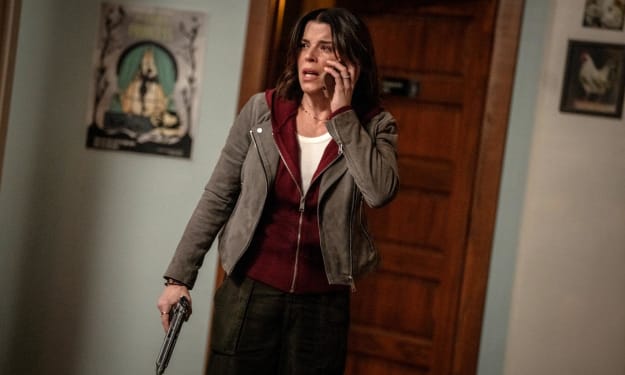
This is the seventh time we’ve had a Ghostface crisis. Scream 7 is the latest edition of the Scream franchise. Sydney Prescott and her family are under attack by another anonymous killer dressed in a Ghostface costume. While having issues with her daughter, Tatum, they run from the bloody murders, trying to determine who is behind it all.
By Marielle Sabbagabout 21 hours ago in Horror
Hello, Goodbye, Dad
I found the medium online, through a Facebook group. We made arrangements to meet. Her name was Delores Debato. She was big, fat, lumpy woman, with a freckled cheeks and bright red hair. She had a lot of tattoos, including eyeballs on the back of each hand.
By Lightning Bolt ⚡2 days ago in Horror


Comments
There are no comments for this story
Be the first to respond and start the conversation.