
The Movie That Made Me Sleep With the Lights On for a Week
A Descent into Darkness: The Setup

What’s the one movie that left you so rattled you couldn’t shake it for days? For me, it was The Exorcist (1973). I was 15, sneaking a late-night watch on a grainy VHS in my parents’ basement, the kind of rebellious act that feels thrilling until the lights go out. By the time the credits rolled, I was clutching a pillow, my heart pounding like I’d just sprinted a mile, and the idea of sleeping in my own bed felt like a personal challenge I wasn’t ready to face. For a solid week, I left every light in the house blazing, convinced that something sinister was lurking just beyond the shadows. This wasn’t just a movie—it was an experience that rewired how I saw fear, faith, and the power of storytelling on screen. How does a single film get under your skin so deeply that it changes how you move through the world?
A Descent into Darkness: The Setup
Picture this: it’s 1973, and The Exorcist, directed by William Friedkin and adapted from William Peter Blatty’s novel, hits theaters. Audiences are lining up, some fainting in the aisles, others reportedly fleeing before the film even ends. The story follows 12-year-old Regan MacNeil, a sweet kid who starts acting strange—really strange. Her mother, Chris, a skeptical actress, watches helplessly as Regan’s behavior spirals from odd to outright terrifying. Doctors are stumped, science fails, and soon, two priests—Father Karras, a man wrestling with his own doubts, and Father Merrin, a seasoned exorcist—step in to confront what might just be the devil himself.
The film wasn’t just a horror flick; it was a cultural earthquake. People didn’t just watch The Exorcist—they felt it. Theaters handed out barf bags, and urban legends swirled about cursed screenings and possessed viewers. Why did this movie hit so hard? It wasn’t just the spinning heads or guttural voices (though those didn’t help my teenage nerves). It tapped into something primal: the fear of losing control, of something ancient and evil invading the safest spaces—your home, your child, your mind.
The Hook: My Night of Terror
I didn’t grow up in a religious household, but I’d heard whispers about The Exorcist—how it was “too scary to watch alone,” how it made people question their beliefs. Naturally, that made it irresistible. I found a beat-up VHS at a garage sale, the cover art promising a forbidden thrill. That night, I waited until my parents were asleep, crept downstairs, and popped the tape into our clunky old player. The basement was freezing, the kind of cold that makes you pull your knees to your chest. The TV’s static hum was the only sound as the opening credits rolled, and I was already second-guessing my life choices.
The film starts slow, almost deceptively calm. A dig in Iraq, Father Merrin unearthing a creepy artifact, a subtle sense of dread building like a storm on the horizon. Then it shifts to Georgetown, to Regan’s cozy bedroom, where things start to unravel. The first time I heard that low, demonic voice rasp through Regan, I froze. It wasn’t just the sound—it was the way it felt wrong, like something that shouldn’t exist in a kid’s body. By the time Regan’s head spun 360 degrees, I was gripping the couch so hard my knuckles ached. I kept glancing at the basement stairs, half-expecting something to slink down in the dark.
Why It Sticks: The Power of Relatable Fear
What makes The Exorcist so terrifying isn’t just the supernatural spectacle—it’s how it grounds the horror in something deeply human. The story starts with a mother and daughter, a bond anyone can understand. Chris MacNeil, played by Ellen Burstyn, isn’t a superhero; she’s a single mom, frazzled and fierce, trying to protect her kid. When Regan starts changing, it’s not just possession—it’s every parent’s nightmare of watching their child slip away, whether to illness, rebellion, or something they can’t name. The film doesn’t just tell you Chris is scared; it shows her chain-smoking, snapping at doctors, her voice cracking as she begs for answers.
Then there’s Father Karras, portrayed by Jason Miller, a priest who’s lost his faith after his mother’s death. His guilt and doubt make him relatable, even to a nonbeliever like me. When he faces the demon, it’s not just a battle against evil—it’s a man wrestling with his own brokenness, trying to find meaning in a world that feels chaotic. The film asks: What do you do when everything you trust—science, religion, love—starts to crumble? That question lingered in my teenage mind, making the horror feel not just scary, but personal.
Painting the Scene: Vivid Horror Done Right
Friedkin’s direction is a masterclass in “show, don’t tell.” Instead of explaining the demon’s power, the film shows it: Regan’s bed shaking violently, her body contorting in ways that defy biology, the air in her room turning icy as objects fly off shelves. The sound design is just as brutal—those guttural growls, the creak of the house, the silence that makes you hold your breath. One scene, where Regan undergoes a spinal tap, isn’t even supernatural, but it’s so raw—her screams, the sterile hospital room, Chris’s helpless tears—that it’s as unsettling as any demon.
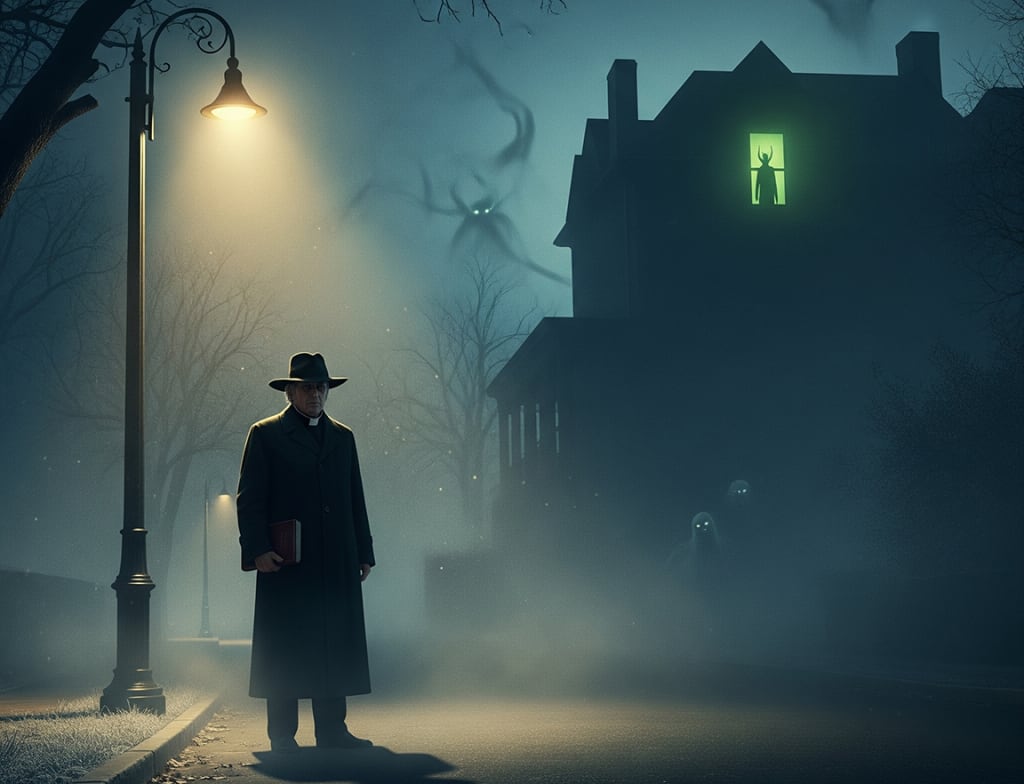
The visuals stick with you. The image of Father Merrin standing under a streetlamp outside the MacNeil house, fog curling around him like a warning, is iconic for a reason. It’s not just a man; it’s a lone figure facing something ancient and unstoppable. That shot haunted me for days, every shadow in my room suddenly feeling like a threat. The film’s pacing, too, is merciless—it builds dread slowly, then hits you with moments so shocking you can’t look away, even if you want to.
A Revelation: The Real Horror Is Us
Here’s the secret The Exorcist whispers: the scariest thing isn’t the demon—it’s what it reveals about us. The film doesn’t just scare you with jump scares or gore (though it has those in spades). It forces you to confront questions we’d rather avoid. What if evil isn’t just “out there” but inside the people we love? What if faith, science, or even courage isn’t enough to save them? The demon taunts Karras with his guilt, mocks Chris’s love for her daughter, and thrives on their fear. It’s not just a monster—it’s a mirror, showing us how fragile our sense of control really is.
For me, that’s what kept the lights on for a week. It wasn’t just fear of a demon crawling out of my closet (though, trust me, I checked). It was the nagging thought that maybe the world wasn’t as safe as I’d assumed. At 15, I was already grappling with big questions—why bad things happen, whether I could trust the adults around me, what I believed about the universe. The Exorcist didn’t give me answers; it made those questions louder, more urgent. It turned my cozy basement into a place where anything could happen, and not the good kind of anything.
A Cultural Phenomenon: Why It Endures
The Exorcist didn’t just scare me—it scared the world. It grossed over $440 million worldwide (adjusted for inflation, that’s closer to $2 billion today), making it one of the highest-grossing films of its time. It was nominated for 10 Oscars, winning two, a rare feat for a horror movie. But its impact went beyond box office numbers. It sparked debates about faith, censorship, and the limits of art. Religious groups protested, claiming it glorified Satan; others praised it for affirming the power of faith. Psychologists weighed in, warning about its effect on impressionable minds (like mine, apparently).
The film’s legacy lives on in countless ways. It birthed a subgenre of possession movies, from The Omen to The Conjuring. Its imagery—Regan’s pale, scarred face, that spider-walk down the stairs—has been parodied, referenced, and ripped off endlessly. Yet nothing quite matches the original’s raw power. Even now, watching it as an adult, I feel that same chill, though I’m less likely to sleep with the lights on (most nights, anyway).
Lessons from the Fear: Why It Matters
So why write about a movie that left me traumatized at 15? Because The Exorcist isn’t just about fear—it’s about what fear teaches us. It’s about the courage to face the unknown, whether it’s a demon or your own doubts. It’s about the love that drives a mother to fight for her child, even when hope feels lost. And it’s about the power of stories to shake us, change us, make us question everything we thought we knew.
For a week after watching it, I was a nervous wreck, jumping at every creak in the house. But I also felt alive, like I’d glimpsed something bigger than myself. That’s what great art does—it doesn’t just entertain; it transforms. The Exorcist reminded me that stories can be more than escapism; they can be a confrontation, a revelation, a mirror held up to our deepest fears and hopes.
So, what’s the movie that got under your skin? The one that made you rethink the world, or at least double-check the locks? For me, it’s The Exorcist—the film that turned my teenage bravado into a week of sleepless nights and a lifetime of respect for the power of a well-told story. Maybe it’s time for a rewatch. But this time, I’m keeping the lights on.
About the Creator
Ozjan Kackar
Writer exploring the world and sharing stories about people, cultures, and nature. Turn experiences into articles, books, and reports that connect with readers.
Keep reading
More stories from Ozjan Kackar and writers in Horror and other communities.
The Movie That Made Me Sleep With the Lights On for a Week
Have you ever watched a movie that didn't just scare you, but followed you into your dreams? A film that refused to let go, even after the credits rolled? That's what happened to me the first time I watched Sinister.
By Ozjan Kackar6 months ago in Horror
Lideco Ghost Town Vietnam: Inside Hanoi’s Most Mysterious Abandoned City
Approximately 15 km to the west of Hà Nội city center, in Hoài Đức District, is one of the most fascinating ruin sights in Vietnam, which is the remnants of a large housing estate called Lideco Bắc 32. This location does not appear to be a typical residential area to tourists who visit there or those who hear of its existence; it is more of a ghost town.
By Kyrol Mojikal3 days ago in Horror



Comments (2)
good
me full support you can you support me