
The Movie of (SAW)
Saw is a famous piece of horror cinema,renowned for its blend of psychological tension and intense gore.

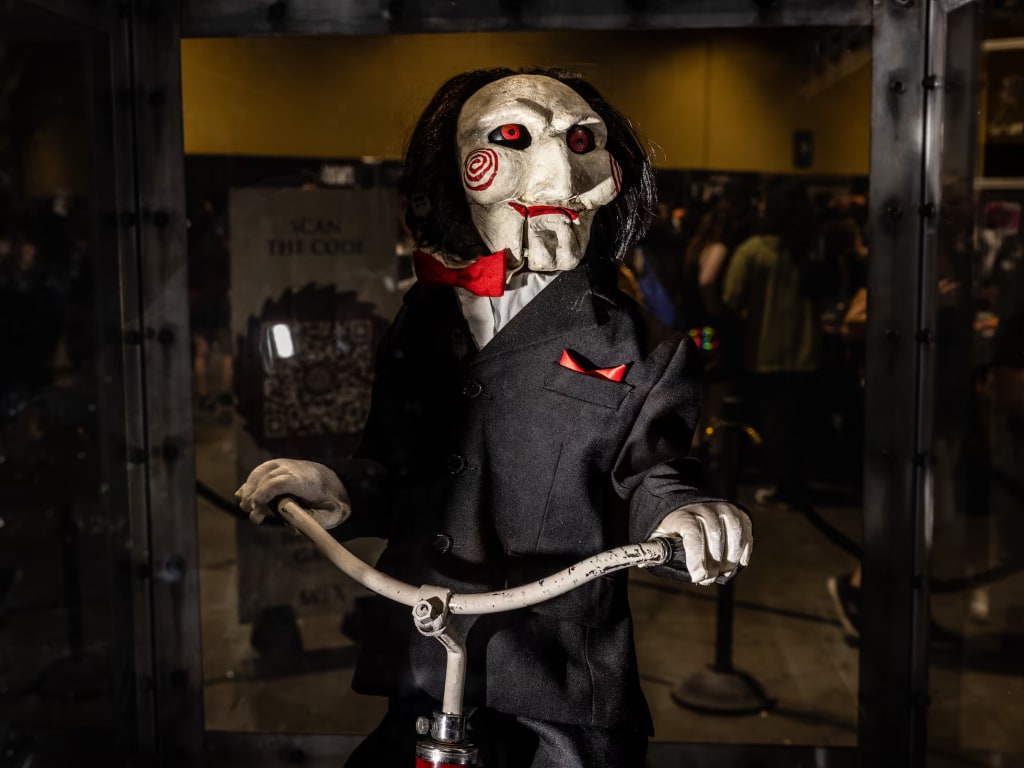
Saw is more than a typical horror movie; it's a suspense-filled, mind-bending thriller that explores themes of morality, survival, and the lengths to which individuals will go when faced with unimaginable choices. This combination of gruesome traps, moral dilemmas, and a dark atmosphere set a precedent for the entire “torture-porn” subgenre, although it also provided deeper psychological depth than many later imitators.
The plot revolves around the mysterious “Jigsaw Killer” (played by Tobin Bell), who doesn’t actually kill his victims directly but instead places them in life-threatening situations that force them to confront their own failings or shortcomings. The main narrative begins with two strangers, Dr. Lawrence Gordon (Cary Elwes) and Adam Stanheight (Leigh Whannell), who find themselves chained in a grimy bathroom with no memory of how they arrived. A tape reveals that they are participants in a twisted “game” orchestrated by Jigsaw. Dr. Gordon is told he must kill Adam by a certain time if he wants to save his own family from certain death. The two men must unravel clues around them, fight off their despair, and confront their worst instincts as the film’s psychological horror element begins to build.
An Innovative Take on the Horror Genre
Saw was praised for its novel approach to horror, shifting from supernatural elements to real-world horror that felt painfully plausible. Jigsaw’s modus operandi is not to kill his victims outright but to make them face moral choices—whether to hurt themselves, hurt others, or suffer mentally—allowing their decisions to determine their survival. This not only forces viewers to confront their own moral boundaries but also pushes characters to explore what survival truly means. The film uses clever, albeit grotesque, traps and puzzles that reflect each victim’s past sins, creating an immersive experience where the audience is forced to ponder their own responses in such situations.
The franchise's structure is also noteworthy, with Saw incorporating twists that are both shocking and logical within the movie’s framework. The final reveal, where viewers learn the true identity of Jigsaw and the reasoning behind his intricate traps, is one of horror cinema’s most iconic moments. Instead of relying on cheap jump scares, Saw builds tension through its characters’ desperation, creating an atmosphere where dread seeps into every frame.
The Psychological Depth of Jigsaw
Jigsaw, or John Kramer, represents a unique and terrifying villain. Kramer doesn’t view himself as a killer but rather as a moral enforcer, placing people in situations that make them reflect on their life choices. His character isn’t driven by sadism; he’s driven by his belief in the transformative power of survival. Diagnosed with terminal cancer and embittered by a system that he feels failed him, Kramer’s motivations stem from his belief that only those who experience real suffering can truly appreciate life. He targets individuals he believes take life for granted, putting them through trials that will either “cure” them of their perceived flaws or eliminate them entirely.
The character of Jigsaw and his motivations provide a deeper layer of psychological horror that elevates Saw beyond mere gore. The audience isn’t just watching characters suffer; they’re being asked to consider the value of human life, morality, and justice from Jigsaw’s twisted perspective. In doing so, Saw brings viewers into the philosophical struggle at the heart of the film—how much is life worth, and what would you endure to keep it?
The Gruesome Legacy of Gore and Traps
One of Saw’s defining characteristics is its graphic depiction of violence, making it both notorious and widely debated. The traps are horrifying in their brutality, designed to challenge the characters physically and psychologically. Each one reflects the theme of punishment and redemption: from crawling through a field of barbed wire to retrieve a key, to a reverse bear trap set to snap open around a character’s head, these traps are as inventive as they are terrifying. They became a staple of the franchise, evolving in complexity with each sequel and continually testing audiences’ stomachs as much as the characters’ limits.
The film’s portrayal of violence earned it both acclaim and criticism. Some viewers found the graphic content gratuitous, while others appreciated it as a form of visceral storytelling that elevated the stakes. Saw arguably set the stage for the “torture-porn” subgenre, inspiring a wave of imitators and sequels that emphasized gore and shock value. However, unlike some of its successors, Saw balances its violent content with strong narrative and psychological elements, which ultimately make it more than a simple gore-fest.
Visual Style and Atmosphere
The film’s visuals are stark and gritty, with a greenish hue that creates a sickly, claustrophobic atmosphere. The set design, especially the iconic bathroom where much of the film takes place, is purposefully dingy and oppressive, amplifying the sense of hopelessness. Wan’s direction, particularly the use of close-ups and disorienting camera angles, adds to the psychological disarray. The confined spaces, moody lighting, and sound design all contribute to an overwhelming feeling of dread, mirroring the characters’ trapped, desperate situation.
The Impact and Legacy of Saw
Saw became a cultural phenomenon, spawning numerous sequels, a dedicated fan base, and a lasting impact on horror cinema. Its combination of psychological horror, moral questioning, and gruesome visuals created a genre-defining experience that has influenced many horror films since. Despite criticism from some who view it as overly violent, Saw has earned a place in horror history as a film that challenged conventions, introduced an enduring villain in Jigsaw, and brought fresh depth to the genre.
In summary, Saw is more than a horror movie with blood and gore; it’s a well-crafted psychological thriller that tests the limits of its characters and viewers alike. By forcing its characters to confront their deepest fears and forcing audiences to face the question of how far they’d go to survive, Saw leaves a lasting impression—one that’s as unsettling and unforgettable as Jigsaw’s traps.
About the Creator
Badhan Sen
Myself Badhan, I am a professional writer.I like to share some stories with my friends.
Keep reading
More stories from Badhan Sen and writers in Horror and other communities.
Why do we watch horror movies especially at night?
Nighttime viewing adds layers of psychological and environmental factors that enhance the scare factor, providing a more intense and immersive experience. This inclination to watch horror after dark stems from a combination of natural human psychology, our enjoyment of controlled scares, and the sensory impact of darkness.
By Badhan Senabout a year ago in Horror
5 Most Haunted Objects in History: From Annabelle to Robert the Doll
I have a confession to make: I am obsessed with European history, specifically castles. There’s something about a stone fortress that feels like a magnet for the paranormal. In my mind, every castle is haunted, usually by a lady in a white dress, a headless nobleman, or (the absolute worst) creepy ghost children.
By Areeba Umair5 days ago in Horror


Comments
There are no comments for this story
Be the first to respond and start the conversation.