
The Living Canvas
Some masterpieces aren’t painted — they are lived, absorbed, and trapped.

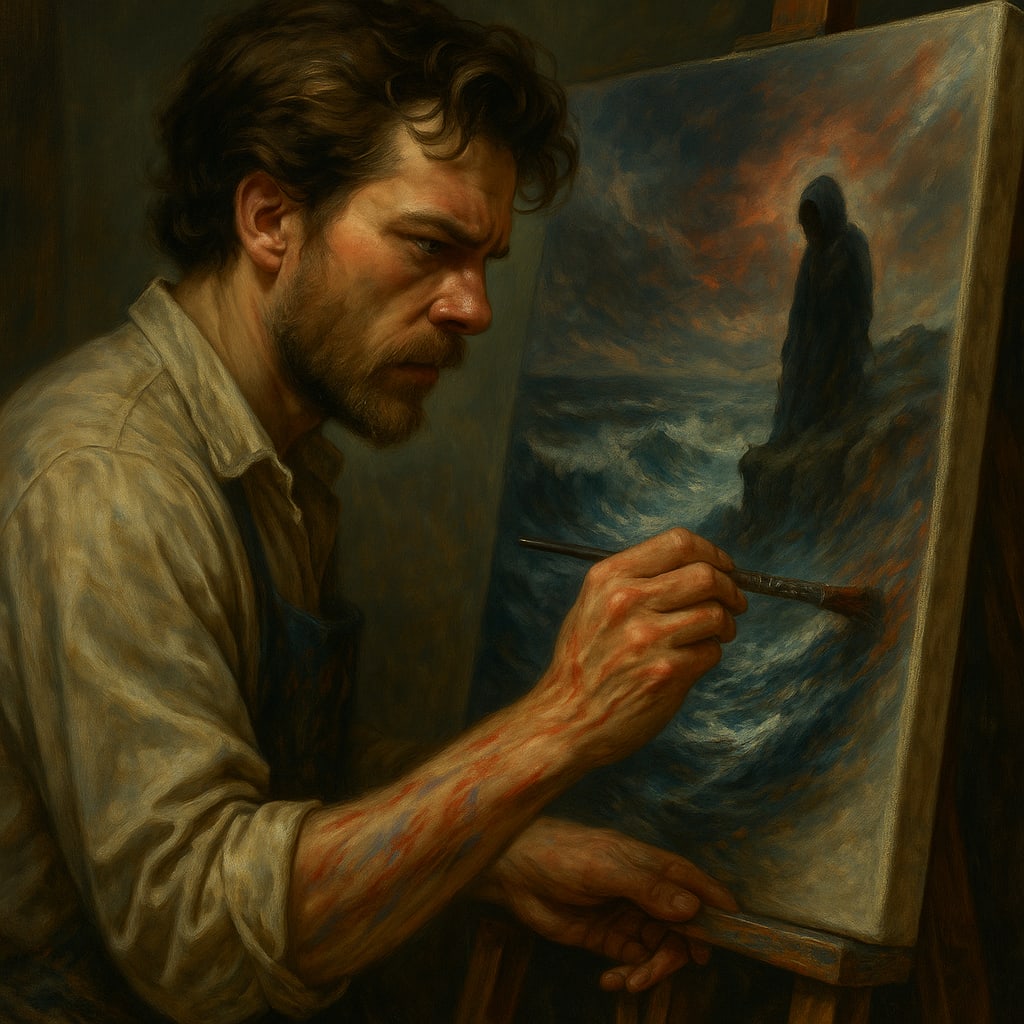
Elias Thorne was an artist — a master of vibrant chaos. His studio, a sun-drenched loft overflowing with canvases and tubes of paint, was his sanctuary. He chased the raw emotion of a scene, the unseen currents beneath the visible.
One rainy afternoon, browsing a dusty, forgotten antique shop, he stumbled upon it — a rolled-up canvas, ancient and strangely heavy, emitting a faint, almost imperceptible warmth. It felt like living skin, even though it was clearly made of aged linen. The shopkeeper, a gaunt man with eyes like polished stones, simply called it “the old one” and let it go for a pittance.
Back in his studio, Elias unrolled it. The canvas was stark white, but not the bleached white of modern art supplies. This was an aged, creamy white, with subtle, organic undulations on its surface, as if something were gently breathing beneath the fibers. He ran his hand over it; a faint pulse seemed to throb beneath his fingertips. It was unnerving — yet intoxicating. This wasn’t just a canvas; it was an experience.
He began to paint, driven by an unfamiliar urgency. He chose a landscape — a stormy sea crashing against jagged cliffs — a subject he’d always found cathartic. As his brush touched the surface, he felt a strange connection, a pull, as if the canvas were drinking his paint, his energy.
He worked for hours, lost in a trance. When he finally stepped back, the painting was magnificent — more vibrant, more alive than anything he’d ever created. The waves seemed to move, the clouds to churn.
But then, the changes began. Subtle at first. A flicker in the stormy sky of his painting, a dark shape that hadn’t been there before. He dismissed it, blaming his tired eyes.
The next morning, the subtle flicker was a definite form — a lone, shadowy figure standing on the cliff’s edge, gazing out at the tempest. Elias hadn’t painted it. He was certain.
He tried to paint over it, but the figure remained, as if etched into the very fabric of the canvas. The more he painted, the more the canvas seemed to absorb not just his colors, but his thoughts, his anxieties. He found himself adding elements he hadn’t intended: distorted faces in the foam of the waves, gnarled trees that looked like reaching claws. The painting was becoming a reflection of his own subconscious fears — fears he hadn’t known he possessed.
His dreams grew vivid, terrifying. He dreamt of being trapped within a painting, the colors suffocating him, the figures on the canvas watching him with cold, judgmental eyes. He’d wake in cold sweats, feeling a strange exhaustion, as if his very essence had been drained.
He researched ancient art, cursed artifacts — anything that might explain the phenomenon. He found obscure legends of “soul canvases,” tools of forgotten cults that could capture the essence of a painter — their creativity, their very being — using it to bring the artwork to terrifying, sentient life.
These canvases weren’t just surfaces — they were hungry entities, feeding on the artistic soul, slowly transferring the artist’s reality into the painted world, trapping them within their own creation.
The horrifying truth clawed its way into his mind: the canvas wasn’t just reflecting his fears — it was making them real within the painting. And the shadowy figure on the cliff? It was the original entity, or perhaps the manifestation of a previous artist it had consumed, now lurking, waiting for its chance to fully emerge — pulling Elias into its painted prison.
One night, as he stood before the canvas, the figure on the cliff began to move. Slowly, deliberately, it turned its head. Its eyes — or where eyes should have been — burned with a cold, ancient hunger. A low hum vibrated from the canvas, the same faint pulse he’d felt when he first touched it — now amplified into a chilling, resonant thrum.
“You are a beautiful canvas,” a voice whispered from the painting — a dry, papery sound, like old parchment rustling. “A vibrant new hue. Almost complete.”
Elias stumbled back, the realization hitting him with the force of a physical blow. The canvas was absorbing him. His memories, his fears, his very will were being siphoned, feeding the entity within.
His reality was blurring with the painted world. He saw faint brushstrokes on his own skin, felt a strange flatness, as if he himself was becoming two-dimensional.
He had to fight. He couldn’t destroy it; he knew that instinctively. It was too old, too deeply ingrained into the fabric of something ancient. But perhaps he could sever the connection, unravel the terrifying art he had created.
He remembered an old lore about “reversing the flow” — not through destruction, but through a spiritual counter-creation, a drawing out of the essence.
With trembling hands, Elias grabbed a bucket of turpentine and his largest brush. He would not destroy the painting — he would undo it. He would use the solvent to strip away the layers, not to erase, but to draw out the absorbed essence, to reclaim what the canvas had taken.
As he began to brush the solvent onto the vibrant colors, the canvas shrieked — a silent, agonizing scream that tore through Elias’s mind. The colors bled, not just running, but receding, as if being sucked back into the canvas itself. The shadowy figure on the cliff writhed, its form distorting, dissolving, fighting against the unraveling.
Faces, fleeting and terrified, appeared and vanished within the dissolving paint — the faces of those artists who had succumbed before him.
The struggle felt cosmic — a battle for his very soul. The canvas pulsed violently, trying to resist, to pull him back into its painted depths. But Elias pressed on, his resolve hardening. He was reclaiming his reality, stripping away the nightmare.
Finally, with a soft, sucking sound, the last of the vibrant colors vanished, absorbed back into the canvas. The ancient linen returned to its original creamy white, inert and silent. The warmth was gone. The faint pulse had ceased.
It was just a blank canvas again — harmless, empty.
Elias never painted again. He sold the studio, abandoned his art. The thought of a blank canvas — of the endless possibilities it held — now filled him with a profound, chilling dread. He knew the canvas was merely dormant, its hunger satisfied for now, waiting for another unsuspecting artist, another creative soul, to pick up a brush.
Sometimes, in the quiet of the night, he’d catch a fleeting glimpse of deep, vibrant colors in his peripheral vision — or feel a phantom pulse beneath his skin.
About the Creator
Noman Afridi
I’m Noman Afridi — welcome, all friends! I write horror & thought-provoking stories: mysteries of the unseen, real reflections, and emotional truths. With sincerity in every word. InshaAllah.
Keep reading
More stories from Noman Afridi and writers in Horror and other communities.
The Echo of the Unsent
The phone was a steal. Not the latest model, but a pristine, unlocked iPhone X. I snagged it for a song from a pawn shop downtown, thinking I’d finally upgrade from my cracked relic. It felt good in my hand, smooth and familiar. A clean slate, I thought. I was dead wrong.
By Noman Afridi9 months ago in Horror
"Scream 7" (2026): Running out of Fresh Screams
This is the seventh time we’ve had a Ghostface crisis. Scream 7 is the latest edition of the Scream franchise. Sydney Prescott and her family are under attack by another anonymous killer dressed in a Ghostface costume. While having issues with her daughter, Tatum, they run from the bloody murders, trying to determine who is behind it all.
By Marielle Sabbag5 days ago in Horror




Comments (1)
That's quite a story! I've had similar experiences with art materials having a life of their own. Creepy and fascinating.