
The Last Letter from Kandahar
A soldier’s final words echo louder than gunfire.

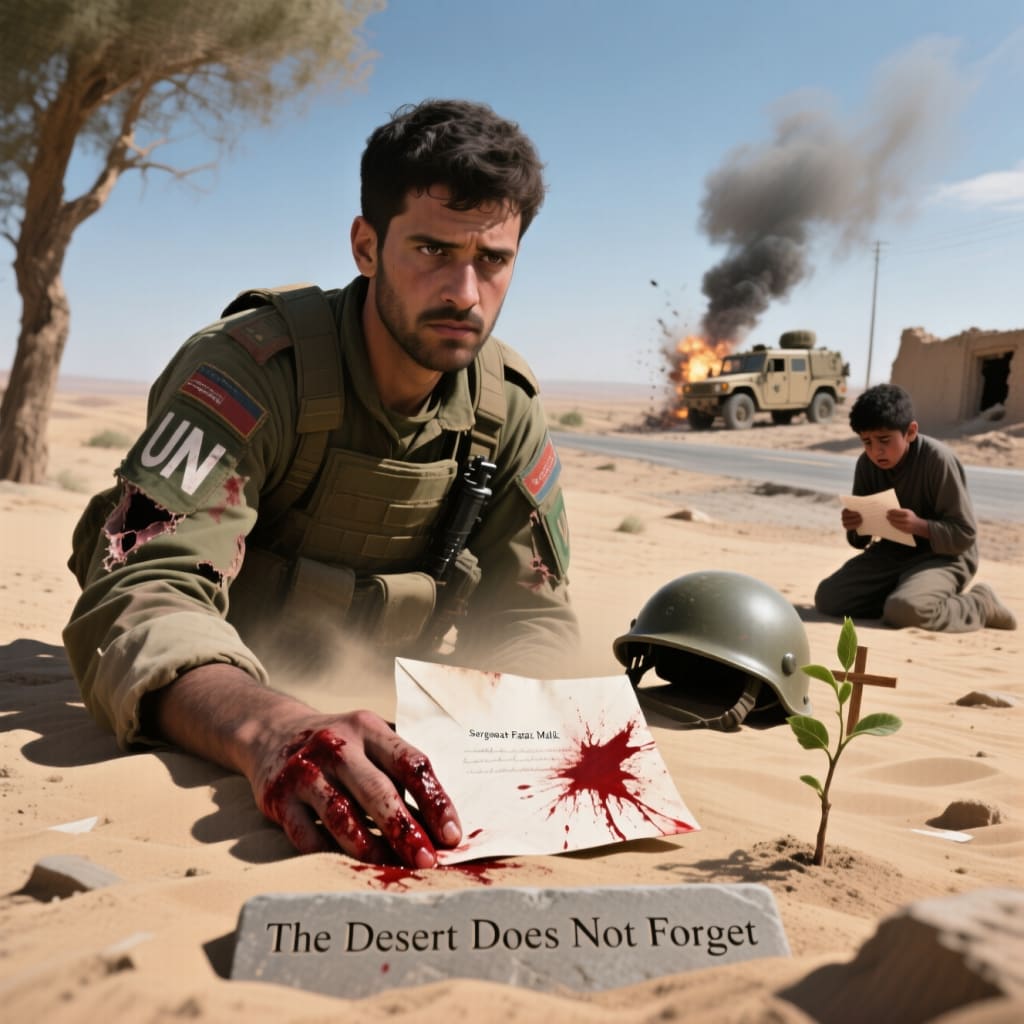
The desert does not forget.
The sand of Kandahar has soaked in centuries of blood, sweat, and silence. Each grain holds stories — of warriors, victims, and men who stood their ground when it mattered most. Among them lies the memory of Sergeant Faraz Malik, whose final act of bravery became more than just a tale — it became a legacy.
Faraz was 28 when he joined the United Nations Peacekeeping Force deployed in Afghanistan’s war-torn southern region. Hailing from the lush green valleys of Swat, Pakistan, he had always believed in service, in standing for something bigger than himself. To him, uniform was not just clothing — it was a shield for the helpless and a sword against injustice.
His mother begged him to stay. “You’ve already served six years,” she had said, tears clinging to her fading smile. But Faraz kissed her forehead gently and replied, “There are still children out there hiding under broken roofs. If I can guard even one, I’ll be at peace.”
Kandahar, however, was far from peaceful.
The days were blistering, the nights haunted by distant gunfire. The enemy wasn’t always visible, but their presence echoed in every crumbled wall and in every hesitant step a child took near a trash pile—because trash piles sometimes exploded.
On the third day of their mission, Faraz wrote a letter by the dim glow of a flickering camp lamp. His hands were calloused, his eyes tired, but his handwriting was steady. He addressed it to his younger brother, Bilal.
“If you are reading this, I’m probably somewhere higher than the clouds. Don’t cry. Tell Ammi I kept my promise. I protected the innocent. I did not fire in anger. And I never let fear break me. Bury me in my uniform. And plant a tree next to my grave — something that grows.”
He folded it carefully, tucked it into the chest pocket of his uniform, and closed his eyes to catch an hour of sleep — the kind that never came easy.
The next morning brought silence — too much of it.
The convoy was moving along a narrow dirt road lined with abandoned market stalls. It was supposed to be a routine patrol. But wars do not follow routines. One of the trucks hit an improvised explosive device buried beneath a pile of rubble. The explosion shook the ground. Flames erupted. Screams followed.
Amid the smoke and chaos, Faraz sprang into action. With shrapnel embedded in his leg, he still managed to drag two injured comrades behind the truck for cover. Blood streamed down his temple, but his focus never wavered. Then, a single shot rang out.
A sniper had spotted him. The bullet pierced his chest, just inches from where the letter lay.
Faraz collapsed but remained conscious. His last movement was to reach into his vest and pull out the letter. With trembling fingers, he pressed it into the hand of the medic he had just saved — whispering, “Give this... to my brother.”
By the time the helicopter arrived, Faraz was gone. His body was still curled protectively toward the men he had rescued, eyes open — staring at the endless Afghan sky, as if watching for peace that never arrived.
The letter did.
It reached Bilal three weeks later. It arrived folded, stained with blood and dust — but still legible. When Bilal read it, he wept in the arms of their mother, not because Faraz was gone, but because he had kept his word.
The story spread. News channels covered his final moments. Schools in Swat held assemblies in his honor. His grave, under a young tree planted by Bilal’s own hands, became a quiet pilgrimage site for villagers.
But perhaps the most powerful moment came months later, when the military released a training manual titled “Honor in Silence.” On its first page was Faraz’s letter — word for word.
In a world flooded with politics, betrayals, and strategies, Sergeant Faraz Malik reminded people of something simpler:
That courage is not loud.
That sacrifice isn’t always grand.
That sometimes, the most powerful weapon a soldier can carry… is a letter.
And though Faraz died on a forgotten road in Kandahar, his words still live not just on paper, but in every soul that believes in peace worth fighting for.
Because in war, courage dies only when forgotten.
About the Creator
Wings of Time
I'm Wings of Time—a storyteller from Swat, Pakistan. I write immersive, researched tales of war, aviation, and history that bring the past roaring back to life
Keep reading
More stories from Wings of Time and writers in Horror and other communities.
The Stranger at the Bridge
The Stranger at the Bridge It was the last day of autumn when the leaves whispered secrets into the wind and the sky blushed with the orange hue of goodbye. As the sun dipped behind the hills of the quiet town of Eldershore, a lone figure stood at the old wooden bridge—where stories ended and sometimes began.
By Wings of Time 8 months ago in Horror
Hottest in the Office
Dear Rafi, You’re very distracting to work around. For the first second I saw you the other day, I thought you were some type of executive. It took a moment to realize no, you were just the new guy, dressed up for the job he wants. Be still, my heart.
By Gabriel Shames4 days ago in Pride


Comments
There are no comments for this story
Be the first to respond and start the conversation.