
The Last Door on Maple Street
Some doors stay closed for a reason—but this one just opened.

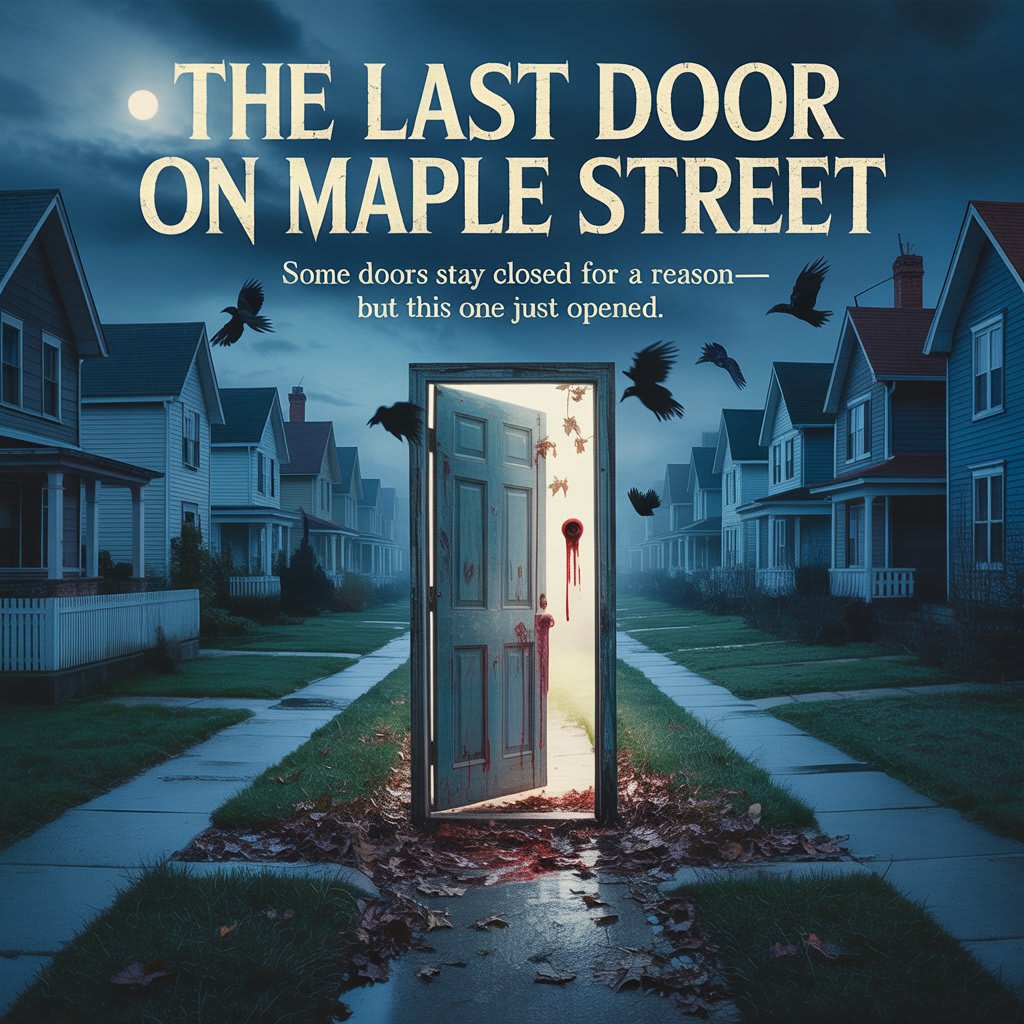
The Last Door on Maple Street
Some doors stay closed for a reason—but this one just opened.
Maple Street was like any other suburban street—neat lawns, trimmed hedges, mailboxes with peeling paint. But at the very end, tucked beneath the gnarled arms of an old oak tree, stood a house with no lights, no visitors, and a door that no one dared to knock on.
House number 99.
Locals called it “the last door.”
Not because it was the final house on the street—but because everyone who ever entered it never seemed quite the same. Or never came back at all.
Most people ignored it. Children dared each other to run up and touch the door, but few got close. The mailman stopped delivering there years ago. And the real estate agents? They stopped trying.
That was, until Eloise Monroe moved in next door.
Eloise was 27, freshly heartbroken, and ready to disappear into a quiet neighborhood. Maple Street was cheap, and she liked the sound of birds in the morning. No traffic. No noise. Just peace.
Until she noticed the door.
The house next door didn’t just look abandoned. It felt abandoned. Heavy air. Cold shadows. She caught herself staring at it through her kitchen window, like the house was staring back.
The door was always shut.
Until it wasn’t.
It was 3:17 a.m. when she saw it first: the door to number 99, cracked open just an inch.
No breeze. No one there.
Just open.
She told herself it was the wind. Or her imagination. But night after night, the door stayed slightly ajar. Sometimes more. Sometimes less.
Once, she swore she saw someone standing just inside.
Not moving.
Just watching.
Eloise lasted six days.
On the seventh, curiosity—lonely and sharp—got the better of her. With a flashlight in one hand and pepper spray in the other, she crossed her yard, stepped onto the creaking porch of number 99, and placed her hand on the doorknob.
It was warm.
The door creaked open wider on its own.
Inside, it smelled of dust and time. The air was thick, still. Cobwebs hung like forgotten curtains. But there were no broken windows, no rotting floors. The furniture was intact. The wallpaper had faded, but not peeled.
It was as if someone had just… left. Yesterday. Or decades ago.
Eloise stepped further in.
“Hello?” she called out.
No response.
She turned toward the stairs. That’s when she heard it.
Click.
The door had closed behind her.
She rushed back and twisted the knob. Locked.
Heart racing, Eloise turned around—and everything was different.
The wallpaper was new. The furniture had changed. Music floated down the stairs—soft, crackling jazz. A woman’s laugh echoed from above. The air smelled like perfume and freshly baked bread.
It was the same house… but not the same time.
Footsteps padded softly from the hallway, and a man in a brown suit rounded the corner. He looked surprised, but not afraid.
“You’re not supposed to be here,” he said gently.
Eloise opened her mouth but couldn’t form words. “What is this?” she finally whispered.
He tilted his head. “This house remembers. It holds echoes of those who enter. Memories... trapped in the walls.”
She backed away, confused. “I’m not a memory.”
“Not yet,” he said. “But the house is watching.”
Eloise ran for the stairs, her breath ragged. Every room she passed was alive—hosting scenes from different eras. A family eating dinner by candlelight. A woman crying into a telephone. A child drawing monsters on the wall.
But the people didn’t see her.
They weren’t real.
They were memories.
Until she reached the attic.
In the attic, it was cold. Silent.
Dust danced in the slats of moonlight. And in the corner sat an old wooden box, carved with the number 99.
She opened it.
Inside: dozens of items. A cracked locket. A wedding ring. A pair of baby shoes. A page from a diary.
Each belonged to someone who had entered this house. Each, a piece of someone lost.
And on top of them all: a photograph of her.
She dropped it, heart pounding.
How?
Suddenly, the air shifted. The man from earlier stood in the doorway. But now, he looked older. Pale. Faded.
“You’ve seen it now,” he said. “It won’t let you forget.”
“What is this place?”
He smiled sadly. “The last door. A doorway between memory and time. A place where the past waits. And sometimes… pulls people in.”
“I want to leave.”
He nodded. “Then don’t forget who you are. That’s how it keeps you—when you forget.”
Eloise ran. Down the stairs. Through the hallway. Toward the door.
This time, it opened.
She woke in her bed.
Sunlight streamed through the window. Birds chirped. Her heart still thudded against her ribs.
She rushed to the window.
Number 99 was there.
But the door was closed again.
She moved out a week later.
She told herself it was stress. That she imagined it all.
But late at night, when she dreams, she’s always back inside that house. Back with the box. The memories. The man with the faded smile.
And sometimes—
She dreams of the door opening again.
The End.
About the Creator
FAIZAN AFRIDI
I’m a writer who believes that no subject is too small, too big, or too complex to explore. From storytelling to poetry, emotions to everyday thoughts, I write about everything that touches life.
Keep reading
More stories from FAIZAN AFRIDI and writers in Horror and other communities.
"The Last Message"
The Last Message He vanished five years ago. Last night, he texted her. Ava Jensen had stopped hoping years ago. Her brother, Liam, disappeared without a trace during a solo hiking trip to their family’s old forest cabin — a place tangled in shadows and silence. The police searched. Volunteers combed the area. Nothing. Not a single footprint. Eventually, grief hardened into acceptance.
By FAIZAN AFRIDI10 months ago in Horror
THE GIRL IN THE MIRROR
Chapter 1: The First Glitch Maya stared at her reflection, tying her hair into a messy ponytail. It was 6:45 AM on a Monday—too early for a sixteen-year-old to function properly. Her uniform hung loosely on her thin frame, and dark circles under her eyes told the story of another sleepless night.
By A Psychologist about 11 hours ago in Horror


Comments
There are no comments for this story
Be the first to respond and start the conversation.