
“The House That Dreamed of Me”
— A writer rents a cabin that begins to write stories about her life — before they happen

The House That Dreamed of Me
By [Ali Rehman]
When I first saw the listing for the cabin, it felt like a whisper from some forgotten place inside me.
“Secluded mountain retreat, perfect for writers,” it said, promising silence, inspiration, and the kind of isolation I desperately needed. After months of writer’s block and deadlines, I packed my bags and left the city behind — craving nothing more than to disappear into quiet and maybe, just maybe, find the words again.
The cabin sat at the edge of a pine forest, surrounded by towering trees that swayed like ancient sentinels in the wind. It was older than I expected, with creaky wooden floors, faded wallpaper curling at the edges, and a fireplace that looked like it hadn’t been used in decades. But there was something warm about it, as if the house itself held a secret smile.
The first night, I unpacked my notebook and laptop, eager to start fresh. But as I sat by the window, watching stars blink to life, a strange feeling settled over me — like the house was watching, waiting.
I shrugged it off as nerves. Writers are prone to imagination, after all.
Days passed. I wrote little — a sentence here, a paragraph there — but the silence was different than I’d expected. It wasn’t peaceful. It was heavy, like the house was breathing stories around me.
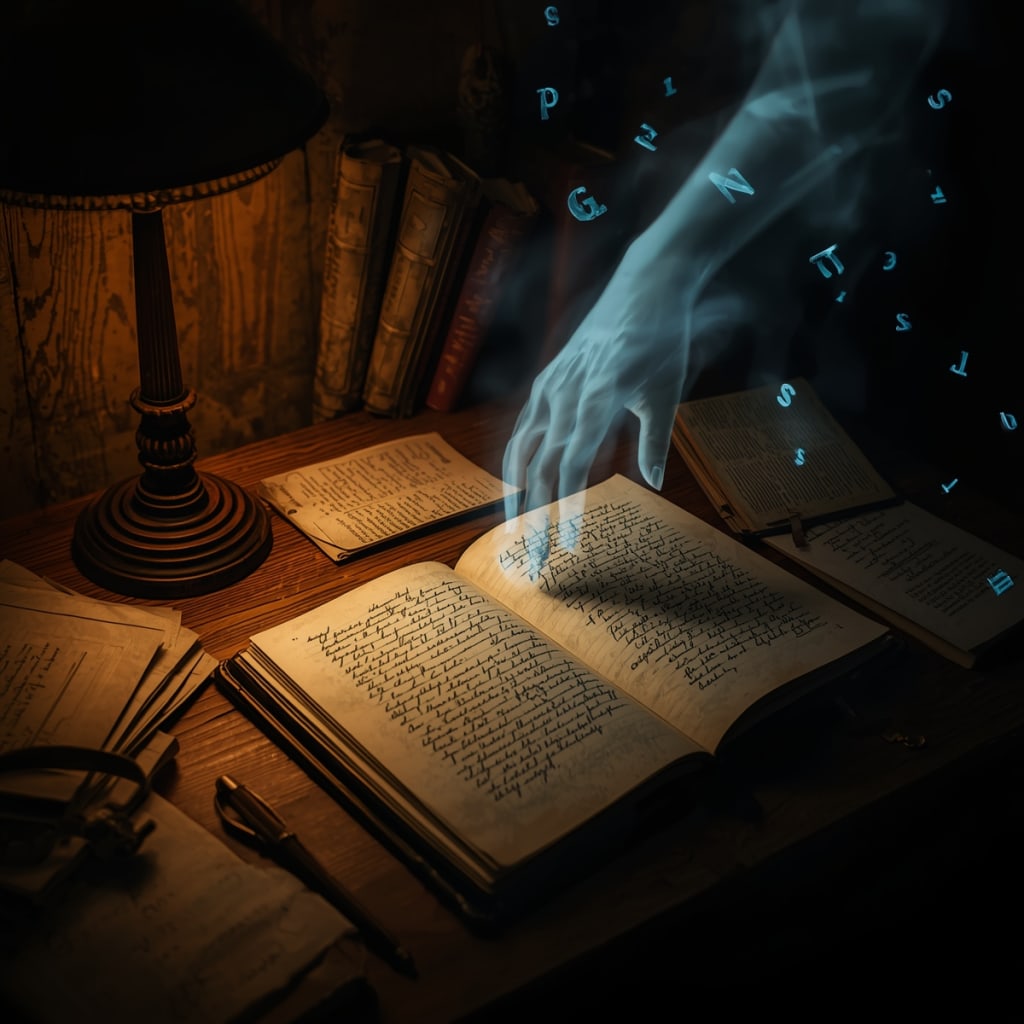
Then I found the journal.
It was tucked beneath a loose floorboard in the living room — bound in cracked leather and smelling of cedar and dust. Curious, I opened it.
The first pages were filled with neat, flowing handwriting: entries from someone named Clara. She was a writer, too, who had lived here long ago. Her words were vivid, raw, and filled with passion — descriptions of the woods, the stars, her hopes and fears. But as I read further, the journal took a strange turn.
Clara wrote about a dream the house gave her — stories that appeared on the pages without her will, stories about people she hadn’t met yet, events that hadn’t happened. At first, she was terrified. But then she realized the house was showing her the future.
I laughed nervously, shutting the journal. Dreams that write themselves? Future stories? It was too much.
Until it happened to me.
One morning, I woke up to find a new story on the kitchen table. It wasn’t mine — the handwriting was elegant, different, but unmistakably real. The story described the exact dream I’d had the night before: walking through a meadow, finding a bird with a broken wing, and helping it heal.
I blinked and looked around. No notebook. No pen. Just that single page, as if it had appeared from thin air.
I read it again. The details were perfect — the bird, the colors, the ache in my chest. I hadn’t told anyone about the dream.
I tried to rationalize it — maybe I’d written it and forgotten? But my memory was sharp, and I was sure.
Over the next days, more stories appeared. They described moments in my life — conversations I hadn’t had yet, choices I was about to make, even fears I kept buried.
At first, I was frightened. How could the house know me so intimately? Was I losing my mind?
Then I realized something more terrifying: these stories came true.
One night, the story on the table told of a storm that would blow in the next evening. I checked the weather. Clear skies. But the next day, clouds rolled in, and a fierce wind tore through the trees just as the story had said.
Another story described a letter from my editor, praising my latest submission. The letter arrived two days later.
I was trapped in a narrative I couldn’t escape. The house wasn’t just dreaming of me — it was writing my life’s script, page by page, before it unfolded.
I wanted to leave. I packed my bags, but every time I stepped outside, the forest seemed to stretch endlessly, the path back dissolving into mist.
I was captive to the house’s dreams.
But then I stopped resisting.
If the house could write my future, maybe I could write back. I sat at the old wooden desk, pulled out a fresh notebook, and began to write my own stories. I wrote hopes and wishes, dreams of courage and joy, stories where I was brave, where I loved, where I healed.
The house responded.
The next morning, on the kitchen table, lay a story of a woman — me — stepping into the sunlight, finally free.
I read it and smiled. The house wasn’t a prison. It was a mirror.
It reflected not just what would be, but what could be.
The days that followed were a dance between my words and the house’s stories — sometimes they matched, sometimes they diverged, but always, I felt alive.
I learned to listen to the house’s breath, to understand the language of dreams and ink.
And when I finally left the cabin, months later, I took the journal with me — a reminder that sometimes, the stories that write us are not chains, but keys.
Because the house that dreamed of me taught me the most important story of all:
That we are not just the characters in our lives, but the authors too.
About the Creator
Ali Rehman
please read my articles and share.
Thank you
Keep reading
More stories from Ali Rehman and writers in Horror and other communities.
. “The Man Who Came Home Before I Did… And Looked Exactly Like Me”
“The Man Who Came Home Before I Did… And Looked Exactly Like Me” By [Ali Rehman] I always believed that horror was something that happened on screens — in movies, in books, in legends whispered at night. I never imagined I would one day walk into a life that no longer belonged to me.
By Ali Rehman3 months ago in Horror
Rust and Retribution: Trucker Drives Straight Into the Heart of Revenge Horror
The new revenge thriller Trucker barrels onto streaming platforms with the rumbling engine of classic exploitation cinema and the emotional weight of a tragedy-driven character study. Directed by Errol Sack and written by Steven Shaffer, this gritty genre throwback delivers exactly what fans of old-school horror crave: relentless tension, brutal action, and a dark moral dilemma at its core. With its 1980s setting, practical effects, and stripped-down storytelling, the film feels like a lost VHS-era cult movie that has finally resurfaced for a new generation.
By Ben Nelson6 days ago in Horror



Comments
There are no comments for this story
Be the first to respond and start the conversation.