
The House My Father Forbade Me to Enter
He said it was cursed. I thought he was protecting me. He wasn’t.

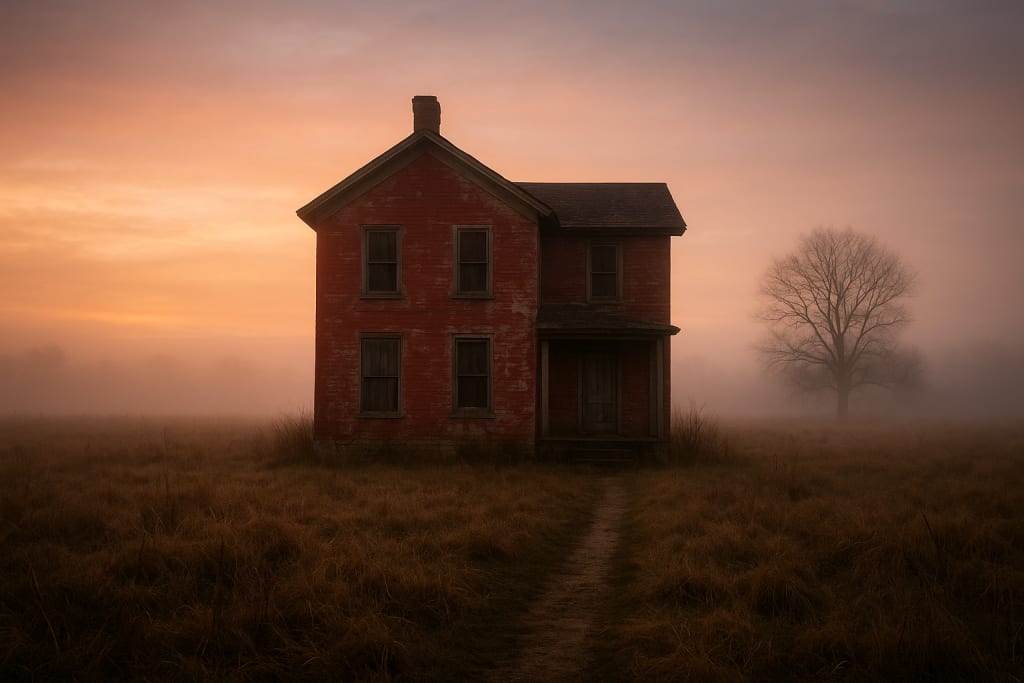
When I was a child, my father made one rule that stood above all others:
“Never go near the red house at the edge of the field.”
It wasn’t much to look at—its red paint faded to a dull rust, the roof sagging under years of rain. The windows were boarded, the chimney cracked, and weeds grew so tall they nearly swallowed the path that led there. Still, to me, that house was alive. I could feel it watching, breathing through the cracks, whispering my name when the wind blew.
Every time I asked why, my father’s face would harden.
“Because some doors, once opened, never close again.”
He’d say it quietly, almost to himself. I learned not to ask anymore.
After he died, the red house became a ghost in my thoughts. I couldn’t pass the field without feeling it pull at me, like an invisible thread tightening around my chest.
One gray October morning—exactly a year after his funeral—I found an envelope slipped under my door. No name, no stamp. Just four words written in his unmistakable hand:
“It’s time to go.”
The handwriting was too perfect to be coincidence. The slanted t, the curved r—it was his. I didn’t want to believe it, but curiosity has a way of drowning fear.
By dusk, I was standing at the gate of the red house, the key from his tool shed heavy in my pocket. The air felt different there—thicker, quieter. Even the birds seemed to avoid the place.
The door creaked open with one push.
Inside, the air smelled of dust and old paper. Furniture hid beneath white sheets, like frozen ghosts waiting to wake. My flashlight cut across the darkness, landing on something out of place: an upright piano in the middle of the living room.
My mother’s piano.
The one my father had sold years ago after she died.
A single envelope rested on its keys. My throat tightened as I read the words on the front:
“For Anna.”
My hands shook as I unfolded it.
“If you’re reading this, then you’ve already broken the promise. This house isn’t cursed, Anna. It’s where your mother died—not by accident, but because I failed her. I told you to stay away because I couldn’t face what I’d done.”
He confessed to everything—how she’d come here during their separation, how she’d taken too many pills, how fear of scandal had made him bury the truth. He sealed the house and called it cursed to hide his guilt.
At the bottom of the letter was a small brass key with “E.R.” engraved on it—my mother’s initials, Elena Rose.
I searched until I found a small door behind the piano. It led to a narrow, hidden room. Inside, time had stood still. My mother’s perfume still lingered faintly. On the table sat a stack of her journals, the top one left open, the last line unfinished:
“If he ever brings Anna here, tell her I forgive him.”
The weight of those words broke something open in me. I cried until my tears turned to laughter, until grief and forgiveness became the same thing.
As the first light of dawn crept through the broken windows, I sat at her piano and pressed one key. Then another. The melody rose softly, trembling through the hollow walls.
For the first time, the red house didn’t feel cursed. It felt like a memory finally set free.
Now, every October, I return. I clean the dust, open the windows, and play her song. The house listens. The wind carries it away.
And I swear—I can hear them both singing along.
About the Creator
Keep reading
More stories from Azlan shah and writers in Horror and other communities.
The Women of Crystal Lake
So today is a special day. Not only is it Women’s History Month, but it’s also Friday the 13th and with me being a big geek for the Friday the 13th film series I thought I’d hit two birds with one rock for the occasion and pay tribute to some of greatest and most important female characters of the Friday the 13th film series.
By Joe Pattersona day ago in Horror


Comments
There are no comments for this story
Be the first to respond and start the conversation.